


What To Know
- Thailand’s export-driven economy could face a devastating blow if trade negotiations with the United States collapse, with Prime Minister Anutin Charnvirakul warning that American tariffs on Thai goods could potentially surge to 50%.
- Importantly, the two countries signed a joint statement on November 17 confirming that negotiations on the principal elements of an Agreement on Reciprocal Trade had been substantially concluded.
Thailand’s export-driven economy could face a devastating blow if trade negotiations with the United States collapse, with Prime Minister Anutin Charnvirakul warning that American tariffs on Thai goods could potentially surge to 50%. The warning comes as Bangkok attempts to secure favorable trading conditions with its largest export market while balancing pressure from Washington against the interests of domestic businesses and agricultural producers.
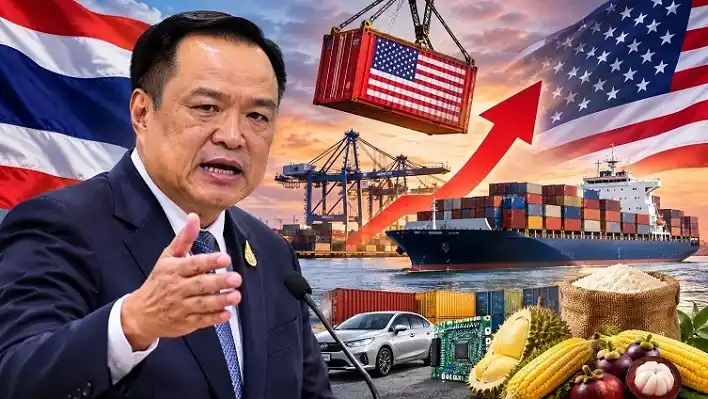
Image Credit: Bangkok Business News
Speaking during his weekly television program, “Talk with PM Anutin,” on Saturday, November 21, the prime minister defended his administration’s approach to negotiations, rejecting accusations that Thailand was surrendering too much to American demands. Amid growing concerns about the country’s economic competitiveness, this Bangkok Business News report examines the government’s trade strategy, the potential consequences for exporters, and the broader diplomatic and economic priorities shaping Thailand’s international relationships.
Thailand’s Trade Surplus Creates Pressure from Washington
Anutin acknowledged that Thailand’s substantial trade surplus with the United States had become a central issue in bilateral negotiations. Although Thailand purchases significant quantities of American products, including Boeing aircraft for Thai Airways, its exports to the United States continue to exceed imports.
The prime minister argued that Washington’s demands for adjustments were therefore understandable, particularly as American authorities seek more balanced trading relationships with major economic partners.
However, he emphasized that trade negotiations should not be viewed simply as a contest between winners and losers. Carefully negotiated concessions, he suggested, could generate opportunities for Thai businesses while preserving important domestic protections.
Agricultural trade has emerged as one particularly sensitive area. Despite Thailand’s position as a major agricultural producer, American negotiators have requested greater access for selected US agricultural products.
Anutin indicated that Thailand could consider allowing certain imports without tariffs, provided strict safeguards protected local farmers and agricultural industries.
One proposed condition would require domestic agricultural supplies to be utilized before additional imports were permitted.
The Ministry of Commerce is expected to explain these arrangements further, particularly their implications for agricultural producers concerned about competition from imported products.
Potential 50% Tariffs Threaten Thai Export Competitiveness
The prime minister delivered his strongest warning when discussing the consequences of unsuccessful negotiations.
He said American tariffs on Thai products could potentially increase from 10% to 30% or 40%, with the possibility of reaching 50% under particularly unfavorable circumstances.
Anutin referenced trade tensions involving Canada as an illustration of how rapidly tariff disputes could escalate.
Such increases would make Thai products considerably more expensive for American buyers, potentially encouraging importers to switch to competing suppliers.
Manufacturers operating on narrow profit margins could face especially difficult decisions over pricing, production costs, and export volumes.
The consequences could extend beyond exporters themselves, affecting suppliers, logistics providers, employment, and investment decisions throughout Thailand’s manufacturing economy.
Anutin acknowledged that Thailand possesses less negotiating leverage than the United States but insisted that this imbalance did not mean Bangkok should abandon its economic priorities.
He said Deputy Prime Minister and Commerce Minister Suphajee Suthumpun had been instructed to pursue the greatest possible benefits for Thailand.
Importantly, the two countries signed a joint statement on November 17 confirming that negotiations on the principal elements of an Agreement on Reciprocal Trade had been substantially concluded.
Nevertheless, the agreement still requires legal review and completion of domestic procedures before taking effect.
Cambodia Dispute Adds Another Diplomatic Challenge
Beyond economic negotiations, Anutin addressed Thailand’s continuing disagreements with Cambodia over territorial and maritime boundaries.
Following the termination of the 2001 memorandum of understanding, commonly known as MOU 44, the prime minister reaffirmed Bangkok’s preference for bilateral negotiations.
He said discussions with Cambodian Prime Minister Hun Manet had included Cambodia’s decision to pursue compulsory conciliation under the United Nations Convention on the Law of the Sea.
Anutin maintained that direct negotiations should remain the primary mechanism for resolving disputes, with international procedures considered only after bilateral efforts had failed.
He warned that Thailand could suspend land and maritime boundary demarcation discussions if Cambodia insisted on compulsory conciliation.
Nevertheless, the government remains committed to cooperation on border security and landmine clearance, particularly to protect communities and military personnel operating near disputed areas.
Thailand Seeks Greater Influence Over ASEAN Digital Trade
Anutin also highlighted Thailand’s involvement in developing the ASEAN Digital Economy Framework Agreement, an initiative intended to establish more consistent rules governing digital commerce across Southeast Asia.
The proposed framework addresses online fraud, cybersecurity, electronic payments, consumer protection, and product standards.
It also seeks clearer mechanisms for refunds, returns, and penalties against businesses violating consumer regulations.
For Thailand, stronger regional digital standards could support cross-border electronic commerce while improving confidence among consumers and investors.
The prime minister linked these ambitions to broader efforts against transnational criminal networks involved in online scams, drug trafficking, money laundering, and technology-enabled fraud.
He portrayed Thailand’s participation as evidence of its increasingly active role in shaping regional economic cooperation.
Political Stability Seen as Crucial for Investment
Turning to domestic economic conditions, Anutin argued that improved political stability had strengthened Thailand’s attractiveness to international investors.
He contrasted the government’s earlier difficulties operating with a parliamentary minority against its current majority-backed administration.
According to the prime minister, stronger parliamentary support provides greater capacity to advance legislation, implement economic reforms, and maintain policy continuity.
He also claimed that major foreign manufacturers had expressed confidence in Thailand and indicated no intention of relocating their production facilities.
The administration has meanwhile adjusted tax structures affecting conventional gasoline-powered vehicles and electric vehicles, seeking fairer competition between the two categories.
These measures form part of the government’s broader efforts to preserve Thailand’s manufacturing competitiveness amid technological changes and shifting international trade conditions.
China Cooperation Targets Northern Thailand’s River Pollution
Environmental concerns also featured prominently in Anutin’s account of recent diplomatic engagements with Chinese leaders.
He said he had raised toxic contamination affecting northern Thai waterways, particularly around Chiang Rai, during discussions with China’s president and premier.
The prime minister linked concerns about pollution to overseas investment activities involving Chinese and Myanmar interests.
He warned that prolonged contamination could damage communities, environmental resources, and eventually Chinese commercial interests operating in Thailand.
According to Anutin, preliminary discussions produced an understanding on cooperation to establish joint water-quality monitoring stations using Chinese technology.
Such monitoring could improve information sharing and strengthen efforts to identify contamination affecting communities dependent on regional waterways.
Thailand Faces a Defining Test of Economic Diplomacy
Thailand’s immediate challenge is to convert diplomatic progress into enforceable trade arrangements without undermining domestic producers. Although negotiations with Washington have advanced, uncertainty surrounding final terms leaves exporters exposed to potentially serious commercial risks. Anutin’s wider diplomatic agenda also demonstrates how trade competitiveness, regional security, environmental protection, and investor confidence are increasingly interconnected. Whether these initiatives deliver measurable economic benefits will ultimately depend on implementation rather than political assurances.


