


What To Know
- What initially appeared to be a temporary bout of weakness has evolved into a broader challenge for the Thai economy, raising concerns among investors, businesses and policymakers about the outlook for trade, inflation and financial stability in the months ahead.
- The result has been a steady erosion of support for the baht at a time when Thailand is already grappling with higher energy costs and slower economic growth.
Bangkok Business News: Thailand’s currency is once again under mounting pressure as a powerful combination of soaring energy prices, escalating geopolitical uncertainty, persistent dollar strength and widening interest-rate differentials pushes the baht toward the closely watched 33-per-dollar level. What initially appeared to be a temporary bout of weakness has evolved into a broader challenge for the Thai economy, raising concerns among investors, businesses and policymakers about the outlook for trade, inflation and financial stability in the months ahead.
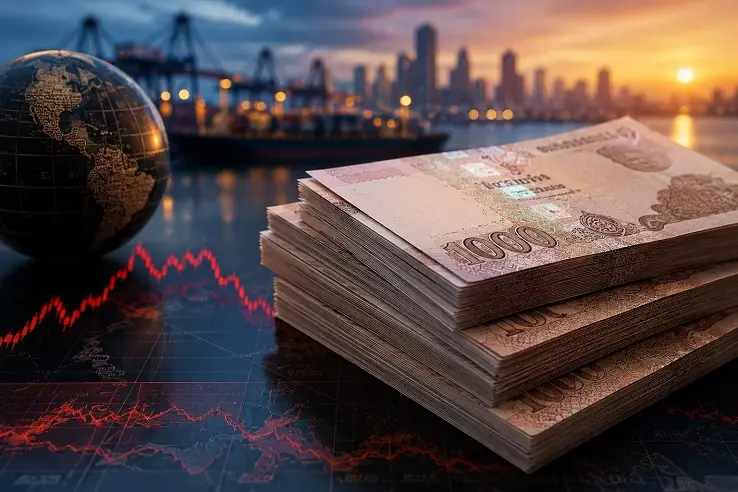
Image Credit: Bangkok Business News
The baht opened the week near 32.94 against the US dollar, extending a period of volatility that has unsettled markets throughout the year. Traders and economists are closely monitoring developments ranging from monetary policy decisions and export performance to global energy markets and foreign capital flows. In the midst of these growing concerns, this Bangkok Business News report finds that the Thai currency is increasingly caught between forces largely beyond the country’s control, leaving it vulnerable to further weakness if current conditions persist.
Oil Shock Reignites Pressure on The Baht
The most immediate threat facing the baht comes from the sharp rise in global energy prices following renewed tensions in the Middle East. Thailand remains heavily dependent on imported oil and natural gas, making the country particularly sensitive to disruptions in energy supply chains and fluctuations in international crude prices.
A significant portion of Thailand’s imported crude oil originates from the Middle East, with much of it transported through strategically important maritime routes. Any disruption to these routes can rapidly increase costs for energy-importing nations. Recent geopolitical developments have intensified fears of prolonged supply constraints, triggering substantial increases in oil prices and creating fresh challenges for economies that rely heavily on imported fuel.
For Thailand, the implications extend far beyond higher petrol prices. Rising energy costs affect transportation, manufacturing, logistics and industrial production. Businesses face higher operating expenses while consumers encounter increased living costs. As these pressures spread throughout the economy, inflation risks rise and economic growth becomes more difficult to sustain.
The energy shock has also placed significant strain on Thailand’s external accounts. Higher import bills require greater demand for foreign currency, particularly US dollars, to pay for imported oil and gas. This dynamic naturally places downward pressure on the baht while reducing the benefits of Thailand’s trade surplus.
Market observers warn that if oil prices remain elevated for an extended period, Thailand could experience a further deterioration in its trade position, making it increasingly difficult for the currency to regain strength.
Stronger Dollar Intensifies Currency Headwinds
While rising oil prices have created one layer of pressure, the strength of the US dollar has added another powerful challenge for the baht.
The Federal Reserve has maintained a relatively hawkish policy stance despite signs of slowing economic momentum in some sectors. Policymakers remain focused on controlling inflation, and financial markets continue to anticipate the possibility of further tightening if price pressures fail to moderate sufficiently.
This outlook has supported the US dollar across global markets. Investors seeking higher yields and relative safety have continued directing capital toward dollar-denominated assets, reinforcing the greenback’s strength against a broad range of currencies.
For emerging-market currencies such as the baht, a stronger dollar often creates difficult conditions. As investors move funds into US assets, demand for local currencies weakens. Countries with significant import requirements, particularly energy importers, tend to experience even greater pressure because they must purchase larger amounts of dollars to meet their external obligations.
The result has been a steady erosion of support for the baht at a time when Thailand is already grappling with higher energy costs and slower economic growth.
Monetary Policy Gap Creates Additional Vulnerability
Another major factor weighing on the baht is the widening interest-rate gap between Thailand and the United States.
While US rates remain relatively elevated, the Bank of Thailand has pursued a more accommodative approach in an effort to support domestic economic activity. Policymakers have prioritized growth concerns as Thailand faces headwinds from weaker global demand, trade uncertainty and rising energy costs.
However, lower interest rates can reduce the attractiveness of domestic financial assets for international investors. When returns available in Thailand are significantly lower than those offered in the United States, capital often flows toward higher-yielding markets.
This interest-rate differential has become increasingly important in determining currency movements. Investors evaluating opportunities across global markets frequently compare yield prospects, and the widening gap has diminished the baht’s appeal.
Financial markets generally expect policymakers to proceed cautiously in upcoming meetings. Additional rate cuts could provide some support for economic activity but may also increase pressure on the currency. Conversely, tighter monetary policy could support the baht but potentially slow economic recovery.
This balancing act has become one of the most difficult challenges facing Thai policymakers.
Foreign Capital Continues to Exit
Recent trading activity indicates that overseas investors remain cautious about Thailand’s financial markets.
Foreign selling has been observed in both equities and bonds, reflecting broader concerns regarding economic growth prospects, currency volatility and global market uncertainty. These outflows reduce demand for the baht and contribute to additional weakness in the exchange rate.
Investor sentiment has also been influenced by concerns surrounding geopolitical developments and the possibility of prolonged energy market disruptions. During periods of heightened uncertainty, international funds often seek larger and more liquid markets, with the United States frequently benefiting from safe-haven inflows.
The decline in foreign participation has placed additional pressure on domestic financial markets and reinforced concerns regarding the near-term outlook for the baht.
Although capital flows can reverse quickly when sentiment improves, investors currently appear reluctant to make aggressive bets on a rapid recovery in the Thai currency.
Thailand Faces Challenges Shared by Other Energy Importers
Thailand is not alone in facing these difficulties. Across Asia, several energy-importing economies have experienced increased currency volatility as higher oil prices and a stronger dollar reshape investor expectations.
Countries that rely heavily on imported fuel have generally faced greater pressure than those that benefit from energy exports. Rising import costs can weaken trade balances, increase inflation and reduce policy flexibility, creating a challenging environment for central banks and governments alike.
Meanwhile, economies with stronger external positions or more resilient policy frameworks have generally weathered recent market turbulence more successfully. This divergence has highlighted the importance of structural economic strengths in determining how countries respond to external shocks.
The contrasting performance among regional currencies has reinforced investor caution toward markets viewed as particularly vulnerable to prolonged increases in energy prices.
What Could Help the Baht Recover?
Despite the current challenges, several developments could improve the outlook for Thailand’s currency.
A meaningful reduction in Middle East tensions would likely ease concerns about energy supplies and contribute to lower oil prices. Such a development would immediately benefit Thailand by reducing import costs and improving market sentiment.
A softer stance from the Federal Reserve could also support a recovery. If inflation in the United States moderates more quickly than expected, policymakers may have less need to maintain restrictive monetary conditions. A weaker dollar would provide relief for many emerging-market currencies, including the baht.
Stronger export performance could offer another source of support. Increased demand for technology-related products, advanced manufacturing goods and emerging high-value industries could strengthen Thailand’s trade position and generate additional foreign-currency earnings.
For now, however, these potential catalysts remain uncertain. The path ahead for the baht appears closely tied to developments in global energy markets, US monetary policy and investor confidence. Until there is clear evidence of easing geopolitical tensions, lower oil prices or a shift in dollar strength, the Thai currency is likely to remain under pressure. Businesses exposed to exchange-rate fluctuations may need to maintain hedging strategies, while investors are expected to remain selective in their positioning. Although periods of recovery may occur, the broader trend suggests that volatility could remain a defining feature of Thailand’s currency market for some time. The approach toward the 33-per-dollar threshold serves as a reminder that external shocks can quickly reshape economic conditions and investor behavior. Whether the baht stabilizes or weakens further will depend largely on developments beyond Thailand’s borders, making the coming months especially important for policymakers, businesses and financial markets seeking greater clarity in an increasingly uncertain global environment.
For the latest on the Thai currency, keep on logging to Bangkok Business News.



