


What To Know
- The spectacular rise of artificial intelligence has transformed global financial markets, turning a handful of technology companies into trillion-dollar giants and fueling one of the biggest investment booms in modern history.
- Japan’s technology-heavy Nikkei index also retreated sharply, while Nvidia, widely regarded as the biggest beneficiary of the AI revolution, lost ground and temporarily surrendered its position as the world’s most valuable listed company to Apple.
International Business News: The spectacular rise of artificial intelligence has transformed global financial markets, turning a handful of technology companies into trillion-dollar giants and fueling one of the biggest investment booms in modern history. However, recent weeks have delivered a sharp reality check as heavyweight chip manufacturers and major technology firms suffered steep share price declines, raising fresh questions about whether the AI investment frenzy is entering a more cautious phase.
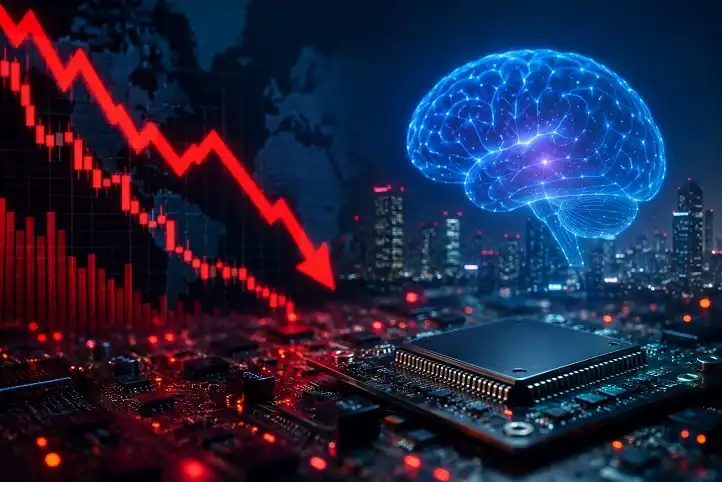
Image Credit: Bangkok Business News
Despite the turbulence, many analysts argue the long-term outlook for artificial intelligence remains intact, although investors are becoming far more demanding about when massive spending will translate into meaningful profits. This International Business News report comes as financial markets across the United States and Asia experience heightened volatility, with investors reassessing the enormous sums being poured into AI infrastructure, data centers and advanced semiconductor production.
Sharp Sell-Off Hits Global Technology Stocks
The most dramatic declines have been seen among semiconductor manufacturers, the companies responsible for producing the powerful chips that drive artificial intelligence systems. South Korean giants Samsung Electronics and SK Hynix have experienced significant losses as concerns grow that demand for AI chips may not continue expanding at the extraordinary pace witnessed over the past year.
The selling pressure extended beyond South Korea. Japan’s technology-heavy Nikkei index also retreated sharply, while Nvidia, widely regarded as the biggest beneficiary of the AI revolution, lost ground and temporarily surrendered its position as the world’s most valuable listed company to Apple.
South Korea’s Kospi Index even triggered temporary trading halts after heavy selling overwhelmed the market, illustrating how rapidly investor sentiment can shift following months of exceptional gains.
Massive AI Spending Faces Growing Scrutiny
Investor attention has increasingly shifted from excitement over AI’s future potential to a more practical question—when will these enormous investments begin generating sustainable financial returns?
Technology leaders including Meta, Microsoft, Amazon, Alphabet and OpenAI continue committing hundreds of billions of dollars to expanding AI infrastructure, purchasing advanced processors and building new data centres capable of supporting increasingly sophisticated AI models.
However, Wall Street is becoming less willing to reward spending alone. Several companies have reported higher capital expenditure forecasts while simultaneously warning of rising costs, causing investors to question whether profits can justify the unprecedented investment cycle.
Meta became one of the latest examples after reporting weaker-than-expected earnings, sending its shares sharply lower despite management continuing to champion AI as the company’s long-term growth strategy.
China’s Progress Adds Competitive Pressure
Adding another layer of uncertainty is China’s accelerating semiconductor industry.
Reports of manufacturing breakthroughs, alongside the successful market debut of memory chip producer ChangXin Memory Technologies (CXMT), have strengthened expectations that China could reduce its dependence on foreign semiconductor technology.
The development has intensified concerns among global investors that competition in AI hardware may become significantly tougher, placing additional pressure on established market leaders while potentially squeezing future profit margins.
Apple Benefits While Others Race Ahead
Interestingly, Apple has emerged as one of the unexpected beneficiaries of recent market uncertainty.
Unlike many rivals that continue spending aggressively on AI infrastructure, Apple has maintained a relatively measured approach to the AI race. Investors seeking stability have rewarded the company, helping it reclaim the title of the world’s most valuable publicly traded company as enthusiasm cooled for several AI-focused competitors.
The contrasting performances highlight an important shift in investor thinking. Companies are increasingly being rewarded not simply for investing heavily in artificial intelligence but for demonstrating financial discipline alongside innovation.
Bubble Fears Continue to Divide Experts
The recent market correction has inevitably revived comparisons with the dot-com bubble of the early 2000s.
Today, a relatively small group of technology companies accounts for an unusually large share of major US stock market indices, with AI-related firms dominating investor portfolios worldwide. Some market observers warn that valuations have reached levels that resemble previous speculative bubbles.
Several financial indicators, including the widely followed Shiller CAPE Ratio, have climbed to levels historically associated with periods of excessive market optimism. At the same time, fund managers increasingly identify a potential AI bubble as one of the greatest risks facing global equity markets.
Still, many investment professionals caution against assuming history will repeat itself exactly. Artificial intelligence is already delivering practical commercial applications across industries including healthcare, finance, manufacturing, software development and logistics, distinguishing it from many speculative technology trends of the past.
Long-Term Potential Remains Strong
Technology pioneers continue to describe artificial intelligence as a transformational breakthrough comparable to electricity or even fire itself. Industry leaders believe AI will fundamentally reshape productivity, business operations and everyday life over the coming decades.
Nevertheless, today’s investors appear less willing to embrace limitless optimism without measurable financial returns. Rising environmental concerns surrounding energy-intensive data centres, increasing competition from China, questions over commercial monetisation and mounting infrastructure costs have all combined to create a far more cautious investment environment.
Rather than signalling the collapse of artificial intelligence, many analysts believe the recent market correction represents a healthy reassessment after extraordinary gains. Companies capable of combining technological leadership with sustainable earnings growth are still expected to emerge as long-term winners, while weaker business models may struggle under closer investor scrutiny. Financial markets now appear to be entering a new phase where disciplined execution matters just as much as ambitious AI promises. As the global technology race intensifies, investors will closely monitor corporate earnings, capital spending and future profitability before deciding whether today’s volatility represents the beginning of a larger correction or simply another chapter in the continuing evolution of the AI revolution.
For the latest International Business News, keep on logging to Bangkok Business News.



