


What To Know
- The United States has intensified its technology and national security strategy by banning imports of newly approved Chinese-made humanoid robots, quadruped robots and connected power inverters, a move that signals Washington’s determination to protect its rapidly expanding artificial intelligence ecosystem while reducing reliance on Chinese technology.
- In the midst of growing geopolitical competition between Washington and Beijing, this Business News report highlights how the latest policy reinforces America’s push to secure strategic technology supply chains and accelerate local production in sectors expected to play a central role in the future AI economy.
The United States has intensified its technology and national security strategy by banning imports of newly approved Chinese-made humanoid robots, quadruped robots and connected power inverters, a move that signals Washington’s determination to protect its rapidly expanding artificial intelligence ecosystem while reducing reliance on Chinese technology. The latest measures, introduced by the Federal Communications Commission (FCC), form part of a broader effort to strengthen domestic manufacturing, secure critical infrastructure and shield key industries from potential cyber threats.
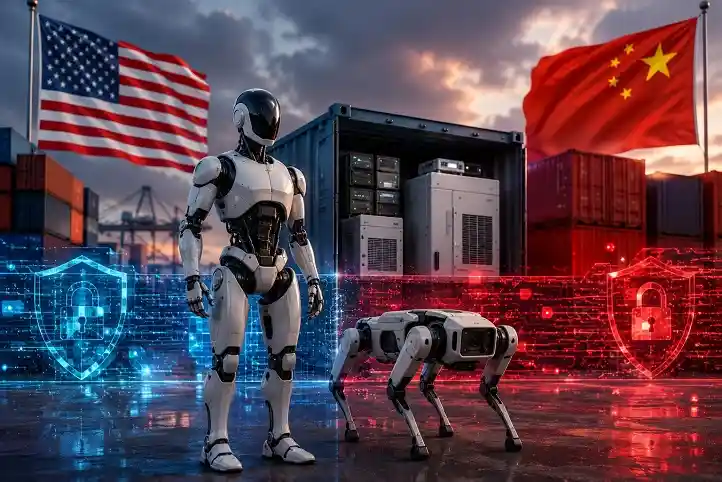
Image Credit: Bangkok Business News
The new restrictions immediately apply to future models of advanced robots and connected power inverters seeking approval for the US market, while previously authorized products remain unaffected unless their approvals are later revoked. In the midst of growing geopolitical competition between Washington and Beijing, this Business News report highlights how the latest policy reinforces America’s push to secure strategic technology supply chains and accelerate local production in sectors expected to play a central role in the future AI economy.
FCC cites national security and cybersecurity risks
According to the FCC, advanced robots and connected power inverters could create vulnerabilities capable of exposing critical infrastructure to cyberattacks, data theft or remote interference. Regulators warned that compromised equipment may allow hostile actors to monitor sensitive operations, disrupt economic activity or gain access to strategic networks supporting artificial intelligence, renewable energy and major data centers.
Power inverters, which connect renewable energy systems and batteries to electricity grids and data-center infrastructure, have become increasingly important as the United States expands AI computing capacity. Officials believe securing these devices is essential to preventing disruptions that could threaten national security or economic stability.
Chinese firms expected to face the biggest impact
Among the companies expected to be significantly affected is Unitree, one of China’s leading humanoid robotics manufacturers and a major global player in the emerging robotics industry. The company has attracted attention through its partnership with Nvidia, using advanced AI chips to power intelligent robotic systems deployed in research and industrial environments.
The Pentagon recently added Unitree to a list of companies it alleges have links to China’s military, increasing concerns among American lawmakers that advanced robots could eventually collect sensitive information or even be remotely controlled to interfere with strategic facilities. The FCC echoed similar concerns, warning that sophisticated robots could potentially conduct surveillance, collect valuable industrial data or support foreign intelligence operations if compromised.
Power inverter restrictions widen technology controls
The latest action also targets Chinese-made power inverters, an industry dominated by manufacturers including Huawei and Sungrow. These devices have become increasingly important as renewable energy installations and large-scale AI data centers continue expanding across the United States.
American officials fear that compromised inverters could allow overseas operators to disable electricity systems, steal operational data or introduce malicious software capable of disrupting essential infrastructure. The policy follows broader US efforts to reduce dependence on Chinese technology after previous concerns involving telecommunications equipment, networking hardware and supply chain vulnerabilities.
The FCC indicated that while current restrictions focus on future products, it retains authority to review and potentially revoke approvals for previously authorized equipment if necessary.
Beijing condemns the latest restrictions
China strongly criticized the latest measures, accusing Washington of politicizing trade and unfairly targeting Chinese technology companies. Officials at the Chinese embassy in Washington urged the United States to respect international business cooperation and stop imposing sanctions based on what Beijing described as unfounded allegations.
Chinese authorities also warned they would take all necessary measures to protect the country’s interests should further actions materially affect Chinese companies. Beijing maintains that China’s progress in artificial intelligence has resulted from sustained investment, innovation and international cooperation rather than intellectual property theft or unfair practices.
Broader technology rivalry continues to intensify
The latest restrictions add another chapter to the expanding technology competition between the world’s two largest economies. Washington has already imposed export controls on advanced semiconductor technology, tightened restrictions on Chinese telecommunications equipment and sought to reduce dependence on Chinese supply chains for strategically important industries.
US officials have repeatedly cited concerns over cybersecurity, intellectual property protection and supply chain resilience, while also attempting to avoid future disruptions similar to those experienced after China’s tightening of rare earth mineral exports. The Trump administration also views the latest measures as an opportunity to encourage domestic investment in robotics, artificial intelligence, advanced manufacturing and clean energy infrastructure.
Several American companies, including Tesla, Figure AI, Agility Robotics and Boston Dynamics, continue expanding humanoid robot development and production, positioning the United States to compete more aggressively in a market expected to grow rapidly over the coming decade.
The latest restrictions demonstrate that technological leadership has become inseparable from national security and economic strategy as competition between Washington and Beijing continues to reshape global supply chains. While supporters believe the measures will strengthen America’s AI ecosystem and reduce strategic vulnerabilities, critics argue they could further deepen tensions between the two superpowers and accelerate the fragmentation of global technology markets. As governments and businesses adapt to an increasingly divided technological landscape, the long-term consequences are likely to extend well beyond robotics and artificial intelligence, influencing global trade, manufacturing investment and future innovation for years ahead.
For the latest International Business News, keep on logging to Bangkok Business News.



