


What To Know
- Thailand is facing an increasingly troubling economic reality as the International Monetary Fund (IMF) reveals that the country is struggling to keep pace with most of its Southeast Asian neighbors.
- The latest figures, released during the IMF and World Bank Annual Meetings in Bangkok, expose the widening gap between Thailand and faster-growing ASEAN economies.
Thailand is facing an increasingly troubling economic reality as the International Monetary Fund (IMF) reveals that the country is struggling to keep pace with most of its Southeast Asian neighbors. Despite years of government stimulus programs, tourism promotion, and promises of economic transformation, Thailand is projected to achieve growth of just 2.1 percent in 2026, placing it near the bottom of the regional economic rankings.
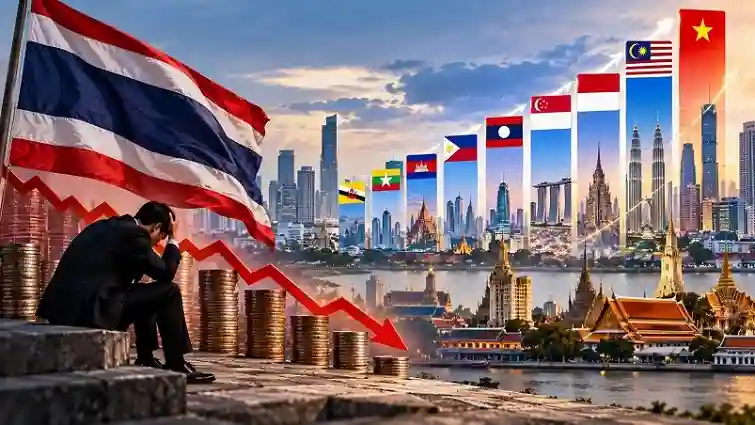
Image Credit: Bangkok Business News
The latest figures, released during the IMF and World Bank Annual Meetings in Bangkok, expose the widening gap between Thailand and faster-growing ASEAN economies. More importantly, this Bangkok Business News report highlights growing concerns that Thailand’s economic difficulties are no longer temporary setbacks but symptoms of deeper structural weaknesses that threaten its competitiveness, investment prospects, and future prosperity.
Thailand Near the Bottom of ASEAN Economic Rankings
According to the IMF’s October 2026 World Economic Outlook, Thailand’s projected economic expansion of 2.1 percent places it ahead of only Myanmar and Brunei among the 11 countries compared.
Vietnam leads with an impressive projected growth rate of 8.4 percent, approximately four times Thailand’s expected performance. Malaysia follows at 5.2 percent, Indonesia at 5.1 percent, and Singapore at 5 percent.
Even Laos, Timor-Leste, the Philippines, and Cambodia are expected to outperform Thailand, with projected growth rates of 4.5 percent, 4 percent, 3.4 percent, and 3 percent, respectively.
Myanmar’s projected growth stands at 2 percent, while Brunei trails at 1.9 percent.
These comparisons underline an uncomfortable reality: Thailand, once regarded as one of Southeast Asia’s most promising industrial economies, is now struggling to match the economic momentum of several less-developed neighbors.
Years of Economic Weakness Are Taking Their Toll
Thailand’s disappointing performance cannot be explained solely by unfavorable global conditions.
The IMF has identified longstanding structural problems, including weak private investment, sluggish productivity improvements, population aging, and substantial household indebtedness.
These problems have progressively weakened domestic purchasing power and restricted opportunities for businesses seeking expansion.
Households burdened by debt have less disposable income, while smaller businesses frequently encounter difficulties obtaining affordable financing.
Consequently, domestic consumption remains vulnerable, and businesses have fewer incentives to increase investment or recruit additional workers.
Thailand’s prolonged dependence on traditional industries and tourism has also created vulnerabilities as neighboring economies attract investment into newer manufacturing and technology sectors.
Vietnam and Regional Competitors Pull Further Ahead
Vietnam’s projected 8.4 percent expansion represents a particularly striking contrast with Thailand’s economic difficulties.
The difference reflects broader questions surrounding industrial competitiveness, investment attraction, export diversification, and the ability to integrate into changing international supply chains.
Thailand retains important advantages, including established manufacturing infrastructure, transportation networks, and a substantial industrial workforce.
However, these strengths are insufficient to guarantee future competitiveness without sustained improvements in productivity, technology adoption, and workforce development.
The IMF’s regional projections suggest that Thailand risks losing further economic ground if competing countries continue expanding considerably faster.
Household Debt and Weak Investment Remain Major Obstacles
High household debt represents one of Thailand’s most persistent economic challenges.
When families must devote significant portions of their income to repayments, spending on consumer goods, housing, and services becomes constrained.
Businesses subsequently face weaker demand, discouraging investment and slowing employment growth.
The IMF has emphasized the importance of orderly household debt restructuring, improved credit transmission, and targeted financial support.
Investment also remains a major concern. Thailand’s investment-to-GDP ratio stands at approximately 22 to 23 percent, highlighting the need for stronger capital formation.
Without substantial improvements, economic growth could remain disappointingly low even if external conditions stabilize.
Global Economic Pressures Add to Thailand’s Troubles
Thailand’s domestic weaknesses are emerging alongside mounting international uncertainty.
The IMF expects Asian economic growth to moderate from 5 percent in 2025 to 4.8 percent in 2026 and 4.4 percent in 2027.
Higher energy costs, geopolitical tensions, volatile financial markets, and elevated borrowing costs are creating additional difficulties.
Thailand’s dependence on international trade leaves its economy particularly exposed to changes in global demand and trade policies.
Meanwhile, the rapid expansion of artificial intelligence-related investment is disproportionately benefiting economies more deeply integrated into advanced technology supply chains.
Countries unable to capture these opportunities risk falling further behind.
Can Thailand Reverse Its Economic Decline?
There are some encouraging developments despite the bleak regional comparisons.
The IMF’s latest 2.1 percent growth projection represents an improvement over its earlier 1.6 percent forecast.
Thailand’s central bank also believes economic growth could eventually return toward 3 percent, provided structural reforms succeed and major external shocks are avoided.
Nevertheless, achieving stronger growth will require more than short-term stimulus measures.
Improving education, reducing household debt burdens, encouraging productive investment, strengthening smaller enterprises, and accelerating industrial modernization will be essential.
The challenge facing Thailand is increasingly urgent. Although the economy is still expanding and retains important financial strengths, continued underperformance could erode living standards, discourage investment, and weaken the country’s regional influence. Reversing this trajectory demands consistent reforms rather than temporary economic relief.



