


What To Know
- Trade figures revealing hundreds of millions of dollars in drone shipments have placed Bangkok under an uncomfortable international spotlight as Washington and Brussels intensify efforts to prevent technology from reaching Moscow’s military.
- As this Bangkok Business News report examines, the dramatic expansion of drone shipments has exposed potential weaknesses in Thailand’s export controls, creating concerns about additional sanctions against companies involved in supplying equipment that could support Russia’s continuing war in Ukraine.
Thailand is facing growing scrutiny over its emergence as a major transit hub for Chinese-manufactured drones reaching Russia, raising concerns that Thai businesses could face further Western sanctions. Trade figures revealing hundreds of millions of dollars in drone shipments have placed Bangkok under an uncomfortable international spotlight as Washington and Brussels intensify efforts to prevent technology from reaching Moscow’s military.
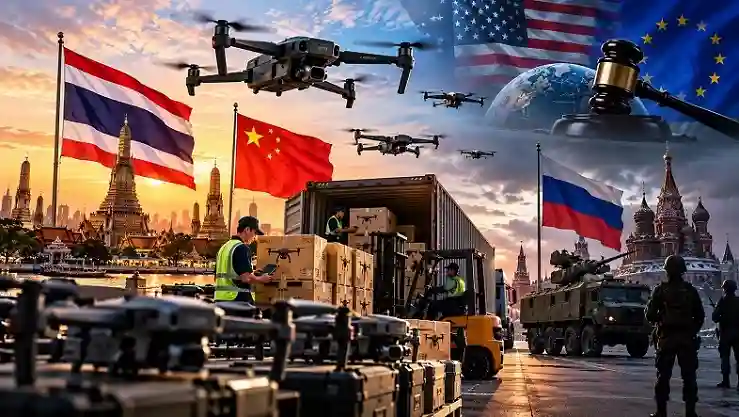
Image Credit: Bangkok Business News
The controversy comes as Thailand attempts to strengthen economic relationships with Russia while maintaining valuable commercial ties with the United States and European Union. As this Bangkok Business News report examines, the dramatic expansion of drone shipments has exposed potential weaknesses in Thailand’s export controls, creating concerns about additional sanctions against companies involved in supplying equipment that could support Russia’s continuing war in Ukraine.
Drone Exports to Russia Surge Eightfold
Official Thai trade figures analyzed by Bloomberg reveal an extraordinary transformation in the country’s drone industry.
During the first eleven months of 2025, Russia imported approximately US$125 million worth of drones from Thailand, representing 88 percent of Thailand’s total unmanned aerial vehicle exports.
That figure was eight times higher than the previous year.
Meanwhile, China exported approximately US$186 million worth of drones to Thailand during the same period, accounting for almost all Thai drone imports.
The contrast with 2022 is striking. Thailand exported less than US$1 million worth of drones that year, with no recorded shipments destined for Russia.
The sudden expansion suggests Thailand has become an increasingly important intermediary in international supply chains serving Russian buyers.
Although these transactions are not automatically illegal under Thai legislation, their scale has attracted attention because drones originally manufactured for civilian applications can also perform military functions.
Western Sanctions Threaten Thai Companies
The possibility of additional sanctions represents a potentially serious challenge for Thailand’s international business reputation.
Western governments have repeatedly targeted companies suspected of helping Russia obtain restricted technology, particularly products classified as dual-use equipment.
Such products include electronic components, telecommunications systems, semiconductors and drones that can serve civilian industries while also supporting military operations.
In October 2025, the European Union sanctioned two Thailand-based companies over their alleged support for Russia’s military.
Britain separately sanctioned Bangkok-based China Thai Corp. for supplying technology to Russian military operations.
These measures demonstrate that Thailand-based businesses are already encountering Western enforcement actions.
However, there has been no confirmed announcement of comprehensive American or European economic sanctions against Thailand itself.
The immediate danger concerns additional restrictions on individual companies, financial transactions and international supply networks rather than an established decision to penalize the entire Thai economy.
Bangkok Companies Under International Scrutiny
Two Bangkok-based businesses feature prominently in the shipment records.
Skyhub Technologies, operating from an office in the Chartered Square building, imported approximately US$25 million worth of Chinese drones during 2025.
Company registration records indicate that the business previously operated in geology-related activities before becoming registered as a car rental enterprise.
Despite that commercial description, shipment records identify Skyhub as one of Thailand’s largest drone importers.
Documents compiled by trade intelligence company Big Trade Data indicate that Skyhub received products manufactured by Chinese drone producer Autel Robotics.
Among those shipments were 976 drones carrying model codes corresponding to Autel’s EVO Max 4T, an advanced aircraft marketed for civilian applications.
The model reportedly costs approximately US$9,000.
Russian company Aero HIT previously sought financial support from Moscow to manufacture the same model domestically, reportedly describing its effectiveness in combat.
Autel denied having a partnership with Aero HIT and stated that it maintains international sanctions compliance procedures.
The manufacturer also said its aircraft incorporate geofencing technology intended to prevent flights within restricted conflict areas.
China Thai Emerges as Major Importer
Another company attracting attention is China Thai Corp., located near Bangkok’s principal international airport.
Trade records indicate that the business imported approximately US$144 million worth of Chinese drones during the first eleven months of 2025.
Its activities have attracted particular scrutiny following British sanctions imposed in October.
Records also connect the company with earlier shipments involving Russian electronics businesses.
In 2023, China Thai reportedly handled freight forwarding for approximately US$2 million worth of Apple iPhones destined for Russian electronics company OOO Atlas.
The European Union subsequently sanctioned Atlas.
Corporate financial statements reveal that China Thai’s reported annual revenue increased from approximately 14,000 baht during earlier operating years to 17.8 million baht in 2023 and 25.3 million baht in 2024.
The business has reportedly begun rebranding as Lanto Global Logistics.
Company representatives declined to comment on questions concerning its activities, although an employee acknowledged awareness of the sanctions.
Thai Customs Authorities Acknowledge Legal Gaps
Thailand’s customs authorities have acknowledged that existing legislation does not necessarily prohibit the transactions attracting Western attention.
Customs Department Director-General Phantong Loykulnanta explained that exporting Chinese-manufactured drones to Russia remains permissible under the current Thai legal framework.
Importers are also not required to declare the intended final use of drones arriving from China.
This creates a regulatory challenge because equipment entering Thailand for apparently legitimate commercial purposes can subsequently be exported elsewhere.
Phantong indicated that authorities would require appropriate legislation before taking additional enforcement action.
The Commerce Ministry’s Foreign Trade Department is examining the issue.
The situation highlights the difficult balance facing Bangkok between maintaining established trading freedoms and responding to increasingly demanding international sanctions regimes.
Why Washington and Brussels Are Concerned
Western governments have spent years attempting to restrict Russia’s access to advanced technology following its full-scale invasion of Ukraine in February 2022.
However, international supply networks have repeatedly adapted.
Previously identified routes through countries including Kazakhstan and the United Arab Emirates have faced increasing scrutiny, encouraging traders to explore alternative destinations.
Sanctions specialist Maria Shagina of the International Institute for Strategic Studies has identified Southeast Asia as an increasingly important region for monitoring such activity.
American officials have also alleged that Chinese-origin products account for approximately 80 percent of dual-use components supporting Russia’s military operations.
China maintains that it does not provide military assistance to Moscow.
For Western authorities, the concern is that intermediary companies can obscure the original supply chain, making restricted technology considerably harder to trace.
Thailand’s Russian Economic Connections Complicate Matters
Thailand’s expanding economic relationship with Russia adds another dimension to the controversy.
Bilateral trade amounted to approximately US$2.3 billion in 2025, relatively modest compared with Thailand’s commerce with major Western economies.
Nevertheless, Russian tourism and property investment have become increasingly significant.
Approximately 1.9 million Russian visitors traveled to Thailand in 2025, while Russian nationals purchased more than US$30 million worth of Thai property during the first quarter of that year.
Phuket has emerged as an especially important destination for Russian residents, tourists and investors.
Moscow has also pursued cultural and educational initiatives, including scholarships for Thai students and plans for a Russian cultural center.
These growing connections create economic incentives for Thailand to maintain constructive relations with Moscow.
Yet they also increase the diplomatic complexity surrounding Western concerns about Russian access to sensitive technology.
Thailand Faces a Difficult Economic Choice
Thailand now confronts a sensitive challenge involving commercial opportunity, national legislation and international diplomatic expectations. Although broader Western sanctions against the country remain unconfirmed, existing restrictions against Thailand-based companies demonstrate genuine exposure. How quickly Bangkok strengthens oversight of sensitive exports could influence future enforcement decisions, investor confidence and its relationships with major trading partners.
Media References:
https://www.japantimes.co.jp/business/2026/02/20/chine-russia-drone-exports-via-thailand
https://defence24.com/geopolitics/how-is-thailand-helping-russia-conduct-the-war
https://radar.am/en/news/world-2743114366



