


What To Know
- Thailand’s ambitious high-speed rail project linking Don Mueang, Suvarnabhumi and U-Tapao airports has reached one of its most critical turning points, with the State Railway of Thailand (SRT) preparing to seek a final policy decision on whether the landmark public-private partnership should be revised or terminated after its private partner failed to secure project financing.
- The proposed rail network, designed to serve as the backbone of the Eastern Economic Corridor (EEC), has been viewed as a transformative project intended to improve connectivity between Bangkok and Thailand’s three major airports while strengthening the country’s logistics and investment appeal.
Bangkok Business News: Thailand’s ambitious high-speed rail project linking Don Mueang, Suvarnabhumi and U-Tapao airports has reached one of its most critical turning points, with the State Railway of Thailand (SRT) preparing to seek a final policy decision on whether the landmark public-private partnership should be revised or terminated after its private partner failed to secure project financing. Midway through the ongoing deliberations, this Bangkok Business News report has learned that financial institutions have declined to support the project, citing heightened investment risks, leaving the future of one of the country’s flagship infrastructure developments hanging in the balance.
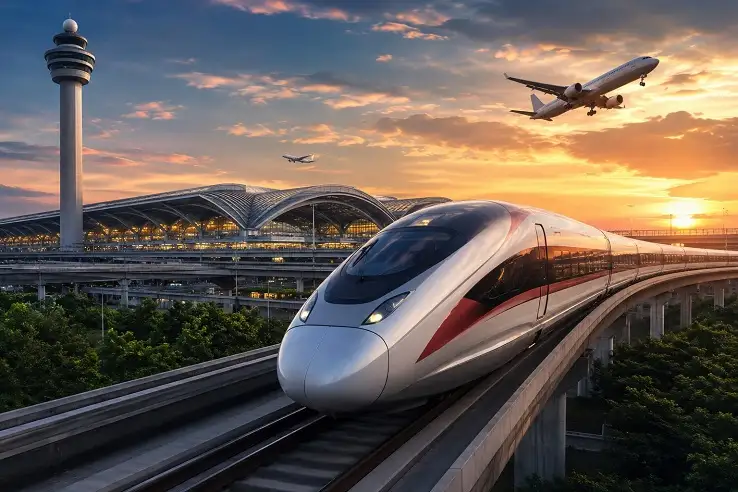
Image Credit: Bangkok Business News
The proposed rail network, designed to serve as the backbone of the Eastern Economic Corridor (EEC), has been viewed as a transformative project intended to improve connectivity between Bangkok and Thailand’s three major airports while strengthening the country’s logistics and investment appeal. However, after years of delays, repeated contract negotiations and changing political administrations, the project now faces its greatest challenge as authorities weigh two remaining options—amending the joint-investment contract or bringing the agreement to an end altogether.
Financing Failure Pushes Project to a Crossroads
The project was originally signed on December 22, 2018, under a public-private partnership between the SRT and Asia Era One Co Ltd, the consortium led by CP Group during the first administration of former Prime Minister Gen Prayut Chan-o-cha.
Construction progress was subsequently disrupted by the Covid-19 pandemic, which delayed the issuance of the Notice to Proceed (NTP). Those delays prompted the private consortium to request relief measures from the government, resulting in Cabinet approval for assistance and a proposed contract amendment in October 2021.
Despite several rounds of negotiations spanning successive governments, including those of Gen Prayut, Srettha Thavisin, Paetongtarn Shinawatra and the current administration led by Prime Minister Anutin Charnvirakul, a final agreement has remained elusive. Although the Cabinet approved the principle of revising the contract in October 2024, concerns regarding compliance with public-private partnership principles prevented the issue from being fully resolved.
Only Two Options Remain
Acting SRT Governor Anan Phonimdang said discussions involving the SRT, the Eastern Economic Corridor Office (EECO) and Asia Era One have now narrowed the choices to just two.
The preferred option is to amend the contract in accordance with the original EEC Policy Committee resolution. If approved, the revised agreement, which has already undergone legal review by the Office of the Attorney-General, would proceed for Cabinet approval before both parties sign a new joint-investment contract.
Should the committee determine that the proposed amendment cannot legally proceed, authorities would instead begin the process of terminating the agreement.
Such a move would require both parties to carefully review the existing contract to establish the legal basis for termination, determine financial obligations under public-private partnership laws, identify completed investments and decide responsibility for various project components.
Banks Lose Confidence in Mega Project
According to Anan, negotiations with Asia Era One confirmed that the consortium had been unable to obtain financing because lenders viewed the project as carrying excessive financial risk.
Without fresh funding, the consortium has informed government agencies that the project cannot continue unless the existing contract is amended. That position has significantly increased the possibility that the joint-investment agreement could eventually be cancelled.
The SRT expects to present the outcome of the three-party negotiations to its board during July before forwarding recommendations to the EEC Policy Committee, with a final decision anticipated around August.
Wider Impact on Rail Network
The consequences of terminating the agreement would extend well beyond the three-airport high-speed rail line.
Officials acknowledged that the Airport Rail Link would also be affected because its operating agreement with Asia Era One expires in September 2026. If the consortium is no longer the project’s investment partner, the SRT would be unable to extend the existing operating arrangement.
To prevent disruption for commuters, the SRT is already preparing alternative operational plans aimed at ensuring uninterrupted Airport Rail Link services while new long-term arrangements are considered.
Meanwhile, the agency is also assessing the implications for Thailand’s wider railway strategy, particularly infrastructure shared with the Thai-Chinese high-speed rail project.
Thai-Chinese Rail Project Also Faces Adjustments
One of the most significant concerns involves Contract 4-1 covering the Bang Sue–Don Mueang section, where infrastructure overlaps with the three-airport railway project.
Should the existing partnership end, the SRT intends to seek Cabinet approval to separate the overlapping construction work so it can undertake the project independently through a new public tender.
Officials said engineering designs for sections not directly linked to the three-airport project have already been completed and can be modified quickly, allowing construction to continue without delaying the broader Thai-Chinese high-speed rail project, which remains scheduled to begin operations in 2031.
Existing Rail Services Offer Temporary Alternative
The SRT has also begun evaluating whether the original high-speed rail concept remains essential under current economic conditions.
The agency already operates double-track rail services into the EEC capable of speeds of up to 120 kilometres per hour and is considering increasing train frequency while expanding passenger capacity if the high-speed project does not proceed.
At the same time, discussions with the EECO will examine future urban development plans and projected passenger demand before determining whether a revised high-speed rail investment remains economically justified.
EECO Secretary-General Chula Sukmanop revealed that authorities had previously examined four possible solutions, including government assistance in securing low-interest financing and separating overlapping construction works. However, following extensive negotiations and further discussions with financial institutions, only two practical options remained after the June 24, 2026 meeting: amend the contract or terminate it.
Chula confirmed that lenders ultimately declined to finance the project, reinforcing concerns over commercial viability. Should the contract eventually be terminated, questions involving compensation, damages and lost investment opportunities would only be addressed after the EEC Policy Committee establishes the project’s future direction and a detailed legal review determines each party’s responsibilities under the existing agreement.
Thailand’s flagship three-airport high-speed rail project now stands at a defining moment after years of delays, shifting economic conditions and prolonged negotiations. The upcoming decision by the EEC Policy Committee will not only determine the future of this multi-billion-baht investment but could also reshape transport planning, public-private partnerships and infrastructure development across the Eastern Economic Corridor for many years ahead.
For the latest developments in the Thai business sector, keep on logging to Bangkok Business News



