


What To Know
- Thai companies are rapidly reassessing their business strategies in Cambodia after a year of rising tensions disrupted trade, weakened consumer confidence and forced many of the Kingdom’s best-known brands to reconsider their long-term commitment to the neighboring market.
- Many companies are also scaling back advertising campaigns, reducing the prominence of logos on packaging and, in some cases, making Thai branding far less visible to consumers in an effort to avoid becoming targets of negative sentiment.
Bangkok Business News: Thai companies are rapidly reassessing their business strategies in Cambodia after a year of rising tensions disrupted trade, weakened consumer confidence and forced many of the Kingdom’s best-known brands to reconsider their long-term commitment to the neighboring market. Businesses across the food, beverage, energy, retail, entertainment and financial sectors are freezing investments, delaying expansion plans, reducing their market presence or preparing to leave altogether as uncertainty continues with little indication of an early resolution.
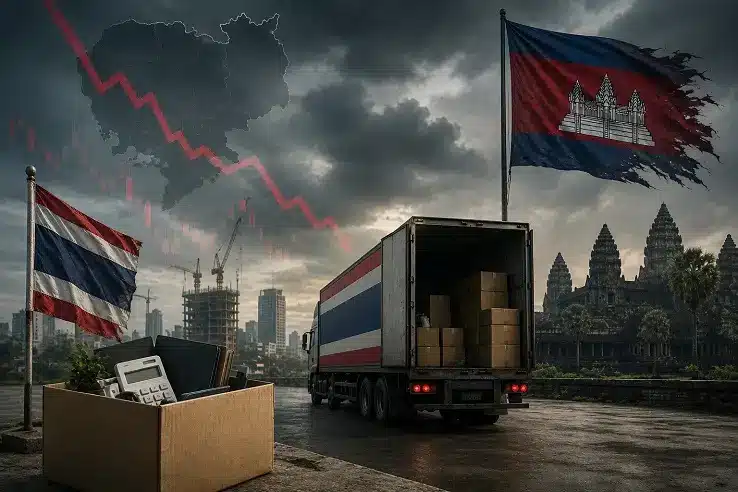
Image Credit: Bangkok Business News
The prolonged instability has created growing challenges for companies that once viewed Cambodia as one of Southeast Asia’s most promising growth markets. This Bangkok Business News report finds that while some businesses are attempting to adapt by reducing the visibility of their Thai identity or restructuring operations, others have decided the risks now outweigh the potential rewards. The differing responses underline how deeply the deteriorating business climate has affected investment decisions and commercial confidence.
Investment Plans Frozen as Businesses Adapt
Several Thai manufacturers have already postponed major projects worth billions of baht because of the uncertain environment. One beverage producer has reportedly delayed the launch of a newly completed Cambodian factory that had originally been scheduled to begin operations late last year. With tensions continuing, production remains on hold indefinitely.
Another producer of essential consumer goods has prepared contingency plans that would temporarily suspend manufacturing under a Thai brand before restarting production under a Cambodian identity. The strategy reflects an increasing effort by businesses to distance products from their Thai origins in response to mounting pressure within the local marketplace.
Many companies are also scaling back advertising campaigns, reducing the prominence of logos on packaging and, in some cases, making Thai branding far less visible to consumers in an effort to avoid becoming targets of negative sentiment.
Consumer Boycotts and Online Pressure Intensify
Industry sources say businesses have faced increasingly organized online campaigns targeting Cambodian retailers and distributors that continue selling Thai products. Social media activity encouraging consumers to avoid Thai brands has intensified over the past year, placing additional pressure on businesses already struggling with weaker demand.
Companies with highly recognizable Thai branding have been among the hardest hit. Distributors transporting Thai goods into local markets have reportedly faced criticism online, prompting some manufacturers to rethink packaging, marketing and promotional strategies while attempting to preserve market share.
The hostile environment has also discouraged aggressive promotional spending, with many businesses choosing instead to maintain only essential commercial activities until conditions improve.
Major Brands Feel the Impact
The effects have spread across numerous industries, with several leading Thai companies reporting significant setbacks.
Entertainment operator Major Cineplex has already withdrawn from Cambodia, ending operations after more than a decade in the country. The closure marked the end of a business that previously operated multiple cinema locations and dozens of movie screens throughout the market.
Carabao Group has also experienced a sharp decline in overseas revenue, with Cambodia and other CLMV markets contributing to weaker international performance. The company has responded by revising both its distribution network and marketing strategy as it seeks to manage the changing business environment.
Manufacturers Pursue Alternative Growth
Food manufacturers are also redirecting their expansion plans. Thai President Foods, the producer of Mama instant noodles, is seeking stronger growth opportunities in larger overseas markets after Cambodia’s slowdown significantly affected sales.
The company is focusing renewed attention on China and India while simultaneously expanding into countries with strong instant noodle consumption, including South Korea and Vietnam. In South Korea, the company plans to promote distinctive Thai flavors such as tom yum, green curry and spicy basil while introducing larger premium product formats designed to compete directly with established local brands.
Expansion into Vietnam is also under consideration through discussions with established retail partners to strengthen distribution channels. However, future international growth will depend partly on increasing manufacturing capacity, with additional production lines being installed to support rising demand for premium noodle products.
Beauty and Franchise Businesses Exercise Caution
Cambodia had also become an important overseas market for cosmetics brand Mistine before business conditions deteriorated. The company has since reduced marketing activities and brand-building efforts while monitoring developments before making further investment decisions.
Restaurant operators are facing similar uncertainty. Some businesses that recently expanded franchise operations into Cambodia are finding it increasingly difficult to supervise local operations because travel has become more complicated. In several cases, discussions regarding future expansion have effectively stalled as companies wait for greater clarity.
Energy Sector Reviews Long-Term Commitment
Among the companies conducting the most comprehensive review is PTT Oil and Retail Business Plc (OR), which has experienced a dramatic decline in fuel sales since border tensions intensified.
The company is reassessing the long-term viability of its Cambodian operations through a structured three-stage evaluation process. Management is first conducting a detailed financial and operational review before determining whether cost reductions and restructuring can restore profitability. If recovery proves unlikely, an orderly withdrawal remains one of the available options.
Although Cambodia contributes only a relatively small percentage of OR’s overall revenue, the review reflects the company’s broader strategy of placing greater emphasis on investment quality, profitability and sustainable long-term returns rather than simply expanding its international footprint.
OR continues to operate an extensive network of fuel stations, Café Amazon outlets, convenience stores and fuel terminals throughout Cambodia while the assessment continues.
Banks Maintain Services but Halt Expansion
Unlike manufacturers and retailers, Thai financial institutions have largely chosen to maintain their existing operations while suspending expansion plans.
Banks with representative offices and branches in Cambodia continue serving existing corporate and retail customers but have put new investment initiatives on hold until conditions improve. Financial institutions are carefully monitoring country risks, safety considerations and broader economic developments before making any additional commitments.
The cautious approach reflects the fact that many Thai corporate clients have themselves delayed or suspended investment projects in Cambodia, reducing opportunities for banks to expand lending and related financial services. Existing operations remain stable, but growth prospects have become increasingly limited as business activity slows.
The evolving situation demonstrates how geopolitical tensions can quickly reshape commercial priorities, forcing companies to balance growth ambitions against operational risk. Businesses that once regarded Cambodia as a strategic destination for long-term expansion are now placing greater emphasis on diversification, careful capital allocation and protecting existing investments while waiting for greater stability to return. Whether companies ultimately rebuild their presence or accelerate their departure will depend largely on how quickly confidence can be restored across the market.
For the latest on Thai Businesses in Cambodia, keep on logging to Bangkok Business News.



