


What To Know
- Thailand’s economy is confronting one of the most dangerous structural periods in its modern history, as high household debt, an aging population, weak domestic demand, deteriorating competitiveness and years of delayed economic reform threaten to lock the country into a prolonged era of low growth.
- In the middle of an increasingly uncomfortable debate over the country’s economic direction, this Bangkok Business News report examines how accumulated structural weaknesses, repeated policy delays and what critics describe as shortsighted economic management have left Southeast Asia’s second-largest economy increasingly vulnerable to “Japanification” — prolonged weak growth, subdued inflation and exceptionally low interest rates.
Thailand’s economy is confronting one of the most dangerous structural periods in its modern history, as high household debt, an aging population, weak domestic demand, deteriorating competitiveness and years of delayed economic reform threaten to lock the country into a prolonged era of low growth. Once celebrated as one of Asia’s most dynamic emerging economies, Thailand is increasingly being compared with Japan during its decades of stagnation, except Thailand faces an uncomfortable difference: it risks growing old before it becomes rich.
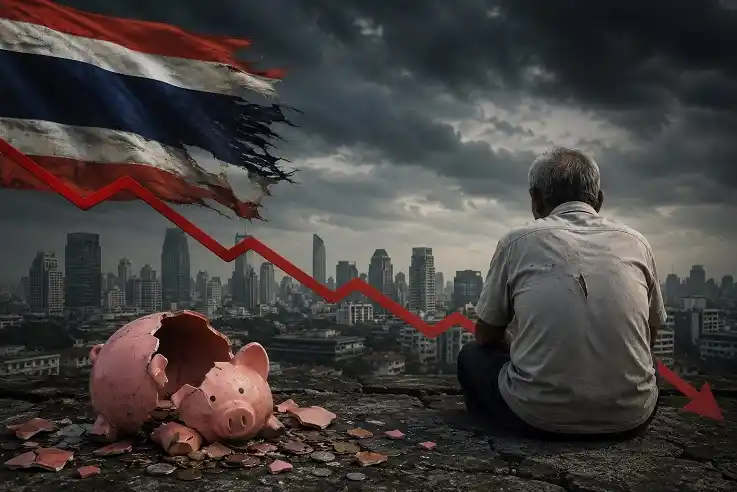
Image Credit: Bangkok Business News
The warning signs are becoming increasingly difficult for policymakers to dismiss. Economic growth remains weak and uneven, small businesses continue to struggle for credit, household finances are stretched and Thailand’s demographic clock is moving rapidly against it. In the middle of an increasingly uncomfortable debate over the country’s economic direction, this Bangkok Business News report examines how accumulated structural weaknesses, repeated policy delays and what critics describe as shortsighted economic management have left Southeast Asia’s second-largest economy increasingly vulnerable to “Japanification” — prolonged weak growth, subdued inflation and exceptionally low interest rates.
Interest Rates Reveal the Depth of Thailand’s Weakness
The Bank of Thailand’s Monetary Policy Committee voted unanimously on August 26 to maintain its policy interest rate at just 1%, confirming that monetary conditions will remain highly accommodative.
The central bank acknowledged that overall economic growth remains “low and uneven,” while weak domestic demand continues to suppress underlying inflationary pressure. The BOT also warned that loans to small and medium-sized enterprises continue to contract even as overall credit conditions show some improvement.
Thailand’s 1% policy rate is not simply evidence of generous monetary policy. It increasingly reflects an economy struggling to generate sufficient domestic demand.
The BOT had already warned earlier in 2026 that subdued growth resulting from structural factors could not be addressed exclusively through monetary policy. That is crucial because cutting interest rates has limited impact when households are heavily indebted, businesses lack confidence to invest and consumers are reluctant or unable to increase spending.
The central bank’s June forecast placed economic growth at 2.3% for 2026 before slowing to only 1.8% in 2027. The World Bank has been even more cautious, forecasting 2026 growth of just 1.6%, citing weaker exports, soft domestic demand, household deleveraging, subdued tourism recovery and uncertainty affecting private investment.
For a country seeking to escape the middle-income trap, growth around these levels is simply not enough to deliver a rapid improvement in living standards.
Thailand Risks Growing Old Before Becoming Rich
Perhaps the most formidable threat cannot be solved by another stimulus package or interest-rate reduction.
Thailand is aging at extraordinary speed. The World Bank has long warned that the demographic transformation is considerably more advanced than Thailand’s income level would normally suggest. Its projections indicate that demographic change could account for more than half of the expected decline in Thailand’s long-term economic growth as fertility falls and the working-age population contracts.
By 2040, earlier World Bank projections estimated that approximately 17 million Thais could be aged 65 or older, representing more than one-quarter of the population. At the same time, the working-age population is shrinking, reducing the number of workers available to support economic production, taxation and an expanding elderly population.
Japan faced similar demographic pressures, but Japan became wealthy before becoming old. Thailand is undergoing the same transition while still attempting to reach high-income status.
A smaller workforce means slower potential economic growth unless Thailand can produce dramatic gains in productivity, automation, technology, education and workforce participation.
It also means greater fiscal pressure. Fewer workers must ultimately support rising expenditure on pensions, health care and long-term elderly care.
Household Debt Has Become an Economic Handbrake
Thailand’s demographic crisis is compounded by another entrenched problem: enormous household indebtedness.
Bank of Thailand statistics show household loans running at roughly the equivalent of the mid-to-high 80% range of GDP in recent reporting periods, placing an extraordinary financial burden on households and restricting their ability to consume.
This creates a vicious cycle.
When a substantial proportion of household income goes toward servicing mortgages, vehicle loans, credit cards, personal loans and other liabilities, consumers have less disposable income. Businesses then face weaker sales, discouraging investment and hiring. Slower employment and wage growth subsequently make household debt even harder to manage.
Low interest rates would normally encourage borrowing, investment and consumption. But when borrowers are already heavily leveraged, cheaper money cannot necessarily persuade them to take on additional debt.
This helps explain why monetary-policy transmission has become increasingly difficult.
The central bank can reduce borrowing costs, but it cannot force heavily indebted households to spend or persuade cautious banks to lend to financially vulnerable customers.
Thailand’s Old Growth Model Is Losing Power
For decades, Thailand depended heavily on manufacturing exports, foreign investment and tourism.
Every component of that model is now facing stronger competition. Vietnam has developed into a formidable regional manufacturing competitor, attracting multinational investment and integrating itself deeper into global electronics and technology supply chains. China remains a manufacturing powerhouse while Chinese products also compete aggressively in Thailand’s domestic market.
Thailand therefore faces pressure from both directions: stronger regional competitors seeking foreign investment and lower-cost imports challenging domestic producers.
Tourism remains essential, but tourism alone cannot transform Thailand into a high-income, innovation-driven economy.
The country needs higher productivity, more sophisticated manufacturing, stronger digital industries, better education, greater research and development, competitive SMEs and an investment environment capable of attracting next-generation industries rather than depending primarily on advantages developed decades ago.
The BOT itself has repeatedly referred to structural impediments and intensified competition when discussing Thailand’s economic outlook.
Years of Delayed Reform Carry an Increasing Price
Thailand’s present difficulties cannot reasonably be attributed to one government, one institution or one economic shock.
Many problems have accumulated over decades.
Political instability, repeated changes of government, bureaucratic inertia, uneven education quality, weak productivity improvements, demographic decline and slow structural reform have prevented Thailand from realizing its full economic potential.
Critics also continue to raise concerns about governance, patronage, corruption and policy decisions driven by short-term political considerations rather than long-term competitiveness. Such allegations must be distinguished from proven misconduct by particular individuals, but the broader damage caused by poor governance and policy uncertainty is economically significant.
Businesses make long-term investment decisions based partly on predictability. When regulations, political priorities and economic strategies repeatedly change, investors can choose competing destinations.
Thailand no longer has the luxury of assuming investors will automatically come.
Monetary Policy Cannot Rescue the Economy Alone
The danger is that policymakers continue treating structural economic weakness as though it were a temporary downturn.
Interest-rate reductions can provide breathing room, but they cannot produce more children, reverse demographic aging, eliminate household debt, reform education or transform industrial productivity.
Fiscal stimulus can support consumption, but government finances also have limits. Permanent dependence on stimulus merely shifts financial pressure from households toward the public balance sheet.
Thailand therefore requires structural reforms that improve productivity rather than simply generating temporary spending.
That means developing skilled workers, reforming education, expanding technology adoption, reducing unnecessary regulatory barriers, supporting competitive SMEs, improving public-sector efficiency, encouraging innovation and creating credible long-term policies that survive changes of government.
Thailand still possesses considerable strengths: sophisticated manufacturing clusters, world-class tourism assets, established infrastructure, a strategic geographical location, substantial private-sector expertise and deep integration with regional supply chains.
But those advantages cannot be treated as permanent. Thailand’s greatest economic danger is not an immediate financial collapse. It is something quieter and potentially more damaging: decades of mediocre growth becoming accepted as normal while regional competitors move ahead. An aging society, shrinking workforce, heavy household debt and weakened investment cannot be repaired through monetary policy alone. Unless political leaders, economic agencies and the bureaucracy accept the scale of structural reform required, Thailand risks spending the coming decades managing decline rather than creating prosperity. The country still has time to change direction, but every year of delayed reform makes the eventual adjustment more difficult, more expensive and more painful.



