


What To Know
- Thailand is entering 2026 with a fiscal narrative that financial markets cannot ignore, as the country’s public debt edges closer to the 70 percent ceiling set by law and global ratings agencies turn more cautious over whether policymakers can manage the buildup.
- Japan-based R&I opened the year with an A-minus and a stable outlook, while the Japan Credit Rating Agency maintained an A rating.
Bangkok Business News: Mixed Signals from Global Watchdogs
Thailand is entering 2026 with a fiscal narrative that financial markets cannot ignore, as the country’s public debt edges closer to the 70 percent ceiling set by law and global ratings agencies turn more cautious over whether policymakers can manage the buildup. The Finance Ministry insists that stabilizing the national balance sheet and defending the sovereign rating are its core priorities, even as sentiment abroad grows more complex. International agencies spent most of 2025 signaling measured confidence in Thailand’s medium-term direction, but volatility across trade, finance, and politics has prompted a sharper spotlight in recent months, this Bangkok Business News report finds.
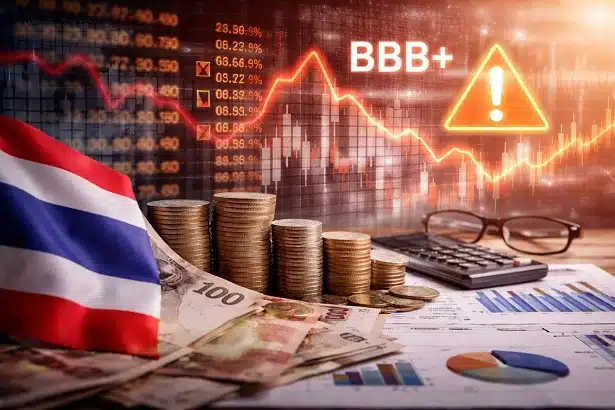
Thai debt levels near the ceiling spark fresh scrutiny from rating agencies
Image Credit: Bangkok Business News
Shift in Market Mood
Japan-based R&I opened the year with an A-minus and a stable outlook, while the Japan Credit Rating Agency maintained an A rating. Such steady assessments helped ease early-year nerves. However, the mood shifted following the United States’ decision in April to levy reciprocal tariffs, a move that jolted exporters and underlined the fragility of global demand. Soon after, Moody’s reaffirmed Thailand’s Baa1 rating but cut the outlook to negative, citing exposure to external shocks and further complications from geopolitical tension.
Pressure Mounts on Policymakers
S&P Global Ratings held tight at BBB-plus with a stable outlook through midyear, noting that tourism revival and Eastern Economic Corridor megaprojects were providing a buffer. Yet, by September, Fitch Ratings also held its BBB-plus but moved its view to negative, warning that fiscal consolidation might stall and public debt trends were no longer benign. The agency pointed to rising political noise, weaker-than-expected tourism receipts, and stubbornly high household debt, while forecasting general government debt near 59.4 percent of GDP.
Government Responds with Fiscal Reset
The turning point came with the reshuffled economic team led by Deputy Prime Minister and Finance Minister Ekniti Nitithanprapas. A revamped medium-term fiscal strategy covering 2027 to 2030 was approved in November and pitched as a reset designed to reassure skeptical markets. S&P soon reaffirmed BBB-plus and kept a stable outlook, highlighting stronger fiscal clarity, large external reserves, a current account surplus forecast at roughly 2.5 percent of GDP across 2025 to 2028, and ongoing investment, especially in infrastructure and the EEC.
Risks Remain and Credibility Is Key
Ekniti argues that the strategy signals discipline, with the deficit planned to ease from 4 to 5 percent of GDP toward 3 percent by 2030, and public debt held under the 70 percent legal threshold. Rules have also been tightened, including reserving at least 4 percent of annual expenditure for principal repayment, limiting multi-year commitments outside the budget to 5 percent, and restricting quasi-fiscal programmes under Section 28 to 32 percent of spending.
Expert Warnings and Long Road Ahead
Economist says deterioration in fiscal space demands vigilance. He notes that finance chiefs must convince ratings firms that consolidation will not drift, and persuade coalition colleagues to scale back costly giveaways, or face higher borrowing costs and heavier interest burdens that could spill into households and firms via rising bond yields. The path will test political stamina and economic judgement alike as Thailand seeks to balance stimulus needs and fiscal prudence in a world of uncertainty. The risk of slipping into a downgrade remains real and could reverberate through the banking system, weaken investor appetite, and place a premium on credible policy signals over political rhetoric. For the latest on the Thai economy, keep on logging to Bangkok Business News