


What To Know
- While this potential loss appears to be already factored into CBG’s current stock price, its new factory in Cambodia remains on track to launch on December 1.
- The situation remains fluid, but the looming risk of supply chain disruptions, a drop in consumer confidence, and long-term reputational damage to Thai interests in Cambodia could reshape corporate strategies in the region for months to come.
Bangkok Business News: Investor Confidence Falters as Tensions Surge
The escalating military conflict between Thailand and Cambodia is sending shockwaves through the business community, especially among companies with significant exposure across the border. Investment consultants and financial analysts are urging extreme caution, pointing to growing risks for sectors such as aviation, energy drinks, retail oil, tourism, and exports.
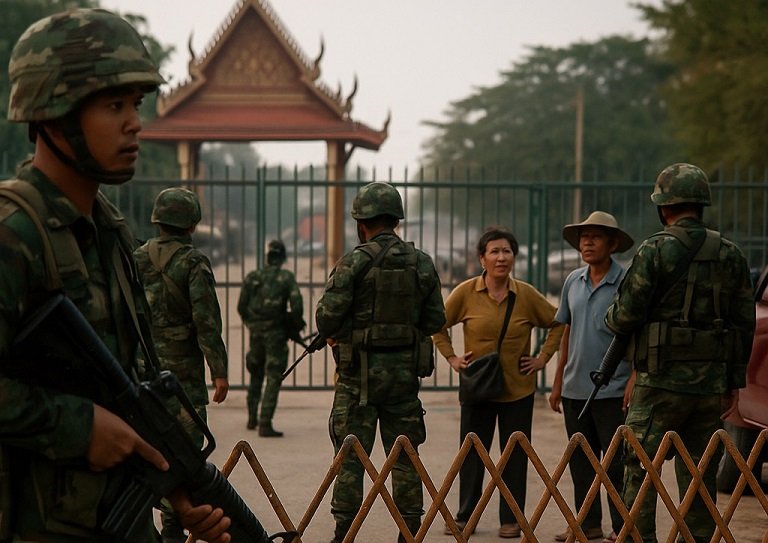
Most Thai businesses with a presence in Cambodia likely to be affected by the ongoing border conflict
Image Credit: AI-Generated
Among the most vulnerable is Samart Aviation Solutions (SAV), whose entire revenue depends on long-term air traffic control concessions in Cambodia. Analysts are advising investors to hold off on SAV until political tensions ease. Carabao Group (CBG), the energy drink titan, is also exposed, with over 13% of its revenue tied to Cambodia. This Bangkok Business News report highlights that CBG has implemented contingency plans, including switching to slower sea freight and expanding its inventory buffer to three months.
Financial Damage Looms but Firms Stay the Course
Despite regional instability, Cambodian distributors report that energy drink demand has remained steady. Still, CBG could lose up to 340 million baht in net profit—roughly 10% of its annual earnings—if cross-border exports are blocked from July through December. While this potential loss appears to be already factored into CBG’s current stock price, its new factory in Cambodia remains on track to launch on December 1.
Other beverage players such as Osotspa (OSP) face limited exposure, with Cambodian revenue contributing only 1% to their total earnings. Retail giants, too, are showing resilience. Siam Global House (GLOBAL) and CP Axtra (CPAXT) both operate stores in Cambodia but derive less than 2% and 1% of their revenue respectively from the market. CP All, the operator of 7-Eleven, runs over 100 stores in Cambodia, but revenue from those outlets remains minimal.
Wider Sector Impact and Military Escalation
In the retail oil segment, PTT Oil and Retail (OR), with 186 petrol stations and 71 convenience stores in Cambodia, reports no operational interruptions yet. The food sector is also minimally affected, with Thai Union Group (TU) and GFPT Plc noting only negligible exposure. Thai construction firms like CH Karnchang (CK), Stecon Group (STECON), and SEAFCO Plc also confirmed continued operations despite employing Cambodian labor in small percentages.
However, Thailand’s tourism industry is already taking a hit. All temple sites near the border have been closed, and hotels report a wave of cancellations. Meanwhile, trade has been decimated by the closure of all Thai-Cambodian border crossings, freezing bilateral trade valued at over 174 billion baht in 2024.
Business Continuity Amid Crisis
In response, Thai firms are moving swiftly. Index Creative Village has cancelled all its 2025 events in Cambodia, while Carabao has tripled stock reserves. Banks and financial institutions have also activated continuity plans and temporarily closed affected branches. The Royal Thai Air Force has launched attacks on Cambodian military sites, while the Thai Foreign Ministry has downgraded diplomatic relations. These actions follow violent clashes since July 24 near Banteay Chhmar and six other key locations, resulting in casualties and heightened military engagement.
Business leaders, including those from the Thai-Cambodia Business Council and the Federation of Thai Industries, are urging diplomacy while advising Thai nationals to monitor the situation closely. Though no direct damage to factories has been reported so far, fears persist of potential attacks on Thai investments reminiscent of past unrest.
The situation remains fluid, but the looming risk of supply chain disruptions, a drop in consumer confidence, and long-term reputational damage to Thai interests in Cambodia could reshape corporate strategies in the region for months to come. As more companies revise plans and brace for worst-case scenarios, the coming weeks will prove critical in determining the economic fallout from the border clashes.
For the latest on the business fallout from the Thailand-Cambodia border crisis, news, keep on logging to Bangkok Business News.



