


What To Know
- Thailand’s property sector is entering a new phase of adjustment as financially pressured developers increasingly sell land banks and Environmental Impact Assessment (EIA)-approved projects to preserve liquidity amid a prolonged market slowdown.
- What began as a strategy of postponing new launches has evolved into a broader reshaping of the industry, with development assets changing hands as companies seek to navigate weaker demand, tighter financing conditions and heightened economic uncertainty.
Bangkok Business News: Thailand’s property sector is entering a new phase of adjustment as financially pressured developers increasingly sell land banks and Environmental Impact Assessment (EIA)-approved projects to preserve liquidity amid a prolonged market slowdown. What began as a strategy of postponing new launches has evolved into a broader reshaping of the industry, with development assets changing hands as companies seek to navigate weaker demand, tighter financing conditions and heightened economic uncertainty.
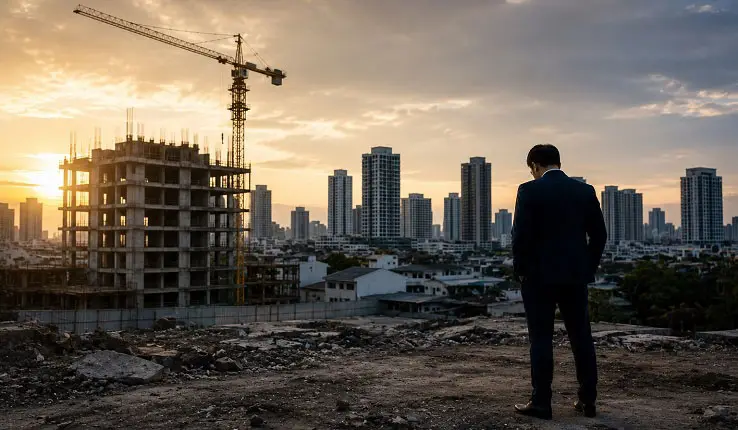
Image Credit: Bangkok Business News
The trend is becoming more visible across the country as developers that accumulated large land reserves during previous market upcycles confront slowing sales and rising holding costs. Rather than continue carrying expensive assets while waiting for conditions to improve, many are choosing to convert those holdings into cash. At the same time, larger and financially stronger developers are taking advantage of the downturn to acquire projects that are already prepared for development. In many respects, this Bangkok Business News report finds that the current market environment is creating a transfer of opportunities from cash-constrained operators to companies with stronger balance sheets and longer-term growth ambitions.
Property Slowdown Forces Strategic Shift
Thailand’s real estate market has faced mounting pressure from several directions. Weak purchasing power, elevated financing costs and ongoing economic uncertainty have weighed heavily on both developers and homebuyers. The challenges have been compounded by tighter lending standards from financial institutions and a more difficult fundraising environment.
Developers that once aggressively accumulated land during periods of rapid growth are now finding themselves under increasing financial strain. Carrying undeveloped land requires substantial capital, and slower sales have reduced the cash inflows needed to support expansion plans and debt obligations.
As a result, many companies are reassessing their priorities. Instead of pursuing new acquisitions or launching additional projects, they are focusing on protecting liquidity and reducing financial burdens. Selling land and EIA-approved developments has emerged as one of the most practical solutions for firms seeking to strengthen their cash position while avoiding prolonged exposure to market uncertainty.
Industry observers note that this adjustment is a natural feature of a property market downturn. Companies with stronger finances are typically better positioned to weather difficult periods and can use the slowdown to secure valuable assets that may have been difficult or expensive to acquire during boom years.
New Investment Activity Drops Sharply
Recent market data highlights the scale of the slowdown affecting Thailand’s residential development sector. The number of housing units receiving land allocation permits during the first quarter declined significantly compared with the same period last year, reflecting a sharp reduction in new investment activity.
Construction approvals have also fallen substantially, indicating that developers are becoming increasingly cautious about launching new projects. Rather than adding fresh supply to an already challenging market, many firms are concentrating on managing existing inventory and maintaining financial stability.
The condominium sector has experienced some of the steepest declines. High-rise developments generally require significant capital commitments and longer project timelines, making them particularly vulnerable during periods of economic uncertainty. Consequently, many developers have delayed condominium launches while focusing on clearing existing stock.
Despite the contraction in development activity, housing demand has not disappeared entirely. Residential transfers and mortgage lending have continued to register growth in selected market segments, particularly among homes priced below three million baht. This segment remains supported by genuine housing demand from owner-occupiers rather than speculative investors.
However, higher-priced residential properties have shown clear signs of weakness. Transaction volumes and values in the upper-end housing market have declined, reinforcing the cautious stance adopted by developers across the country.
EIA-Approved Projects Gain Strategic Value
One of the most important developments emerging from the market slowdown is the increasing attractiveness of EIA-approved projects. These developments hold significant value because they have already completed many of the regulatory and planning stages required before construction can begin.
Obtaining environmental approvals, completing project designs and securing necessary permits can take considerable time and resources. By acquiring projects that have already passed these stages, buyers can eliminate much of the preparation period and accelerate future development plans.
For stronger developers, acquiring such projects represents an efficient growth strategy. Instead of spending years assembling land, preparing designs and navigating approval processes, they can move directly toward development once market conditions improve.
The approach also reduces certain development risks. Since many regulatory hurdles have already been addressed, acquiring a prepared project provides greater certainty compared with launching a completely new development from scratch.
Industry participants report growing interest in projects that are ready for development but whose original owners no longer possess the financial capacity or confidence to proceed. This trend is expected to continue as more developers prioritize liquidity over expansion.
Competition Shifts from Buying Land to Buying Opportunity
The changing market is also transforming the competitive landscape within Thailand’s property sector. During previous growth cycles, competition largely centered on acquiring land. Developers frequently competed aggressively for prime locations, pushing land prices higher and creating intense bidding activity.
Today, the focus is shifting. The greatest advantage now belongs to developers with sufficient capital and the ability to identify quality opportunities during a downturn. Instead of competing for scarce land, these companies are evaluating prepared projects and land holdings being offered by developers seeking liquidity.
This shift has created a more favorable environment for buyers. Assets that may have commanded premium valuations during the market peak are becoming available at more reasonable prices, allowing financially stronger companies to expand strategically without facing the intense competition seen in previous years.
The phenomenon is evident in several regions across Thailand, where smaller and medium-sized developers are increasingly selling assets while larger players selectively build future development pipelines.
Land Prices Show Signs of Stabilizing
The evolving market conditions are also influencing land prices. In several key development areas, land values surged dramatically following the pandemic recovery period as developers rushed to secure sites for future projects.
However, the pace of appreciation has begun to slow. Many major developers already possess extensive land banks and no longer need to acquire additional plots at the same aggressive pace. As demand for land moderates, prices are beginning to stabilize.
Market analysts believe further significant increases may be limited unless a new wave of buyers emerges. At the same time, some investors who acquired land at elevated prices may eventually return those holdings to the market if development plans become unviable or financing conditions remain restrictive.
This combination of reduced demand and potential new supply could contribute to a more balanced land market over the coming years.
Industry Focus Turns to Survival and Preparation
Thailand’s property industry appears set for a year defined more by adjustment than expansion. Developers are increasingly focused on strengthening balance sheets, managing risk and preserving liquidity rather than pursuing rapid growth.
For stronger companies, the downturn presents an opportunity to acquire quality assets and build future project pipelines at more attractive costs. For smaller or financially stretched operators, selling land and EIA-approved developments offers a means of reducing financial pressure and improving cash flow.
The growing transfer of EIA-approved projects reflects a broader restructuring taking place within the sector. Assets are moving from developers seeking immediate liquidity to those with the financial resources to wait for the next market recovery. While the process may be challenging for some operators, it is helping reshape the industry in a way that could ultimately create a stronger foundation for future growth.
As economic conditions remain uncertain, success will likely depend on financial discipline, careful risk management and strategic decision-making. Developers capable of preserving liquidity while identifying long-term opportunities are expected to emerge from the downturn in a stronger competitive position.
Meanwhile, those burdened by excessive costs and limited access to capital may continue to dispose of assets as they adapt to a market that increasingly rewards financial resilience over aggressive expansion. The changing ownership of EIA-approved projects is therefore becoming one of the clearest indicators of how Thailand’s property industry is evolving during this challenging period.
For the latest on the Thai economy, keep on logging to Bangkok Business News.



