
What To Know
- He recalled cooperation agreements established with the Thai Chamber of Commerce in 2003 and the Federation of Thai Industries in 2016.
- Alexey Kretov, director and head of the Project Finance Office at the Russian Export Center, estimated Russian investment in Thailand at approximately US$1.
Moscow and Bangkok are accelerating efforts to transform their longstanding diplomatic relationship into commercially viable investment partnerships, with Russian officials promoting opportunities in advanced manufacturing, artificial intelligence, transportation, pharmaceuticals, and urban technology. The initiative could open new business channels between Thailand and Russia as both capitals prepare to celebrate important diplomatic milestones in 2027.
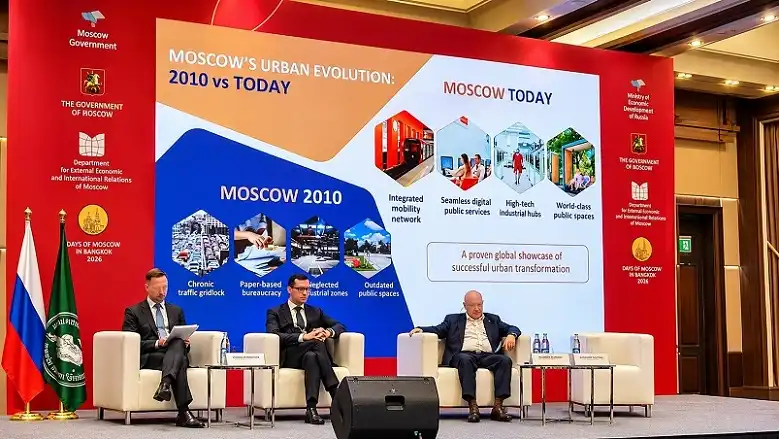
Image Credit: Bangkok Business News
The ambitious investment agenda emerged during the Russian-Thai Investment Forum 2026, held at the Royal Orchid Sheraton Riverside Hotel Bangkok on October 30. Discussions examined how both cities could move beyond conventional trade relationships and develop projects involving technology transfers, industrial cooperation, and private investment. As this Bangkok Business News report highlights, the central challenge is turning diplomatic goodwill into financially sustainable ventures that deliver measurable economic benefits.
Historic Anniversaries Create Urgency for Investment
The initiative comes ahead of two important anniversaries in 2027: 130 years of diplomatic relations between Russia and Thailand, established in 1897, and 30 years of friendly relations between Moscow and Bangkok, dating to 1997.
Officials emphasized that these milestones should be accompanied by tangible business achievements rather than ceremonial celebrations alone.
Thailand’s established tourism connections with Russia, alongside growing interest in Russian education, technology, and industrial expertise, provide a foundation for expanding commercial engagement.
However, participants acknowledged that stronger institutional coordination, credible investment proposals, and improved investor protections will be essential.
Moscow Promotes Billion-Dollar Trade Relationship
Viacheslav Manuylov, deputy head of Moscow’s Department for External Economic and International Relations, estimated that trade between Moscow and Thai companies approached US$1 billion in 2025.
He identified transportation, healthcare, digital services, tourism, and education as promising areas for expansion.
Moscow’s intelligent traffic management systems, electronic government services, and electric river transportation were presented as examples of urban technologies potentially relevant to Bangkok.
Artificial intelligence applications in medical diagnostics and data-driven city planning also featured prominently.
Manuylov encouraged Thai companies to examine opportunities in microelectronics, robotics, pharmaceuticals, aerospace, and electric transportation.
He highlighted Technopolis Moscow, a special economic zone reportedly accommodating more than 180 high-technology companies, as a potential destination for industrial collaboration.
These proposals suggest that Moscow wants its relationship with Thailand to extend beyond commodity transactions toward technology-intensive investment.
Bangkok Seeks Opportunities Beyond Transportation
Witoon Apisitpuvakul, director-general of the Bangkok Metropolitan Administration’s Strategy and Evaluation Department, emphasized that future cooperation must reflect Bangkok’s broader economic and social priorities.
Although transportation remains important, Bangkok is also seeking opportunities involving small and medium-sized enterprises, tourism, festivals, creative industries, and the nighttime economy.
Witoon highlighted the importance of connecting government agencies with private investors while improving access to reliable municipal data.
Transparent information about development policies, investment opportunities, and project implementation could help businesses make better-informed decisions.
His remarks indicated that Bangkok’s interest extends beyond importing technology to developing partnerships that support employment, entrepreneurship, and urban living standards.
Russian Businesses Target Joint Product Development
Vladimir Platonov, president of the Moscow Chamber of Commerce and Industry, said Moscow has more than 900,000 small and medium-sized enterprises, representing a substantial potential network of commercial partners.
He advocated cooperation in healthcare, pharmaceuticals, food processing, transportation, and digital services.
Rather than concentrating exclusively on exports, Platonov encouraged companies to pursue joint product development, technology exchanges, and lasting business relationships.
He recalled cooperation agreements established with the Thai Chamber of Commerce in 2003 and the Federation of Thai Industries in 2016.
Business organizations, he argued, must actively help companies identify suitable partners, negotiate agreements, and maintain commercial relationships after investment conferences conclude.
He also highlighted entrepreneurship programs connecting young innovators with commercial opportunities.
Russian Investment in Thailand Reaches US$1.5 Billion
Alexey Kretov, director and head of the Project Finance Office at the Russian Export Center, estimated Russian investment in Thailand at approximately US$1.5 billion, much of it concentrated in real estate.
He called for greater diversification into manufacturing, logistics, processing industries, and advanced technology.
Kretov outlined export-credit insurance, overseas investment insurance, and assistance helping companies establish distribution networks and eventually local production facilities.
The forum also promoted the Made in Russia trade platform, intended to connect Russian suppliers with Thai businesses and support market entry through certification, marketing, and legal assistance.
Investment Protection Remains a Major Obstacle
Despite the commercial optimism, unresolved investment protections could complicate expansion.
Russia and Thailand signed a bilateral investment treaty in October 2002, but the agreement has never entered into force, according to the United Nations
Kretov identified stronger investor safeguards as important for encouraging capital commitments.
Meanwhile, Alexander Shatirov of the Roscongress Foundation Investment Platform outlined 24 Moscow investment opportunities being presented to Thai businesses.
He also described a broader Russian pipeline approaching 4,000 projects, including opportunities in medical technology, robotics, software, logistics, food, and wellness.
The platform provides financial indicators, project budgets, and developer contacts to support investment assessments.
The Real Test Comes in 2027
The coming year will determine whether Moscow and Bangkok can translate promising discussions into operational businesses, investment agreements, and measurable technology partnerships.
Both cities have identified substantial commercial opportunities, but success will depend on credible financing, regulatory clarity, investor confidence, and sustained cooperation between private enterprises.
Delivering even a handful of successful joint ventures before the 2027 anniversaries would demonstrate that their historic relationship can generate meaningful economic value.


