


What To Know
- As the city rolls out the red carpet for over 15,000 elite global finance delegates, central bankers, and policy analysts attending the high-stakes 2026 IMF-World Bank Annual Meetings, municipal operations have ground to a frustrating halt for ordinary residents.
- Securing a hosting spot for the IMF-World Bank Annual Meetings serves as a vital stamp of institutional approval, signaling to global markets that Thailand remains a stable, highly capable financial hub in Southeast Asia.
The contrast between high-level international diplomacy and the daily struggles of municipal commuting has never been more starkly illuminated than it is this week. As the city rolls out the red carpet for over 15,000 elite global finance delegates, central bankers, and policy analysts attending the high-stakes 2026 IMF-World Bank Annual Meetings, municipal operations have ground to a frustrating halt for ordinary residents. While government spokespersons eagerly broadcast the massive multi-billion-baht economic boost anticipated from this prestigious gathering, millions of local commuters are finding themselves trapped behind police barricades, navigating severe gridlock, and scrambling to adapt to sudden corporate work-from-home mandates. This economic juxtaposition raises a critical, uncomfortable question regarding the real price of international prestige: what is the actual cost of showcasing Bangkok to the global elite when local productivity is sacrificed? According to data compiled for this Bangkok Business News report, the financial losses incurred by small enterprises, delivery logistics networks, and hourly laborers stuck in gridlock threaten to significantly offset the immediate windfall generated by luxury hotel bookings and upscale delegate hospitality.
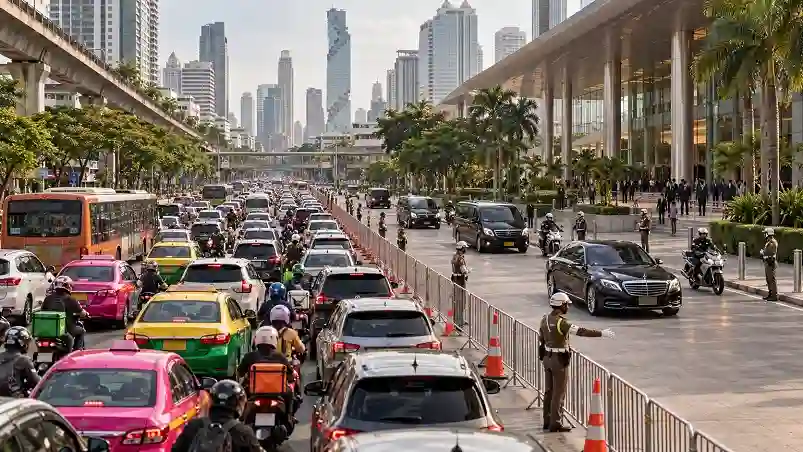
Image Credit: Bangkok Business News
The True Price of Global Prestige
For the average motorist navigating the gridlocked corridors of Sukhumvit, Ratchadapisek, and Rama IV roads, the macro-level arguments celebrating long-term foreign investment feel entirely disconnected from reality. Official state estimates suggest that hosting this global summit injects roughly nine billion baht into the broader tourism, hospitality, and service sectors through high-end accommodations, fine dining, and elite transport services. However, independent transport economists note that forcing millions of workers into standstill traffic or mandating sudden digital remote work creates immediate, severe operational frictions. Logistics providers are reporting widespread delays in supply chains, while retail businesses located inside the heavily restricted security zones are seeing their foot traffic drop to near-zero levels. This economic friction represents a hidden tax levied directly onto local working-class citizens to fund a global public relations victory for the current administration.
Commuter Rage and Economic Mismatch
The escalating frustration filling local community forums highlights an acute societal divide between the wealthy decision-makers inside the convention centers and the citizens living outside them. Security checkpoints, rolling roadblocks, and exclusive VIP motorcade lanes have turned standard thirty-minute commutes into grueling three-hour tests of endurance. For hourly wage earners, delivery riders, and street food vendors who cannot simply log in from home, these municipal disruptions translate directly into lost wages and ruined perishables. While macro-economists praise the structural reforms discussed behind closed doors, the immediate reality on the asphalt is one of widespread operational inefficiency. The sheer scale of the disruption reveals that Bangkok’s foundational infrastructure is still critically underprepared to absorb massive international events without causing severe internal economic paralysis.
The Long-Term Return on Investment
Government planners stand firmly by their operational strategy, asserting that the long-term geopolitical and financial advantages far outweigh a single week of urban inconvenience. Securing a hosting spot for the IMF-World Bank Annual Meetings serves as a vital stamp of institutional approval, signaling to global markets that Thailand remains a stable, highly capable financial hub in Southeast Asia. The connections forged during these high-level corporate networking sessions are projected to yield billions in future foreign direct investment, particularly within the country’s expanding technological and renewable energy infrastructure. Furthermore, the global media exposure positions the capital as a prime destination for luxury business tourism, potentially accelerating high-value tourism growth for the next decade.
Balancing Hospitality with Daily Survival
The ultimate test for municipal leadership lies in developing a cohesive urban strategy that can successfully accommodate global events without completely abandoning the needs of its residents. Going forward, the city must invest heavily in automated, real-time traffic management systems and high-capacity public transit networks that ensure local commerce can function smoothly during international summits. Relying on sweeping work-from-home mandates is merely a temporary band-aid that shifts the logistical burden onto individual workers and small business owners. For Bangkok to truly solidify its standing as a world-class megacity, its administrative infrastructure must evolve to protect the daily livelihoods of its working class while simultaneously hosting the world’s most influential financial leaders.
Looking Beyond the Summit
When the final international delegates depart and the heavy security blockades are dismantled, the local community will be left to assess the true net impact of this massive financial summit. The true metric of success cannot merely be measured by the total number of luxury hotel rooms booked or the immediate revenue generated by fine dining establishments. Instead, it must be evaluated by whether the strategic agreements signed during these meetings translate into tangible, long-term economic relief and better infrastructure for the citizens who endured the chaos. Until that structural balance is achieved, the massive nine-billion-baht summit will be remembered by locals as a week of unnecessary hardship rather than a historic milestone.



