


What To Know
- Severe flooding across Bangkok is inflicting heavy damage on the capital’s restaurant industry, with some operators reporting sales declines of as much as 80% as flooded roads, transportation disruption, and persistent rainfall keep diners away.
- For many smaller operators, this Bangkok Business News report highlights how a weather emergency can quickly become a financial crisis, particularly when businesses have limited cash reserves and little ability to absorb weeks of sharply reduced revenue.
Severe flooding across Bangkok is inflicting heavy damage on the capital’s restaurant industry, with some operators reporting sales declines of as much as 80% as flooded roads, transportation disruption, and persistent rainfall keep diners away. Even restaurants that have escaped direct inundation are struggling as employees, customers, suppliers, and delivery riders face difficulty reaching commercial districts.
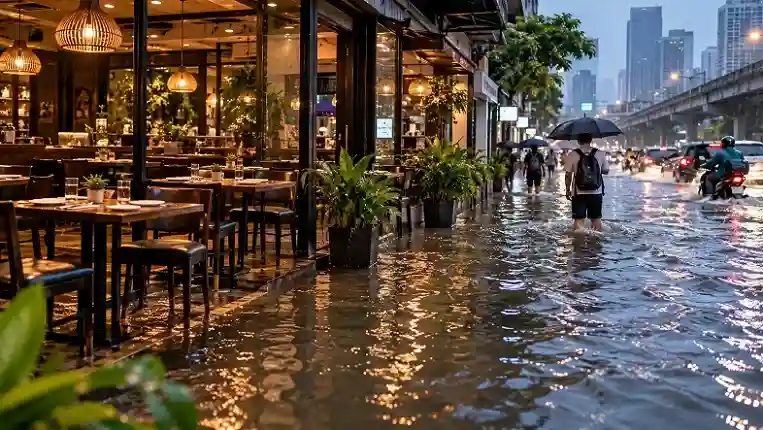
Image Credit: Bangkok Business News
The disruption has rapidly developed into a cash-flow problem because restaurants must continue paying rent, salaries, utilities, and other fixed expenses even as daily income collapses. For many smaller operators, this Bangkok Business News report highlights how a weather emergency can quickly become a financial crisis, particularly when businesses have limited cash reserves and little ability to absorb weeks of sharply reduced revenue.
Flooded Roads Empty Restaurant Tables
Executives of the Restaurant Operators Club said the latest flooding has been particularly damaging because water has affected several important inner-Bangkok commercial areas, including Phetchaburi, Ramkhamhaeng, Asok, Sukhumvit, and Lat Phrao.
The problem extends far beyond restaurants that have physically flooded. When surrounding roads and residential neighborhoods become difficult or impossible to navigate, customers cancel reservations and employees struggle to reach work.
The scale of the disruption was illustrated at a certain restaurant at Srinakarin Main Road, opposite Paradize Park. Although the restaurant itself remained dry, eight large group reservations were reportedly canceled during a single weekend because many customers lived in nearby flooded neighborhoods and could not travel.
Cash Reserves Come Under Pressure
For larger restaurant businesses, several days or even a week of weak trading may be manageable. Smaller and medium-sized operators, however, face a much tighter financial timetable.
Executives from the Restaurant Operators Club warned that if severe disruption continues for around two weeks, liquidity problems could become increasingly serious. A month of depressed business could force some operators to temporarily close, place workers on unpaid leave, or reduce staffing.
The timing adds another layer of pressure because restaurants must meet payroll obligations while simultaneously coping with declining cash receipts.
Operators are already adjusting their businesses to preserve cash. Some are reducing purchases of perishable ingredients to limit waste, while others are shortening opening hours. Restaurants that previously operated from early morning into the evening are increasingly opening around noon and closing at approximately 6 p.m. as evening customer traffic falls.
Food delivery has not provided the safety net restaurants might normally expect. Heavy rain and flooded roads have prevented some riders from completing journeys, leaving orders difficult to fulfill even when kitchens remain operational.
Vegetable Prices Add Another Shock
Restaurants are also confronting higher ingredient costs as flooding disrupts agricultural supply chains, wholesale markets, and transportation routes.
Wholesale prices for commonly used vegetables, including Chinese kale, cucumbers, and yardlong beans, have reportedly doubled as rainfall, high tides, drainage problems, and transportation bottlenecks restrict supplies.
That creates a difficult combination for restaurant owners: sharply lower revenue alongside rising input costs. Businesses must therefore closely monitor inventory, staffing, and available cash to determine how long they can continue covering fixed expenses.
Executives from the Restaurant Operators Club called on government agencies to provide businesses with advance weather and water-management information so operators can prepare more effectively. He also urged authorities to consider targeted financial assistance and to monitor wholesale food prices after floodwaters recede, reducing the risk that temporary supply disruptions develop into longer-lasting inflationary pressure.
Bangkok’s restaurant sector now faces a critical test of financial resilience. If flooding persists, the consequences could extend beyond temporarily empty dining rooms to business closures, reduced employment, higher menu costs, and lasting pressure on smaller operators already working with narrow margins. Faster drainage, reliable forecasting, restored transportation links, and careful monitoring of food prices will be crucial to determining how quickly the industry can recover.



