


What To Know
- Bangkok’s commercial property market is facing mounting pressure as Thailand’s slowing economy, business closures, and cautious corporate spending collide with an expanding supply of office buildings.
- 65 million square meters of office space already vacant, another 120,000 square meters is expected to enter the market during the final quarter of 2026, raising concerns about prolonged oversupply and increasingly fierce competition among landlords.
Bangkok’s commercial property market is facing mounting pressure as Thailand’s slowing economy, business closures, and cautious corporate spending collide with an expanding supply of office buildings. With approximately 1.65 million square meters of office space already vacant, another 120,000 square meters is expected to enter the market during the final quarter of 2026, raising concerns about prolonged oversupply and increasingly fierce competition among landlords.
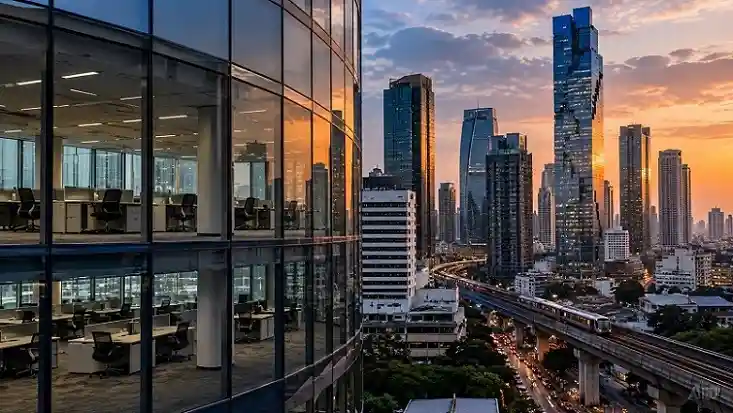
Image Credit: Bangkok Business News
The situation highlights a growing disconnect between Bangkok’s ambitious commercial property developments and the economic realities confronting businesses. Companies are increasingly prioritizing survival, operational efficiency, and cost reductions over expansion. Against this challenging backdrop, this Bangkok Business News report examines how weakening economic momentum, changing workplace requirements, and continued construction activity are reshaping the capital’s office market, potentially leaving older buildings struggling to retain tenants.
Economic Weakness Deepens Property Market Concerns
Thailand’s economic slowdown has become an increasingly important factor influencing corporate leasing decisions. Gross domestic product expanded just 1.9% year on year during the second quarter of 2026, compared with 2.8% in the preceding quarter.
More troublingly, the economy contracted 0.2% on a seasonally adjusted quarterly basis, reflecting weakening momentum that could discourage businesses from committing to additional office space.
As companies confront rising operating expenses and uncertain revenue prospects, many are reviewing existing leases, consolidating departments, and seeking smaller or more affordable premises.
Although business closures add to concerns about future occupancy, available office market figures do not establish how many vacancies resulted directly from companies shutting down.
Millions of Square Meters Compete for Tenants
Bangkok’s total office inventory reached approximately 6.83 million square meters during the third quarter, increasing 0.8% following the completion of AIA Connect, which contributed another 53,600 square meters.
Overall occupancy stands at about 71.4%. Occupancy remains substantially below the historical 10-year average of 84%.
Average asking rents remained unchanged at approximately 820 baht per square meter monthly, indicating that landlords have limited room to increase prices.
The impending completion of One Bangkok Tower 2 and Summit Tower will introduce additional competition into an already saturated market.
For existing property owners, the challenge extends beyond filling empty floors. Newer developments increasingly threaten to attract tenants away from established buildings rather than generate genuinely additional demand.
New Buildings Win While Older Offices Struggle
A striking divide is emerging between modern commercial developments and aging office properties.
Four newer buildings, BTS Visionary Park, Cloud 11, One Origin, and AIA Connect, collectively recorded approximately 66,100 square meters of additional occupied space during the third quarter.
However, the remainder of Bangkok’s office market experienced a combined net occupancy decline of approximately 17,000 square meters.
This divergence suggests that much of the apparent improvement reflects companies relocating between properties rather than expanding their overall office requirements.
Modern buildings offering energy efficiency, flexible layouts, advanced technology, and convenient transportation connections are increasingly attractive to corporate tenants.
Older buildings without comparable facilities risk losing occupants unless owners invest in renovations or introduce more competitive leasing packages.
Landlords Forced to Offer Attractive Deals
With substantial vacant space available, businesses searching for offices enjoy considerable negotiating power.
Landlords are increasingly competing through rental discounts, rent-free periods, flexible contractual arrangements, and financial contributions toward interior improvements.
These incentives can significantly reduce a tenant’s overall occupancy expenses, even when advertised rental rates remain relatively stable.
Grade A offices recorded occupancy of 74%, with average asking rents reaching 1,170 baht per square meter monthly.
Grade B occupancy declined to 72%, while average rents stood at 840 baht. Grade C buildings maintained comparatively stronger occupancy of 79%, with average rents around 525 baht.
The figures illustrate a fragmented market where building quality, affordability, and location increasingly determine performance.
Businesses Look Beyond Bangkok’s Traditional Business Districts
Commercial districts outside central Bangkok are attracting growing attention from cost-conscious companies.
Non-central business district locations generated approximately 48,000 square meters of net absorption during the third quarter, compared with only 2,000 square meters inside the central business district.
Average asking rents outside the CBD reached 655 baht per square meter monthly, while occupancy climbed to 77%.
Phahonyothin–Vibhavadi recorded particularly strong improvement, with occupancy increasing 5.1 percentage points to 80%.
Bang Na–Srinagarindra also strengthened, reaching 68% occupancy following a 3.5-percentage-point increase.
Meanwhile, central Bangkok continued facing pressure, with average CBD asking rents declining 0.4% to 960 baht per square meter monthly.
These developments suggest companies are increasingly willing to consider alternative commercial locations when substantial savings are available.
Green Buildings Reshape Corporate Leasing Decisions
Environmental performance is becoming another important competitive factor.
Bangkok now has approximately 3.04 million square meters of environmentally certified office space, representing around 43.5% of total inventory.
Businesses seeking lower energy consumption, improved workplace conditions, and stronger sustainability credentials are increasingly attracted to certified properties.
However, the expanding availability of environmentally efficient buildings creates additional difficulties for older developments requiring expensive upgrades.
Owners unable to modernize may face prolonged vacancies, particularly when newer competitors offer attractive introductory leasing incentives.
Slower Construction Could Eventually Ease Pressure
Despite the immediate oversupply concerns, Bangkok’s longer-term development pipeline offers some potential relief.
Approximately 540,000 square meters of additional office space is projected through 2031, with around 55% currently under construction.
Following 2026, annual completions are expected to average approximately 83,000 square meters.
Only 55,000 square meters is scheduled for completion in 2027, while no projects are currently scheduled for delivery in 2028.
This slowdown could gradually allow existing vacancies to be absorbed, provided economic conditions improve and businesses resume meaningful expansion.
Bangkok Faces a Difficult Road Ahead
Bangkok’s office market faces a prolonged adjustment as new developments compete for limited corporate demand amid economic uncertainty. Reduced construction may eventually restore balance, but recovery will depend on stronger business confidence, sustainable economic growth, and genuine employment expansion. Until then, landlords must prepare for continued competition, cautious tenants, and pressure on rental income.


