


What To Know
- Thailand’s business environment is facing mounting pressure from an aggressive expansion of Chinese commercial interests, inexpensive imports, suspected illegal business operations, and foreign-controlled networks that are increasingly disrupting domestic industries.
- From struggling Thai manufacturers and retailers to concerns about unauthorized Chinese workers, nominee companies, environmental violations, and international trade sanctions, the kingdom faces an economic challenge that could undermine decades of industrial development.
Thailand’s business environment is facing mounting pressure from an aggressive expansion of Chinese commercial interests, inexpensive imports, suspected illegal business operations, and foreign-controlled networks that are increasingly disrupting domestic industries. From struggling Thai manufacturers and retailers to concerns about unauthorized Chinese workers, nominee companies, environmental violations, and international trade sanctions, the kingdom faces an economic challenge that could undermine decades of industrial development.
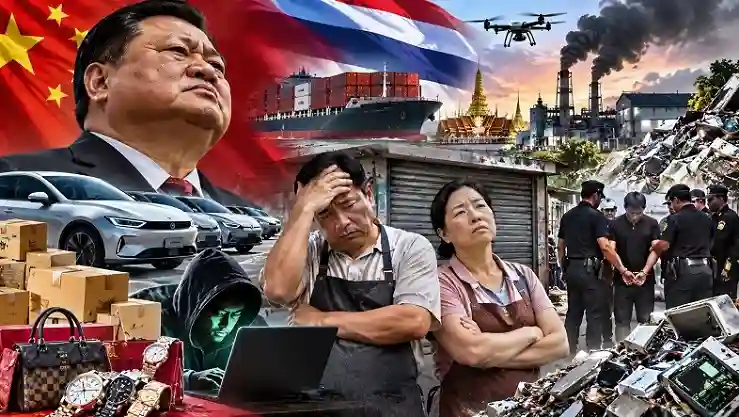
Image Credit: Bangkok Business News
While legitimate Chinese investment continues to contribute to Thailand’s economy, the activities of certain operators are raising serious questions about whether existing regulations adequately protect Thai businesses.
For decades, Thailand established itself as one of Southeast Asia’s most successful manufacturing and tourism economies, supported by domestic entrepreneurs and substantial Japanese and Western investment. However, changing global trade conditions, China’s industrial overcapacity, and the expansion of Chinese businesses into Southeast Asia are transforming this economic landscape. As this Bangkok Business News report examines, the growing controversy concerns not merely foreign competition but allegations of illegal commercial activities, unfair pricing, regulatory circumvention, and business practices that threaten the survival of Thai enterprises.
Cheap Chinese Imports Are Crushing Thai Businesses
Thailand’s domestic manufacturers are struggling against a relentless influx of inexpensive Chinese products entering the country through conventional trading channels and international e-commerce platforms.
According to figures cited in the supplied material, Chinese imports increased by more than 31% during the first half of 2026, reaching approximately 2.21 trillion baht, although these figures require independent verification.
Thai businesses producing textiles, plastics, furniture, ceramics, electronics, and household merchandise face competition from Chinese factories benefiting from enormous production capacity and lower manufacturing costs.
Chinese online merchants can also sell directly to Thai consumers, bypassing domestic wholesalers, distributors, and conventional retail outlets.
For smaller Thai enterprises, competing against factory-direct pricing is increasingly difficult.
The consequences extend beyond declining profits. Factory closures, reduced production, and disappearing domestic suppliers threaten employment opportunities and weaken Thailand’s industrial capabilities.
Consumers may initially benefit from lower prices, but the long-term disappearance of local manufacturers could leave Thailand increasingly dependent on imported products.
Chinese Electric Vehicle Companies Disrupt Thailand’s Automotive Industry
Thailand’s automotive industry, traditionally known as the “Detroit of Asia,” is experiencing substantial structural changes following the arrival of major Chinese electric vehicle manufacturers.
Chinese automakers have invested heavily in production facilities, particularly within Thailand’s Eastern Economic Corridor.
These investments offer opportunities for technological modernization and employment, but concerns remain about whether established Thai component manufacturers are receiving sufficient economic benefits.
Electric vehicles generally require fewer mechanical components than conventional gasoline-powered automobiles, reducing demand for certain products manufactured by traditional Thai automotive suppliers.
Some Chinese manufacturers also rely heavily on imported batteries, motors, electronic systems, and affiliated component suppliers.
Consequently, Thai companies that previously supported Japanese and Western automotive manufacturers risk losing business unless they successfully transition into electric vehicle supply chains.
Aggressive discounting by Chinese electric vehicle brands has created additional pressure on dealerships, vehicle resale values, and competing manufacturers.
Without stronger local sourcing requirements and meaningful technology transfers, Thailand could become increasingly dependent on foreign-controlled automotive production networks.
Chinese Nationals Working Illegally and Operating Restricted Businesses
One particularly sensitive issue involves Chinese nationals allegedly working without proper authorization or operating businesses in sectors where Thai laws impose foreign ownership and occupational restrictions.
Thailand reserves certain occupations for Thai citizens and requires foreign nationals to obtain appropriate work authorization.
Nevertheless, authorities have investigated suspected violations involving restaurants, retail establishments, tourism operations, construction activities, and other commercial enterprises.
Some foreign operators allegedly use Thai nominees to register companies while retaining effective control over business operations.
Such arrangements can allow foreign-controlled enterprises to compete in sectors where lawful foreign participation is restricted or requires specific approvals.
Unauthorized employment also creates concerns when foreign workers perform occupations legally reserved for Thai nationals.
These practices can undermine compliant Thai entrepreneurs, reduce employment opportunities, and weaken confidence in regulatory enforcement.
Importantly, these allegations concern particular individuals and businesses rather than Chinese nationals generally. Many Chinese investors and employees operate legally and contribute to Thailand’s economy.
The issue is whether Thai authorities can consistently enforce employment and ownership regulations without discrimination or preferential treatment.
Counterfeit Chinese Merchandise Damages Legitimate Enterprises
Counterfeit products represent another significant challenge for Thailand’s commercial sector.
Fake branded clothing, cosmetics, electronics, automotive components, luxury accessories, and other merchandise continue to appear in physical markets and online marketplaces.
The supplied material reports that authorities confiscated more than 1.8 million counterfeit products across 512 enforcement cases between January and July 2026, representing estimated economic damage exceeding 809 million baht.
These reported figures have not been independently confirmed.
Counterfeit merchandise deprives legitimate businesses of revenue while exposing consumers to potentially unsafe or defective products.
Fake automotive components and cosmetics are particularly concerning because product failures or contamination can create serious health and safety risks.
Online platforms complicate enforcement because sellers can quickly establish replacement storefronts after authorities remove illegal listings.
Persistent intellectual property violations also threaten Thailand’s reputation among international manufacturers and investors seeking reliable legal protections.
Illegal Waste Operations Threaten Thailand’s Environment
Environmental violations linked to suspected foreign-backed industrial operations have generated additional public concern.
Thailand has repeatedly confronted illegal electronic waste processing, hazardous material storage, and improperly managed recycling facilities.
Some suspected operators reportedly use nominee ownership arrangements to establish factories or warehouses while concealing foreign control.
Industrial provinces including Chachoengsao, Chon Buri, and Prachinburi have experienced growing concern over industrial pollution and regulatory enforcement.
The supplied material describes alleged contamination associated with flooding in Prachinburi, although the specific incidents and environmental findings require independent confirmation.
Improperly stored industrial waste can contaminate agricultural land, waterways, and groundwater.
The financial consequences may extend far beyond individual businesses when environmental remediation becomes the responsibility of local communities or taxpayers.
Stronger ownership verification, hazardous waste tracking, and factory inspections are essential to preventing further environmental damage.
Chinese Grey Capital Networks Distort Thailand’s Economy
Thailand’s concerns about Chinese grey capital have become particularly prominent in tourism, real estate, entertainment, and financial services.
The expression generally describes suspected illicit financial networks that use apparently legitimate businesses to conceal proceeds from criminal activities.
Investigations have examined possible connections involving online scams, illegal gambling, money laundering, and nominee-controlled enterprises.
Bangkok, Phuket, and Chiang Mai are among the locations where concerns about foreign-controlled commercial networks have attracted attention.
Certain suspected operations reportedly maintain interconnected businesses, payment systems, and service providers that channel revenue through closely controlled commercial arrangements.
These practices can disadvantage independent Thai businesses and complicate taxation and financial oversight.
However, operating interconnected businesses or using Chinese payment platforms does not itself establish criminal activity.
Investigators must demonstrate actual violations, including fraudulent ownership arrangements, illegal financial transactions, or other prohibited conduct.
Thailand Risks Becoming a Gateway for Trade Circumvention
Potentially more damaging than domestic competition is Thailand’s exposure to international trade investigations involving goods originating in China.
Some exporters have allegedly attempted to avoid Western tariffs by routing merchandise through third countries and misrepresenting its origin.
Thailand’s established manufacturing infrastructure and extensive international trading relationships make it a potentially attractive location for such activities.
However, simply transporting, repackaging, or relabeling Chinese merchandise in Thailand generally does not qualify those products as Thai-origin goods.
Exporters must satisfy applicable rules of origin, which may require substantial manufacturing transformation or specified domestic value addition.
Fraudulent declarations can result in customs investigations, additional tariffs, financial penalties, and shipment seizures.
Widespread violations could also trigger increased scrutiny of legitimate Thai exporters.
That would impose additional compliance costs on domestic manufacturers that have no involvement in unlawful transshipment.
Chinese Drone Shipments Raise International Sanctions Concerns
Thailand’s potential involvement in sensitive technology shipments to Russia presents another serious geopolitical risk.
Trade analyses cited in the supplied material indicate that Russian drone imports from Thailand reportedly increased eightfold during 2025, reaching approximately $125 million.
The material also reports approximately $186 million in Chinese drone exports to Thailand during the same period.
These figures require verification against underlying trade records.
Commercial drones have legitimate civilian applications, including agriculture, infrastructure inspection, mapping, and surveying.
However, certain drones and components can also serve military purposes, potentially bringing transactions within the scope of international export controls.
Companies knowingly facilitating prohibited shipments may face sanctions under applicable laws.
Thailand’s exposure depends on the specific products, intermediaries, destinations, and evidence of wrongdoing.
Nevertheless, allegations involving dual-use technology could intensify scrutiny of Thai-registered trading companies and their international transactions.
Chinese Criminal Gangs Damage Thailand’s Tourism Reputation
The growing presence of Chinese criminal syndicates involved in kidnappings, robberies, theft, extortion, and cross-border scams is further damaging Thailand’s international reputation. Several high-profile cases involving Chinese travelers being abducted or lured into criminal operations have generated alarming publicity overseas, raising serious concerns about visitor safety. Although the exact number of Chinese criminal gangs operating in Thailand remains unclear, these incidents have contributed to declining confidence among Chinese tourists and may also discourage travelers from other countries. With tourism being a major pillar of Thailand’s economy, continued criminal activity and negative international media coverage threaten hotel occupancy, local businesses, tourism revenue, and the country’s image as a safe holiday destination.
Thai Authorities Face Pressure to Protect Domestic Businesses
Prime Minister Anutin Charnvirakul’s administration faces growing pressure to strengthen commercial enforcement while preserving Thailand’s important economic relationship with China.
The supplied material describes intensified customs inspections, corporate ownership investigations, financial monitoring, and efforts to strengthen country-of-origin verification.
Authorities are also reportedly examining large numbers of suspected nominee companies.
Effective enforcement requires coordination between customs officials, immigration authorities, labor inspectors, commercial regulators, and financial investigators.
Greater transparency over beneficial ownership could help expose companies established specifically to circumvent foreign business restrictions.
Stronger workplace inspections could protect occupations reserved for Thai nationals while ensuring that legally employed foreign workers are treated fairly.
Industrial policy must also encourage foreign manufacturers to develop Thai suppliers, purchase locally produced components, and transfer technical expertise.
Thailand cannot afford to discourage legitimate international investment. However, neither can it allow unlawful commercial activities to undermine domestic businesses and public confidence.
Thailand Must Act Before More Businesses Disappear
Thailand’s economic future depends on whether authorities can distinguish productive foreign investment from illegal operations and unfair commercial practices. Chinese investment remains important, but allegations involving nominee businesses, unauthorized employment, environmental violations, counterfeit merchandise, and trade circumvention demand consistent investigation and enforcement. Protecting Thai entrepreneurs, strengthening domestic supply chains, and preserving access to Western export markets will require sustained regulatory action rather than temporary crackdowns. Without effective safeguards, Thailand risks losing valuable manufacturing capabilities, employment opportunities, and economic independence.


