


What To Know
- Are government agencies presenting selective economic indicators to create an impression of recovery that is stronger than the underlying reality.
- The issue is not simply whether published economic figures are accurate, but how those figures are selected, interpreted, and communicated to the public.
Thailand’s economic recovery is facing growing scrutiny over whether optimistic government announcements accurately reflect conditions experienced by businesses and households. While official statements frequently highlight improving tourism, investment prospects, consumer activity, and economic stimulus initiatives, the wider picture remains complicated by household debt, uneven purchasing power, and pressure on smaller businesses. The contrast raises an uncomfortable question: Are government agencies presenting selective economic indicators to create an impression of recovery that is stronger than the underlying reality?
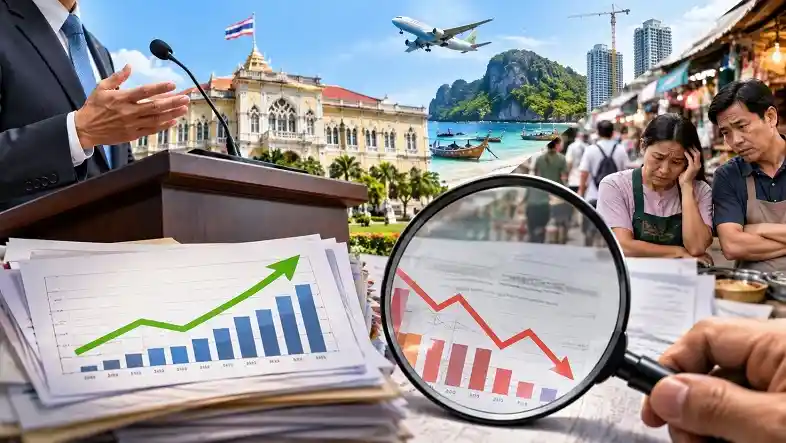
Image Credit: Bangkok Business News
The issue is not simply whether published economic figures are accurate, but how those figures are selected, interpreted, and communicated to the public. Against this backdrop, this Bangkok Business News report examines the distinction between legitimate government promotion and potentially misleading economic messaging, particularly when favorable statistics receive extensive publicity while less encouraging indicators attract comparatively little attention.
When Positive Headlines Conceal Economic Weakness
Economic performance cannot be measured through isolated announcements about visitor arrivals, investment applications, or retail promotions. Tourism revenue, for example, may increase without delivering proportionate benefits to smaller operators, particularly when operating costs rise or spending becomes concentrated among larger businesses.
Similarly, investment applications represent proposed commitments rather than completed projects. Presenting these figures as immediate economic gains risks creating unrealistic expectations about employment, industrial expansion, and future income.
The Difference Between Data and Public Relations
Government agencies have legitimate reasons to promote investment opportunities and communicate economic achievements. Problems emerge when publicity campaigns emphasize favorable comparisons without explaining their limitations.
Year-on-year growth can appear impressive when measured against an unusually weak period. Percentage increases can also conceal disappointing absolute figures, while selective reporting periods may exaggerate apparent improvements.
Such practices do not automatically constitute data manipulation. Establishing deliberate statistical distortion requires documentary evidence, methodological inconsistencies, or independently verified discrepancies.
Nevertheless, selective presentation can influence public perceptions even when individual figures remain technically correct.
Businesses Need Evidence, Not Optimistic Narratives
For Thai businesses, economic confidence depends on actual sales, financing conditions, customer spending, and sustainable profitability.
A rise in tourism arrivals means relatively little to an operator experiencing declining margins. Likewise, announcements about expanding investment pipelines offer limited reassurance to manufacturers facing weak orders or restricted access to credit.
Independent economists, industry associations, and journalists therefore have an important responsibility to examine whether official claims are supported by broader economic indicators.
Greater transparency around data collection, statistical revisions, and reporting methodologies would also help distinguish genuine improvements from promotional interpretations.
Credibility Could Become the Bigger Economic Risk
Thailand needs credible economic communication as much as it needs stronger growth. Government agencies should be able to celebrate genuine progress, but public confidence suffers when optimistic narratives appear disconnected from everyday commercial realities.
There is currently insufficient evidence presented here to establish that Thai agencies have deliberately falsified economic data. However, selective messaging deserves rigorous scrutiny because misleading impressions can undermine business planning, investor confidence, and public trust.
Ultimately, a recovery measured through transparent, independently verifiable results will carry considerably greater credibility than one promoted through favorable headlines alone.


