


What To Know
- A worsening cargo backlog at Thai Airways’ warehouse at Bangkok’s Suvarnabhumi Airport has triggered urgent discussions among airport authorities, freight operators, and logistics associations, as hundreds of pallets remain stranded and businesses struggle to retrieve shipments.
- At the center of the disruption is a malfunctioning cargo management process that has left warehouse personnel unable to identify the precise storage locations of incoming shipments.
A worsening cargo backlog at Thai Airways’ warehouse at Bangkok’s Suvarnabhumi Airport has triggered urgent discussions among airport authorities, freight operators, and logistics associations, as hundreds of pallets remain stranded and businesses struggle to retrieve shipments. The disruption is raising concerns about Thailand’s air freight efficiency during the crucial year-end trading season.
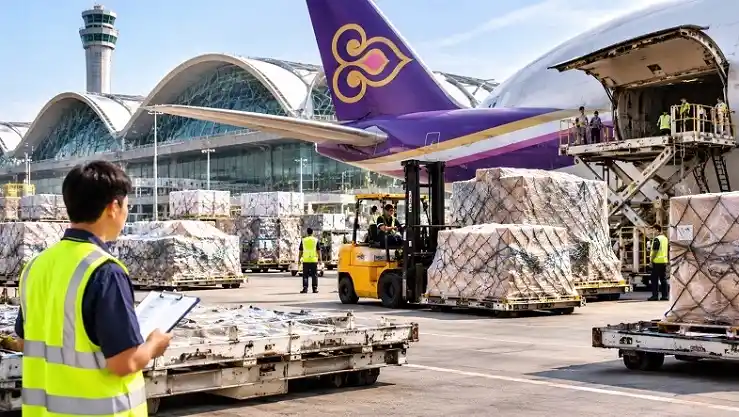
Image Credit: Bangkok Business News
According to sources at the ariport, more than 1,000 cargo lots are awaiting release, while approximately 700–800 pallets remained unpacked. As highlighted in this Bangkok Business News report, the problem extends beyond warehouse congestion, exposing weaknesses in cargo tracking systems that are preventing shipments from reaching importers, manufacturers, and other customers.
Missing Cargo Locations Fuel Warehouse Chaos
At the center of the disruption is a malfunctioning cargo management process that has left warehouse personnel unable to identify the precise storage locations of incoming shipments.
The Thai Airfreight Forwarders Association (TAFA) reported that the AOT Cargo Clearhouse system, developed by Airports of Thailand (AOT) and Thai Airways, was not displaying shipment statuses and storage locations correctly.
Consequently, freight forwarders and customs brokers have struggled to complete payment and release procedures, even when shipments have already arrived at Suvarnabhumi.
Large quantities of freight also remain on unit load devices, the containers and pallets used aboard aircraft, awaiting unpacking through a process known as cargo breakdown.
The resulting bottleneck has created additional congestion outside the warehouse in the airport’s free zone, where trucks and logistics personnel face uncertainty over collection times.
Airport Authorities Convene Emergency Discussions
AOT has coordinated discussions involving Suvarnabhumi Airport officials, Thai Airways’ cargo division, Bangkok Flight Services, the Customs Department, transport associations, and the Thai National Shippers’ Council.
The meetings aim to identify immediate operational solutions while preventing further deterioration as cargo volumes increase during the peak shipping season.
Although earlier flooding has subsided and Thai Airways has resolved previous baggage handling disruptions, flight delays, and cancellations, warehouse congestion remains a significant operational challenge.
TAFA acknowledged some improvements in cargo releases but warned that the overall situation remained serious.
Thai Airways Deploys More Workers and Technology
Thai Airways has introduced several corrective measures designed to accelerate cargo processing and restore confidence among freight customers.
Beginning November 1, the airline increased warehouse personnel and equipment to address accumulated shipments and improve handling capacity.
It also announced plans to install 100 additional Wi-Fi access points throughout the warehouse, strengthening connectivity for cargo processing operations.
A new application will allow employees to scan shipments and record their exact storage locations in real time, potentially reducing the time wasted searching for misplaced consignments.
Priority is being given to shipments that arrived before October 23, although the airline must simultaneously process newly arriving cargo to prevent another accumulation.
Meanwhile, Bangkok Flight Services has introduced a monitoring dashboard linked to its FEMS truck-queue management system.
The dashboard displays vehicle waiting statuses and automatically flags trucks that have remained in the queue for more than two hours.
Freight Forwarders Demand Accountability
TAFA has presented four proposals intended to restore operational efficiency and protect affected businesses.
First, the association wants Thai Airways’ cargo division to issue a formal explanation and apology for the delays. Such documentation would help freight forwarders explain disruptions to customers, including factories and smaller importers.
Second, TAFA is demanding accurate updates to cargo classified under the “F2” status, which indicates shipments awaiting breakdown.
Once unpacked, consignments should have their actual storage locations recorded immediately in AOT Cargo Clearhouse.
This would prevent unnecessary truck journeys and reduce additional expenses incurred when customers arrive to collect unavailable shipments.
Third, the association has proposed establishing a centralized command center or dedicated communication channel connecting Thai Airways with freight agents.
Such coordination would allow problems involving individual shipments to be identified and resolved more quickly.
Industry Warns Against Blanket Cargo Restrictions
TAFA’s fourth proposal addresses the possibility of temporarily restricting selected incoming shipments if congestion becomes unmanageable.
However, the association strongly opposes a blanket cargo embargo, warning that widespread restrictions could inflict substantial economic damage.
It recommends maintaining normal acceptance of essential factory raw materials, perishable goods, and express shipments while considering selective limitations on non-urgent imports.
The distinction is particularly important for manufacturers dependent on timely deliveries to maintain production schedules.
Pressure Mounts to Restore Normal Operations
The continuing disruption underscores how weaknesses in warehouse tracking and communication can undermine an otherwise functioning air cargo network.
For Thai Airways and airport authorities, clearing the backlog will require more than additional manpower. Reliable shipment visibility, coordinated decision-making, and transparent communication will be essential to rebuilding customer confidence.
With peak-season demand continuing, the effectiveness of these corrective measures will determine how quickly Suvarnabhumi restores normal cargo operations and limits further disruption to Thailand’s trade and manufacturing supply chains.


