


What To Know
- Expanding investment in advanced manufacturing, developing skilled workers, and helping smaller businesses participate in technology-driven industries could reduce dependence on a limited number of export categories.
- Without stronger industrial diversification, improved competitiveness, and broader participation in emerging industries, the country could struggle to translate export success into sustainable economic prosperity and meaningful improvements in household incomes.
Thailand’s export industry faces a potentially difficult year in 2027, with economists warning that the impressive growth recorded throughout 2026 could lose considerable momentum. Rising international trade barriers, uncertainty surrounding American tariff policies, geopolitical tensions, and changing global demand for electronics threaten to weaken one of the kingdom’s most important economic engines.
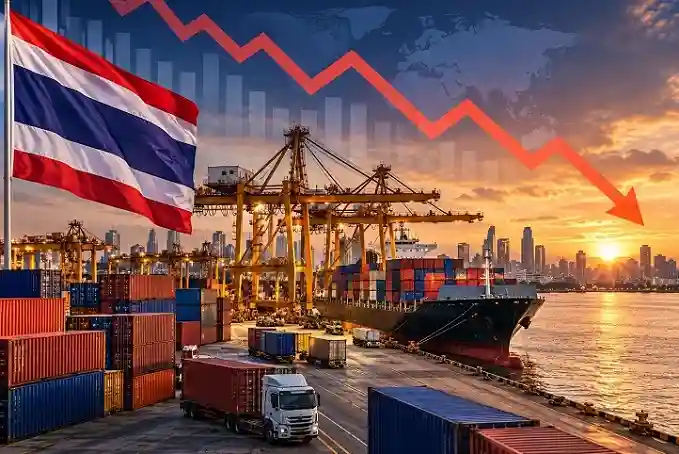
Image Credit: Bangkok Business News
According to projections from the University of the Thai Chamber of Commerce (UTCC), Thai exports could expand by 17.8% in 2026 before slowing sharply to just 7.4% in 2027. The findings highlighted in this Bangkok Business News report suggest that businesses benefiting from this year’s export boom may encounter substantially tougher trading conditions as international economic pressures intensify.
Export Growth Expected to Lose Momentum
The anticipated slowdown represents a decline of 10.4 percentage points in annual export growth, raising concerns about Thailand’s ability to maintain its recent trade performance.
Although exports are still expected to increase in 2027, the considerably slower expansion could affect manufacturers, logistics providers, agricultural exporters, and businesses dependent on overseas customers.
Thailand’s export performance has been particularly strong in technology-related industries. However, economists caution that this growth has become increasingly concentrated in a relatively narrow group of products and international markets.
Electronics Boom May Be Difficult to Sustain
Electronics have emerged as a major contributor to Thailand’s export expansion, supported by international investment in artificial intelligence, semiconductor technologies, and data centers.
SCB Economic Intelligence Center reported that Thai electronics exports surged 67.8% year-on-year in July 2026, helping lift overall monthly exports by 21.6%.
Nevertheless, this dependence creates vulnerabilities. Any moderation in global technology investment or weaker demand for electronic components could significantly affect Thailand’s export earnings.
The Bank of Thailand has similarly warned that merchandise export growth could decelerate during 2027 as international demand for technology-related products loses momentum.
American Tariffs and Geopolitical Tensions Add Pressure
Uncertainty surrounding United States trade policies represents another significant challenge.
Additional tariffs, stricter scrutiny of transshipment practices, and restrictions affecting products manufactured through international supply chains could undermine the competitiveness of Thai exporters.
Meanwhile, geopolitical instability in the Middle East continues to threaten shipping operations, energy prices, and international trade routes.
Disruptions around the Strait of Hormuz could increase transportation and production expenses, particularly for manufacturers dependent on imported fuel and raw materials.
These pressures could prove especially damaging for smaller exporters operating with limited financial reserves.
Strong Exports Are Not Benefiting Every Business
Despite Thailand’s impressive export figures, economists have identified growing disparities between technology-oriented industries and traditional businesses.
SCB EIC warned that export expansion increasingly depends on imported components, meaning higher overseas sales do not necessarily translate into equivalent gains in domestic employment or household income.
Small and medium-sized enterprises remain particularly vulnerable because of financing constraints, weaker purchasing power, and intensifying international competition.
The Bank of Thailand expects economic growth to moderate from 2.3% in 2026 to 1.8% in 2027, reinforcing concerns about the broader economy’s resilience.
Thailand Faces an Important Economic Test
Thailand’s ability to navigate the expected slowdown will depend partly on diversifying export markets, improving industrial competitiveness, and strengthening domestic supply chains.
Expanding investment in advanced manufacturing, developing skilled workers, and helping smaller businesses participate in technology-driven industries could reduce dependence on a limited number of export categories.
Although the projected 7.4% export increase still represents positive growth, the substantial deceleration underscores the risks facing Thailand’s trade-dependent economy. Without stronger industrial diversification, improved competitiveness, and broader participation in emerging industries, the country could struggle to translate export success into sustainable economic prosperity and meaningful improvements in household incomes.
References:
https://www.krungsri.com/th/research/macroeconomic/monthly-bulletin/bulletin-20261019
https://www.scbeic.com/en/detail/product/trade-020926
https://www.bot.or.th/en/thai-economy.html
https://www.utcc.ac.th/services/


