


What To Know
- Global finance ministers and central bank governors gather at the Queen Sirikit National Convention Center in Bangkok for the 2026 IMF-World Bank Annual Meetings, marking a historic return to the region thirty years after the Asian Financial CrisisImage Credit.
- For the Thai government, this week is a triumphant validation of their long-term economic restructuring, proving that the kingdom is an indispensable anchor of stability in the ASEAN region.
A massive financial migration is underway as the global economic center of gravity shifts entirely to Southeast Asia this week. The global economy stands at a critical juncture, fractured by stubborn inflation, fracturing supply chains, and escalating geopolitical realignments. Against this volatile backdrop, the world’s most powerful economic arbiters are gathering under one roof to map out the future of international finance, global trade, and cross-border monetary policy.
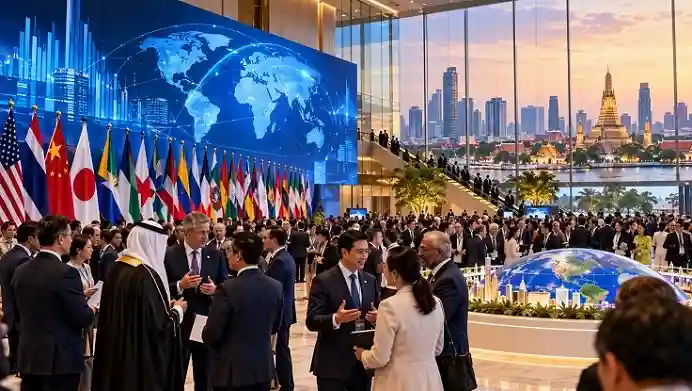
Image Credit: Bangkok Business News
As over 15,000 global finance leaders, central bank governors, and corporate CEOs touch down in the capital, local editorial boards are kicking into overdrive. The latest headlines across Bangkok Business News are entirely dominated by the immense security apparatus, the logistical feats, and the high-stakes policy agendas taking over the city. From October 12–18, 2026, the Queen Sirikit National Convention Center (QSNCC) transforms into the epicenter of global wealth, hosting the highly anticipated 2026 International Monetary Fund (IMF) and World Bank Group Annual Meetings.
The 30-Year Ghost: From IMF Rescue to Global Host
The decision to host the 2026 summit in Thailand carries an extraordinary amount of historical poetry and economic irony. Exactly thirty years ago, in 1997, Bangkok was the flashpoint for a devastating financial contagion that tore through developing markets. The collapse of the Thai Baht triggered the infamous Asian Financial Crisis, a systemic meltdown that forced the nation to accept a humiliating multi-billion-dollar IMF bailout, accompanied by strict, painful economic austerity measures.
Three decades later, the narrative has completely flipped. Thailand is no longer a vulnerable patient on the IMF’s operating table; it is the confident, affluent host steering the conversation for the rest of the developing world. The transformation of Bangkok from a bankrupt regional market into a hyper-modernized financial and technological powerhouse serves as a case study in macroeconomic resilience. For the Thai government, this week is a triumphant validation of their long-term economic restructuring, proving that the kingdom is an indispensable anchor of stability in the ASEAN region.
The Viral Twist: Why the US Treasury Secretary Bailed
Yet, just as the final preparations were being locked in, a major diplomatic bombshell shattered the summit’s carefully curated prelude. In a surprising political twist that sent shockwaves through international ministries, the newly appointed US Treasury Secretary, Scott Bessent, abruptly announced he would be skipping the Bangkok meetings entirely. Citing pressing, urgent domestic engagements in Washington, the face of American economic policy opted out of the year’s most critical multilateral financial gathering.
The fallout from this sudden cancellation was instantaneous. Behind closed doors at the QSNCC, delegates and geopolitical analysts are intensely speculating on what this means for US foreign policy priorities. Bessent’s absence is being viewed by many as a troubling signal that the United States may be turning inward, prioritizing domestic fiscal gridlock over multilateral engagement in Asia. With global trade tensions simmering, the empty seat at the American delegation table leaves a massive power vacuum—one that rival economic superpowers are eager to exploit during bilateral negotiations throughout the week.
Managing a Fragmented World at the QSNCC
The empty chair of the US Treasury Secretary only amplifies the immense challenges facing IMF Managing Director Kristalina Georgieva and World Bank President Ajay Banga. The official agenda for the 2026 meetings reads like a catalog of global anxieties. Delegates are stepping into meeting rooms burdened by a fractured global economy where growth is slowing to a sluggish 2.6% and global bond markets are in a state of severe whiplash.
A primary focus of the summit will be navigating the financial fallout of escalating Middle Eastern conflicts, which have driven crude oil prices to a volatile $104 a barrel. Central bank governors from Europe to Latin America are arriving with data showing how these energy spikes are threatening to trigger a secondary wave of global inflation. At the same time, the US 10-year Treasury yield has surged to a staggering 5.34%, squeezing liquidity out of emerging markets and making sovereign debt repayment dangerously expensive for developing nations.
The QSNCC meet will serve as a pressure cooker where leaders must negotiate debt relief frameworks before a widespread default crisis takes root.
The “Bangkok Blueprint”: Showcasing the Digital Future
Despite the heavy macro shadows, the summit provides Thailand with an unparalleled stage to pitch itself as a premier destination for next-generation capital. The Thai delegation plans to aggressively market its newly minted $11.7 billion industrial alliance with Japan and its national semiconductor strategy.
Delegates walking the halls of the convention center will be introduced to the “Bangkok Blueprint,” a master plan showcasing how the country is using hyper-scale AI data centers and digital infrastructure to insulate itself from traditional market downturns.
To make an impression on the visiting central bank governors, local organizers are actively demonstrating Thailand’s leadership in grassroots financial technology. The country is showcasing advanced financial AI assistants like Nok Krasip, which are already being utilized by millions of local street vendors and small-and-medium enterprises (SMEs) across the city to manage cash flow and bridge digital banking gaps. By blending high-stakes macroeconomic policy with real-world technological innovation, Bangkok is out to prove that it is no longer just a tropical destination, but a vital architect of the future digital economy.



