


What To Know
- While the influx of foreign capital is helping to strengthen manufacturing, expand industrial production and attract advanced technologies, it is also raising difficult questions over land ownership, regulatory oversight, rising property prices and whether Thailand is receiving sufficient long-term benefits from the investment boom.
- This Bangkok Business News report finds that Chinese investors have steadily increased their presence in industrial estates across the country, with their market share climbing from just 6 percent in 2019 to more than 17 percent during the first quarter of 2026, making China the second-largest investor group after Japan.
Bangkok Business News: Thailand’s Eastern Economic Corridor (EEC), long promoted as the country’s flagship investment and industrial development zone, is experiencing an unprecedented wave of Chinese investment that is transforming its economic landscape. While the influx of foreign capital is helping to strengthen manufacturing, expand industrial production and attract advanced technologies, it is also raising difficult questions over land ownership, regulatory oversight, rising property prices and whether Thailand is receiving sufficient long-term benefits from the investment boom. Increasing numbers of industry observers now warn that without stronger safeguards, parts of the EEC could gradually evolve into what some describe as a “Mini China,” where foreign-controlled supply chains dominate large sections of the industrial economy.
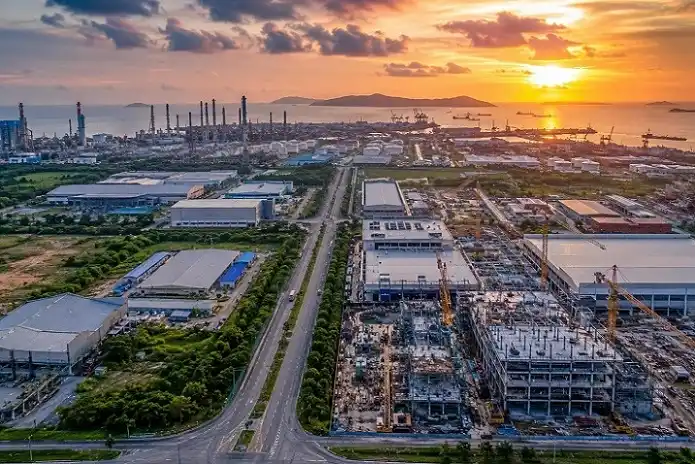
Image Credit: Bangkok Business News
The rapid expansion of Chinese investment has become one of the defining features of Thailand’s industrial property market during the past several years. This Bangkok Business News report finds that Chinese investors have steadily increased their presence in industrial estates across the country, with their market share climbing from just 6 percent in 2019 to more than 17 percent during the first quarter of 2026, making China the second-largest investor group after Japan. Much of this activity is concentrated within the EEC provinces of Chonburi, Rayong and Chachoengsao, where demand for factory sites has accelerated dramatically as manufacturers relocate production capacity amid continuing geopolitical uncertainty and global supply-chain diversification.
Chinese Capital Drives Land Boom
The strongest impact has been felt in Chonburi and Rayong, where industrial land prices have risen by between 20 and 30 percent over the past two years. Industry sources say major Chinese investors have aggressively purchased large land parcels both inside officially designated industrial estates and in surrounding areas suitable for future industrial expansion.
Developers and brokers linked to Chinese investors have reportedly assembled extensive land banks covering thousands of rai before gradually developing and selling plots to other Chinese businesses seeking manufacturing bases in Thailand. The practice has intensified competition for industrial land while placing considerable upward pressure on prices, making expansion increasingly difficult for many domestic companies.
According to market data, industrial land in Chonburi now averages around 9.5 million baht per rai, while Rayong averages approximately 7.5 million baht per rai and Chachoengsao around 7.75 million baht per rai. At the same time, vacancy rates within industrial estates have continued to decline, reflecting sustained demand despite ongoing global economic uncertainty.
Rising Questions Over Economic Benefits
Although foreign direct investment is widely recognized as an important engine of economic growth, some industry representatives question whether Thailand is fully benefiting from every investment project.
Particular concern surrounds so-called “zero-dollar” investment models, where Chinese-funded factories reportedly rely almost entirely on imported construction materials, machinery, labour, suppliers and logistics from China. Critics argue that such arrangements generate limited spending within Thailand, reducing opportunities for local contractors, manufacturers and service providers while weakening economic multiplier effects.
Business groups also point to the growing use of integrated Chinese supply chains that minimise procurement from Thai enterprises. If these practices continue to expand, some economists fear the country’s industrial growth could become increasingly dependent upon foreign-controlled production ecosystems rather than encouraging wider domestic participation.
Nominee Concerns and Escalating Property Costs
Another issue drawing attention involves allegations that some investors may be using Thai nominee companies established through legal or accounting firms to acquire land. While authorities continue to examine such cases, industry observers argue that stronger enforcement is required to ensure compliance with Thai law.
The surge in foreign demand has also contributed to rapidly rising rental costs. In some commercial districts, rental rates have reportedly increased several times over previous levels, while industrial land values have surged sharply. Many smaller Thai businesses say they can no longer compete with well-funded foreign buyers, forcing some entrepreneurs to postpone expansion plans or exit strategic locations altogether.
Industrial groups under the Federation of Thai Industries have also warned that between 22 and 25 of Thailand’s 46 industrial sectors face increasing competitive pressure, with electrical appliances, construction materials and steel manufacturers among those reporting the greatest challenges.
Hengtu Industrial Park Under Scrutiny
One of the highest-profile developments attracting attention is the proposed Hengtu Industrial Park in Bo Thong district of Chonburi Province.
Although the company operates as a real estate brokerage business with registered capital of five million baht, reports indicate it has accumulated land covering around 1,000 rai, with wider holdings potentially reaching 5,000 rai. The project has reportedly sought infrastructure support, including electricity demand estimated at approximately 300 megawatts—comparable to requirements for major industrial estates—as well as significant water resources for future industrial operations.
However, questions have emerged because the project area falls within land classified under the EEC’s “light yellow” zoning category, designated primarily for rural communities, local economic activity and residential development rather than large-scale industrial operations.
Industry sources argue that current zoning regulations restrict industrial estate development in such areas and prohibit activities likely to create significant environmental or public health impacts. These concerns have prompted calls for greater transparency regarding planning approvals, environmental assessments and regulatory compliance before large-scale development proceeds.
Authorities Stress Legal Compliance
Thailand’s Board of Investment (BOI) has emphasized that investment promotion privileges do not exempt companies from complying with other laws governing land use, zoning, environmental protection and factory licensing.
BOI Secretary-General Narit Therdsteerasukdi has clarified that while Chinese investors remain among Thailand’s most significant foreign investors, the Hengtu Industrial Park itself has not received BOI investment promotion. He also stressed that industrial estate development must satisfy all legal requirements and obtain approvals from relevant government agencies before operations can commence.
Authorities further noted that companies receiving BOI incentives gain only specific investment benefits, such as exemptions on import duties for machinery and selected materials, and must continue to comply fully with all other applicable legislation.
Investment Continues Expanding
Despite growing scrutiny, Chinese investment continues to expand across Thailand’s strategic industries.
Between 2021 and September 2025, Chinese investors submitted nearly 2,450 BOI investment applications worth more than 608 billion baht. During 2025 alone, applications reached almost 1,000 projects valued at over 172 billion baht, contributing significantly to Thailand’s record foreign investment levels.
The strongest investment has been concentrated in electrical appliances, electronics, metals, automotive components and next-generation manufacturing. Major Chinese companies are also helping establish Thailand’s electric vehicle ecosystem through investments in battery production, automotive assembly and supporting supply chains.
Beyond manufacturing, Chinese investment is increasingly targeting semiconductors, advanced electronics, digital technology, artificial intelligence, cloud computing, data centres and projects supporting Thailand’s Bio-Circular-Green Economy strategy. Government officials believe these investments can strengthen Thailand’s competitiveness while positioning the country more prominently within global technology supply chains.
To facilitate future investment, the BOI has introduced programmes such as Thailand FastPass for high-value technology projects and expanded its investment offices across China, including Beijing, Shanghai, Guangzhou and a planned office in Chengdu.
Protecting Long-Term National Interests
Thailand’s challenge is no longer whether to welcome foreign investment but how to ensure it delivers balanced and sustainable benefits for the country. Chinese investment has undoubtedly accelerated industrial development, generated employment opportunities, introduced advanced technologies and strengthened Thailand’s manufacturing base. Yet the accompanying concerns over land accumulation, nominee structures, closed supply chains, zoning compliance and rising property prices demonstrate that economic growth alone cannot be the sole measure of success. Policymakers increasingly face the task of balancing investment promotion with effective regulatory oversight that protects national interests, supports Thai entrepreneurs and preserves fair competition. Industry stakeholders argue that stronger monitoring, greater transparency and stricter enforcement of existing laws will be essential if Thailand is to avoid excessive dependence on any single source of foreign capital while maintaining investor confidence. The long-term success of the Eastern Economic Corridor will ultimately depend not only on attracting billions of baht in investment but also on ensuring that the resulting prosperity is broadly shared throughout the Thai economy rather than concentrated within isolated foreign-controlled industrial networks.
For the latest developments in the business sector in Thailand, keep on logging to Bangkok Business News.



