


What To Know
- In the middle of growing concern over Thailand’s economic direction, this Bangkok Business News report examines the key forces driving the widening gap and why many analysts believe the situation could worsen in the coming months.
- The widening imbalance has been largely driven by a flood of Chinese products entering Thailand and the wider ASEAN market after Chinese exports to the United States contracted sharply amid continuing trade tensions.
Bangkok Business News: Thailand’s economy has been hit by a historic trade imbalance after the country posted a record trade deficit of US$10.021 billion in April 2026, reflecting mounting pressure from soaring oil prices, an influx of Chinese imports and rising production costs across multiple industries. Despite another strong month for exports, the rapid increase in imports has exposed growing vulnerabilities within the Thai economy and intensified concerns among economists and business leaders.
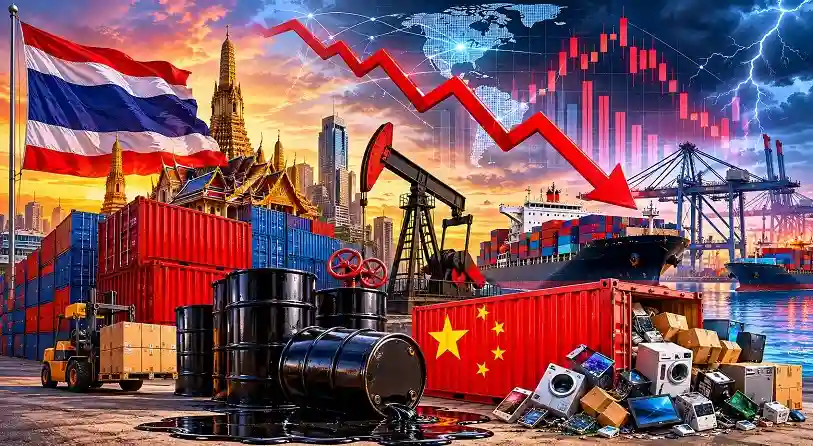
Image Credit: Bangkok Business News
According to figures released by the Ministry of Commerce, Thailand’s exports in April reached US$31.583 billion, representing a strong 23.1% increase from the same period last year and marking the 22nd consecutive month of export growth. However, imports surged by an even sharper 45% to US$41.604 billion, pushing the country into its largest monthly trade deficit on record. In the middle of growing concern over Thailand’s economic direction, this Bangkok Business News report examines the key forces driving the widening gap and why many analysts believe the situation could worsen in the coming months.
Excluding oil-related products, military goods and gold, exports still expanded by an impressive 25.7%, underlining the continued strength of Thailand’s manufacturing and export sectors. Electronics, automobiles, electrical appliances, integrated circuits, and gems and jewellery remained major contributors to export growth as global buyers accelerated orders amid fears of supply-chain disruptions and higher future costs linked to geopolitical instability.
For the first four months of 2026, Thai exports rose 18.9%, while imports jumped 35.7% to US$147.250 billion. This left Thailand with a cumulative trade deficit of US$19.497 billion between January and April, a sharp deterioration compared to previous years.
Fuel imports become a major burden
One of the biggest contributors to the trade deficit was Thailand’s soaring energy import bill. Fuel imports in April reached US$8.389 billion, representing a dramatic 128.6% increase year-on-year as crude oil prices surged following escalating tensions in the Middle East.
Thailand remains heavily dependent on imported energy, relying on overseas suppliers for nearly 95% of its oil consumption. Around 60% of those imports come from the Middle East, making the Thai economy highly vulnerable to geopolitical conflict in the region. The country also imports significant amounts of natural gas, accounting for approximately 30% of domestic demand.
Commerce officials stated that rising oil prices had become a critical factor behind the unprecedented import surge. They explained that even if import volumes remained relatively stable, the sharp increase in global crude prices significantly inflated the total value of imports.
Beyond fuel, imports of capital goods climbed 32.8% to US$10.384 billion, while raw materials and semi-finished goods rose 38.7% to US$17.607 billion. Consumer goods imports increased 13% to US$3.490 billion, while vehicle and transport equipment imports rose 15%.
Analysts noted that imports of machinery, printed circuit boards and integrated circuits reflected stronger production demand linked to global technology cycles. However, they also warned that Thailand’s growing reliance on imported industrial components was deepening external vulnerabilities.
China trade imbalance raises alarm
Thailand’s trade relationship with China has become another major source of concern for policymakers and domestic businesses. In April alone, Thailand recorded a trade deficit with China worth US$7.680 billion. During the first four months of the year, the cumulative deficit with China expanded to US$29.202 billion.
The widening imbalance has been largely driven by a flood of Chinese products entering Thailand and the wider ASEAN market after Chinese exports to the United States contracted sharply amid continuing trade tensions. Experts estimated that Chinese shipments to the US had declined by between 40% and 50%, forcing Chinese manufacturers to redirect goods into Southeast Asia.
Electrical machinery, mechanical equipment and industrial components were among the largest categories imported from China. While these imports support Thailand’s manufacturing supply chains, they are also intensifying competition for local businesses, particularly small and medium-sized enterprises already struggling with rising energy and operating costs.
Economists warned that many Thai businesses may increasingly choose to import products for resale rather than manufacture goods domestically because of cost pressures. Others fear that smaller producers could eventually be forced out of the market altogether.
In contrast to its position with China, Thailand continued to post a strong trade surplus with the United States. The surplus reached US$4.648 billion in April and US$21.519 billion for the first four months of the year.
Export outlook remains uncertain
Despite the record deficit, the Ministry of Commerce still believes Thai exports can continue expanding throughout 2026, although officials acknowledged that significant risks remain.
The ministry’s forecast for export growth this year ranges from a contraction of 3% to expansion of 8%, reflecting uncertainty surrounding geopolitical tensions, freight costs and global demand. Under the ministry’s base-case scenario, exports are expected to grow by 3% to approximately US$349.824 billion.
However, officials admitted that achieving the optimistic scenario would depend heavily on exporters and shipping operators being able to adapt quickly to rising costs and ongoing instability in international markets.
Among the biggest concerns are elevated sea freight rates, uncertainty surrounding the Strait of Hormuz and worsening drought risks linked to El Niño, which could damage agricultural production during the second half of the year.
Calls intensify for urgent restructuring
Business leaders and economists are now urging the Thai government to accelerate reforms aimed at reducing dependence on imported energy and foreign goods.
Several experts called for stricter controls on imports, tighter inspections of goods claiming Thai origin and stronger measures to prevent unfair competition from low-cost foreign products. Others argued that foreign direct investment projects operating in Thailand should be required to source more raw materials and products locally in order to strengthen domestic supply chains.
There have also been growing calls for Thailand to diversify its energy sources away from the Middle East by seeking additional supplies from Russia, Africa and Central Asia while simultaneously investing more aggressively in renewable energy.
Many analysts believe the current trade deficit reflects deeper structural problems that have been developing over the past decade. While Thailand has frequently experienced deficits linked to imported goods, the sharp increase in oil prices during 2026 has magnified those pressures dramatically and exposed how vulnerable the economy remains to external shocks. Economists warned that unless decisive reforms are implemented soon, Thailand could face prolonged trade imbalances, weaker industrial competitiveness and greater financial pressure on households and businesses alike.
References:
https://uploads.tpso.go.th/editor/pdf/1779681360_6d8199658b77798d50ec.pdf
https://tradereport.moc.go.th/en
https://tradereport.moc.go.th/en/documentpublish
For the latest on the Thai economy, keep on logging to Bangkok Business News.



