

What To Know
- The controversy intensified following the November 17, 2026, signing ceremony in Manila, where Prime Minister Anutin Charnvirakul and Trump endorsed a joint statement on an Agreement on Reciprocal Trade (ART).
- If Thailand is moving toward eliminating tariffs on a substantial range of American products, accepting greater agricultural competition, and committing to billions of dollars in purchases, what binding concessions has Washington offered in exchange.
Thailand’s latest trade breakthrough with the United States is facing uncomfortable questions after President Donald Trump publicly celebrated sweeping concessions from Thailand, including the proposed elimination of tariffs on American exports and an estimated $2.6 billion in additional agricultural purchases. Yet Thai exporters continue facing American import duties, leaving the government struggling to explain exactly what Thailand has gained from negotiations portrayed as a diplomatic success.

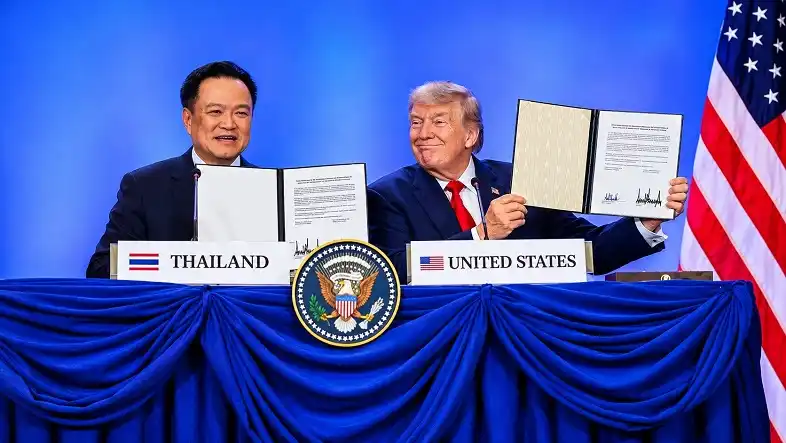
Image Credit: Bangkok Business News
The controversy intensified following the November 17, 2026, signing ceremony in Manila, where Prime Minister Anutin Charnvirakul and Trump endorsed a joint statement on an Agreement on Reciprocal Trade (ART). While officials emphasized stronger economic relations and improved investor confidence, this Bangkok Business News report examines a far more contentious issue: why Thailand appears prepared to offer extensive market access to American suppliers while still negotiating for a reduction in the tariffs imposed on its own exports.
Trump Celebrates While Thailand Faces Difficult Questions
Trump’s description of the prospective agreement as a victory immediately highlighted the contrast between Washington’s confident messaging and Bangkok’s more cautious explanations.
According to Reuters and AFP reporting, the American president announced that Thailand would eliminate tariffs on US exports, remove significant non-tariff barriers affecting American vehicles, medical devices, pharmaceuticals, ethanol, and poultry, and purchase approximately $2.6 billion in additional American agricultural products.
These are substantial proposed concessions, particularly for an economy whose agricultural producers and manufacturers already face intense competition.
However, the document signed in Manila was not the final trade agreement.
The White House’s official statement confirms that negotiations have been substantially concluded but that both governments must still complete the procedures necessary for the agreement’s signature and entry into force.
That distinction is central to the growing controversy.
The ceremony produced a political commitment, not immediate tariff relief for Thai businesses.
Zero Tariffs for America, But Continued Duties for Thailand?
The apparent imbalance has become the most provocative aspect of the negotiations.
Washington has publicly outlined its expectations for expanded access to Thailand’s market, while Bangkok is still seeking better treatment for its exports.
On November 18, Commerce Minister Suphajee Suthumpun confirmed that Thailand would seek to reduce the additional US Section 301 tariff from 12.5 percent to 10 percent.
That reduction has not yet been secured.
The 12.5 percent measure applies to covered Thai-origin products and can be charged in addition to normal import duties. Government officials say exemptions exist for 2,120 product categories, representing more than half the value of Thailand’s exports to the United States.
These details complicate claims that every Thai export faces the same tariff, but they do not eliminate the central concern.
Thailand is discussing extensive concessions while the additional American tariff remains in force on covered goods.
Even the proposed reduction to 10 percent would not establish universally tariff-free access for Thai products.
For businesses expecting genuinely reciprocal treatment, that raises an obvious question: how much market access must Thailand surrender to secure a relatively modest reduction in American duties?
What Exactly Did Suphajee Achieve in Earlier Negotiations?
The scrutiny now extends directly to Commerce Minister Suphajee Suthumpun, who led Thailand’s negotiating team under instructions from Anutin and the Cabinet.
The government has repeatedly emphasized extensive consultations with public agencies, private businesses, and affected industries.
Yet the latest American announcements raise questions about the tangible benefits secured through that process.
If Thailand is moving toward eliminating tariffs on a substantial range of American products, accepting greater agricultural competition, and committing to billions of dollars in purchases, what binding concessions has Washington offered in exchange?
The earlier October 2025 framework already contemplated removing tariffs on approximately 99 percent of American goods. The latest negotiations have therefore not emerged from nowhere; they build upon commitments discussed for more than a year.
Suphajee’s latest objective of reducing the Section 301 tariff to 10 percent suggests that an important element of Thailand’s desired outcome remains unresolved.
That does not establish that the minister failed in negotiations. American tariff policy has also changed substantially during the negotiating period.
Nevertheless, the government owes businesses a detailed account of which concessions were negotiated, which protections were retained, and what improvements were obtained compared with the previous framework.
Thai Farmers Could Pay for Washington’s Agricultural Gains
The agricultural component is especially controversial because it potentially exposes domestic producers to stronger American competition.
According to Bloomberg reporting, Thailand has agreed in principle to open its market to American pork, previously considered a sensitive negotiating issue.
Foreign Minister Sihasak Phuangketkeow acknowledged that Thailand had to make compromises because of the importance of the American market.
The proposed $2.6 billion in additional agricultural purchases also includes products such as soybeans, some of which could be used by Thai manufacturers producing goods for export.
That distinction matters: not every agricultural import necessarily competes directly with Thai farmers.
However, the potential consequences for pork producers, poultry businesses, ethanol manufacturers, and other domestic industries cannot be dismissed.
Market access provisions could affect prices, competition, production decisions, and rural livelihoods.
The government has indicated that quotas, import limits, and other safeguards may protect sensitive industries, but their precise scope remains undisclosed.
Until those protections are published, farmers have little basis for assessing whether their interests have been adequately defended.
Government Scrambles to Clarify Trump’s Claims
On November 18, Thailand’s Commerce Ministry moved to clarify that the Manila statement does not immediately eliminate tariffs on American imports.
Officials emphasized that existing Thai import duties remain unchanged and that any reductions would depend on the final agreement, individual product schedules, and completion of legal procedures.
The ministry also disputed the impression that every American product would automatically receive duty-free treatment.
These explanations reveal a significant difference between Trump’s sweeping public description and Bangkok’s more qualified interpretation.
That difference deserves attention.
If Washington believes Thailand has committed to comprehensive tariff elimination while Thai officials insist sensitive products will remain protected, the eventual legal schedules must establish which interpretation prevails.
Otherwise, the apparent diplomatic breakthrough could become a source of renewed disagreements.
The government’s clarifications may help address public concerns, but they also reinforce the need for transparency about the concessions actually negotiated.
Thailand’s Dependence on America Weakens Its Bargaining Power
Thailand’s vulnerability stems partly from its reliance on the American market.
The United States accounts for approximately one-quarter of Thailand’s exports, making access to American consumers critically important.
Government figures indicate that Thai exports to the United States generated approximately 2.37 trillion baht in 2025 and supported employment connected to around 1.25 million workers.
Losing competitiveness in that market could therefore carry serious consequences for factories, suppliers, and households.
That dependence helps explain Bangkok’s willingness to compromise.
However, it also raises broader questions about Thailand’s long-term economic strategy.
An economy heavily dependent on one powerful trading partner may find itself repeatedly pressured into accepting unfavorable conditions to preserve existing market access.
The government has indicated that it wants to diversify exports through additional trade relationships, including negotiations with the European Union.
Such diversification could eventually strengthen Thailand’s negotiating position, although it offers little immediate protection against current American tariff measures.
A Diplomatic Victory or an Expensive Compromise?
The next stage of negotiations will determine whether Thailand’s concessions produce meaningful economic returns.
Suphajee has indicated that legal teams could require approximately two months to finalize the agreement, followed by Cabinet consideration, public consultations, and parliamentary procedures.
Implementation could therefore remain several months away.
During that period, Thai exporters will continue operating under the applicable American tariff arrangements, while domestic producers await details about future market opening.
The government can reasonably argue that maintaining access to the United States is essential. It can also point to exemptions covering numerous Thai export categories and the possibility of securing lower duties.
But those arguments do not remove the need to demonstrate that the final agreement is balanced.
The most important issue is not whether Thailand secured a signing ceremony with the American president. It is whether the country obtained sufficient, enforceable benefits in return for the market access and purchasing commitments being discussed.
The Manila announcement has exposed an uncomfortable gap between diplomatic celebration and economic certainty. Washington has publicly identified substantial benefits it expects to receive, while Bangkok is still seeking a reduction in important American tariffs and clarifying which domestic sectors will be protected. Suphajee and Anutin now face the task of demonstrating that their negotiations produced more than promises. Until the final agreement reveals the full balance of concessions, questions about who really benefits will remain difficult for the government to dismiss.