

What To Know
- While a recent surge in share prices has revived investor optimism and attracted billions of dollars in foreign capital, market experts increasingly argue that the rally conceals far deeper structural weaknesses that threaten Thailand’s long-term financial competitiveness.
- To address this gap, the SET has promoted its Board of Investment-to-IPO framework, encouraging foreign companies establishing operations in Thailand—particularly in electric vehicles, semiconductors, renewable energy and data centres—to eventually list on the Thai exchange.
Bangkok Business News: For decades, the Stock Exchange of Thailand (SET) has served as one of Southeast Asia’s principal gateways for domestic and international investment, helping finance the country’s industrialization, infrastructure expansion and corporate growth. Today, however, the exchange finds itself at a critical crossroads. While a recent surge in share prices has revived investor optimism and attracted billions of dollars in foreign capital, market experts increasingly argue that the rally conceals far deeper structural weaknesses that threaten Thailand’s long-term financial competitiveness.

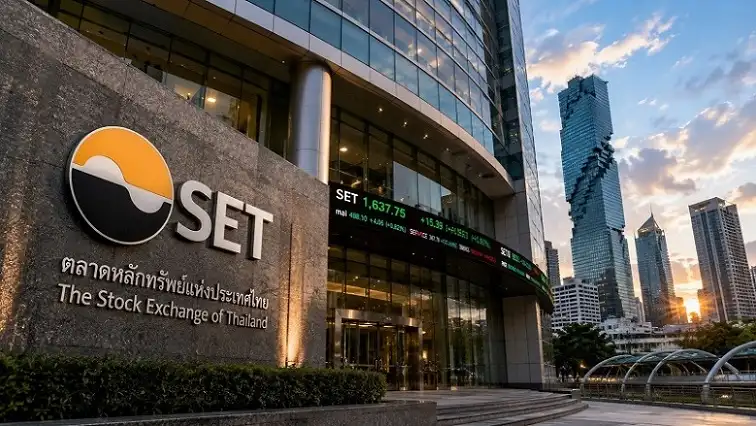
Image Credit: Bangkok Business News
Speaking at the Nikkei Asia Forum APAC 2026 in Bangkok this week, SET President Asadej Kongsiri highlighted the exchange’s impressive 30 per cent rise this year, supported by nearly US$2 billion in net foreign fund inflows following February’s general election. This Bangkok Business News report finds that although renewed investor confidence reflects improved political stability and optimism surrounding government policy, many economists believe the recovery represents only a temporary boost in market sentiment rather than evidence of lasting institutional reform.
Asadej credited the market’s recovery to a more stable political environment and the implementation of long-delayed economic initiatives aimed at stimulating investment and restoring business confidence. His message was straightforward: investors are responding not to promises but to visible policy action.
Yet beneath the encouraging headlines lies a more complicated picture. Many financial analysts contend that Thailand’s stock market continues to struggle with structural inefficiencies, limited market diversification, inconsistent regulatory enforcement and an overreliance on speculative trading. These longstanding issues, they argue, continue to discourage institutional investors seeking stable, transparent and innovation-driven markets.
The timing could hardly be more significant. Thailand is actively pursuing membership of the Organisation for Economic Co-operation and Development (OECD), a milestone that would strengthen the country’s standing among developed economies. Achieving that goal, however, will require more than strong market performance. It demands capital markets built upon transparency, effective regulation, corporate accountability and investor confidence.
From Regional Leader to Intensifying Competition
Thailand emerged from the 1997 Asian Financial Crisis determined to rebuild its financial system. A series of reforms restored confidence and, for several years, positioned the SET among Southeast Asia’s leading exchanges.
However, the competitive landscape has changed dramatically over the past decade.
Singapore has transformed itself into a sophisticated global financial hub offering multiple asset classes and advanced investment products. Japan has revitalized its capital markets through sweeping corporate governance reforms designed to improve shareholder returns and unlock trillions of yen in dormant domestic capital. South Korea continues expanding its technology-driven market, while Vietnam and Indonesia are rapidly modernizing their exchanges to attract both regional and international investors.
Against this backdrop, Thailand’s progress has been comparatively modest.
One of the SET’s biggest structural challenges is its market composition. Banking, energy, manufacturing, telecommunications and commodity companies continue to dominate listed capitalization. While these industries remain vital to the Thai economy, they do not offer the high-growth opportunities increasingly sought by international investors focused on artificial intelligence, biotechnology, semiconductor manufacturing, digital infrastructure and advanced software.
Even Asadej acknowledged during the Nikkei forum that Thailand lacks the “high-growth” technology listings capable of capturing the attention of modern global investment funds.
To address this gap, the SET has promoted its Board of Investment-to-IPO framework, encouraging foreign companies establishing operations in Thailand—particularly in electric vehicles, semiconductors, renewable energy and data centres—to eventually list on the Thai exchange.
While the initiative represents a positive step, market observers question whether it will deliver meaningful results. Many multinational corporations prefer retaining full ownership of overseas subsidiaries rather than floating minority stakes on local exchanges, allowing them greater flexibility over global operations and capital allocation.
Shrinking IPO Pipeline Raises New Concerns
Another emerging challenge is Thailand’s declining pipeline of large-scale initial public offerings.
Compared with regional competitors such as Singapore, Indonesia and India, Thailand has witnessed relatively few headline-grabbing IPOs capable of attracting significant international attention. Indonesia has successfully listed major companies linked to its booming nickel processing and digital economy, while India’s rapidly expanding technology and financial sectors continue generating sizeable new listings that appeal to global investors.
Singapore, meanwhile, has diversified its listing strategy by targeting specialized sectors, including real estate investment trusts, infrastructure funds and international business trusts.
Thailand’s more limited pipeline reduces market dynamism and narrows investment opportunities for both domestic and overseas investors. Without a steady stream of innovative companies entering the market, liquidity becomes increasingly concentrated among established blue-chip corporations, limiting the exchange’s long-term growth potential.
The Speculation Challenge
Despite improvements in market performance this year, trading behavior continues to concern many analysts.
Retail investors account for a substantial proportion of daily trading activity on the SET, making the market considerably more susceptible to rapid swings in sentiment than exchanges supported by larger institutional investor bases.
While retail participation broadens financial inclusion and encourages household investment, excessive dependence on individual investors can also increase volatility. Trading decisions are often influenced by short-term market movements, social media sentiment and speculative opportunities rather than careful analysis of corporate fundamentals.
This dynamic creates an environment where share prices may fluctuate sharply even when underlying economic conditions remain relatively stable.
Institutional investors—including pension funds, insurance companies and sovereign wealth funds—generally favor markets characterized by regulatory certainty, predictable governance and transparent disclosure standards. Their investment horizons typically extend over many years, providing stability that speculative trading cannot.
Thailand has taken important steps to expand its investment ecosystem. The SET and the Securities and Exchange Commission have introduced new financial instruments, including an extensive Depository Receipt programme that allows Thai investors to gain exposure to hundreds of overseas equities.
These initiatives have broadened investment opportunities, yet some analysts argue they have also increased market complexity without fully addressing the structural issues that continue to undermine investor confidence.
Regulatory enforcement remains one of the market’s most persistent concerns. Corporate scandals, accounting irregularities, allegations of market manipulation and disputes involving short-selling practices have periodically shaken confidence among both domestic and international investors.
Where enforcement is perceived to be slow or inconsistent, confidence inevitably suffers.
Long-term institutional capital tends to migrate toward markets where shareholder protections are stronger, penalties for misconduct are imposed swiftly and regulatory independence is beyond question.
Corporate Governance Takes Centre Stage
Strengthening corporate governance has therefore become one of the most pressing priorities facing Thailand’s capital market.
International investors increasingly scrutinize board independence, executive accountability, financial disclosure and minority shareholder protection before committing capital. These factors now carry as much weight as earnings growth or dividend performance.
For Thailand, improving governance is no longer simply a regulatory exercise—it has become an economic necessity.
The Organisation for Economic Co-operation and Development (OECD) has consistently stressed that transparent markets with effective regulatory oversight are fundamental characteristics of advanced economies. As Thailand pursues OECD accession, expectations surrounding the country’s financial institutions are becoming considerably more demanding.
Among the OECD’s recommendations is a clearer separation between the commercial activities of the Stock Exchange of Thailand and its regulatory responsibilities to eliminate potential conflicts of interest. The organization has also called for stronger enforcement powers for Thailand’s Securities and Exchange Commission (SEC), enabling it to investigate misconduct more efficiently and impose timely penalties where appropriate.
Such reforms would not only strengthen investor confidence but also signal that Thailand is committed to operating under internationally recognized standards of transparency and accountability.
ESG Investing Reshapes Global Capital Flows
The global investment landscape has also evolved significantly over the past decade.
Large pension funds, sovereign wealth funds and institutional asset managers increasingly allocate capital according to Environmental, Social and Governance (ESG) principles. While profitability remains essential, investors now examine how companies manage environmental risks, board diversity, labor standards, sustainability reporting and long-term governance.
Markets capable of demonstrating robust ESG frameworks are often rewarded with greater institutional participation and more stable investment flows.
Thailand has made measurable progress in encouraging sustainability reporting among listed companies, with several corporations earning international recognition for their ESG performance. Nevertheless, analysts argue that the broader market still has room to improve disclosure standards, consistency and regulatory oversight to remain competitive with leading financial centers.
As sustainable finance continues expanding worldwide, exchanges that provide investors with confidence in governance and disclosure practices are expected to enjoy a growing competitive advantage.
Competition for Capital Has Intensified
Today’s investors enjoy far more choices than they did a decade ago.
International fund managers can now allocate capital across an expanding range of Asian markets, each competing aggressively to attract global investment.
Singapore continues positioning itself as Southeast Asia’s premier financial gateway, supported by sophisticated regulatory frameworks, diversified investment products and a highly international investor base.
Vietnam has emerged as one of the region’s fastest-growing markets, benefiting from rapid manufacturing expansion, strong foreign direct investment and an increasingly modern regulatory environment.
Indonesia has successfully leveraged its abundant natural resources and downstream industrial strategy to attract billions of dollars into mining, electric vehicle supply chains and industrial processing.
India continues capturing global attention through its rapidly expanding digital economy, vibrant technology sector and one of the world’s most active IPO markets.
Against such formidable competition, Thailand cannot rely solely on its historical reputation or favorable geographic location. Capital flows toward markets that demonstrate innovation, efficiency, transparency and long-term growth potential.
Digital Transformation Is Redefining Modern Exchanges
Global stock exchanges are no longer merely venues for buying and selling shares.
Leading financial centers are investing heavily in artificial intelligence, fintech innovation, blockchain applications, digital assets, cybersecurity and advanced market surveillance systems designed to improve efficiency while detecting market abuse more quickly.
Artificial intelligence now plays an increasingly important role in identifying suspicious trading patterns, monitoring compliance and strengthening investor protection.
Many exchanges are also developing next-generation trading platforms capable of processing larger trading volumes with greater speed and resilience while expanding digital services for listed companies and investors alike.
As financial technology rapidly evolves, Thailand faces growing pressure to modernize its own market infrastructure if it hopes to remain regionally competitive and attractive to future generations of investors.
The Broader Economic Impact
The consequences of a weaker capital market extend well beyond investment portfolios.
Efficient capital markets provide businesses with affordable access to financing, allowing companies to expand operations, develop new technologies and create employment.
When investor confidence weakens, the cost of raising capital typically rises.
Large corporations may postpone investment projects, while small and medium-sized enterprises (SMEs) often face even greater challenges securing the funding needed to innovate and compete internationally.
Reduced investment activity can ultimately slow economic growth, weaken productivity and limit the country’s ability to move into higher-value industries.
For Thailand, whose long-term development strategy increasingly focuses on advanced manufacturing, digital technology, renewable energy and knowledge-based industries, maintaining a vibrant capital market is essential to achieving sustainable economic transformation.
Global Interest Rates Offer Only Temporary Relief
Recent expectations that global interest rates may gradually ease have improved sentiment across many emerging markets, including Thailand.
Lower borrowing costs generally encourage investors to seek higher returns outside developed markets, temporarily supporting equity markets throughout Asia.
However, economists caution that favorable global monetary conditions should not be mistaken for structural competitiveness.
External financial conditions can change rapidly. Sustainable investment ultimately depends on domestic reforms, credible institutions and predictable policy frameworks rather than temporary shifts in international interest-rate cycles.
Markets that combine strong governance with structural reform are generally better positioned to retain investment when global conditions become less favorable.
Lessons from Regional Reform
Thailand’s regional competitors provide valuable examples of how strategic reforms can reshape investor confidence.
Japan’s corporate governance initiatives have encouraged companies to improve capital efficiency, increase shareholder returns and strengthen board independence, helping revive international interest in Japanese equities.
Singapore has broadened its role beyond traditional equity listings by building a diversified marketplace encompassing derivatives, commodities, real estate investment trusts and sustainable finance products.
Vietnam has accelerated market modernization through regulatory improvements, increased foreign participation and rapid economic expansion, transforming itself into one of Asia’s most closely watched emerging investment destinations.
Each example demonstrates that sustained reform—not short-term market rallies—is what ultimately attracts long-term institutional capital.
A Defining Moment for Thailand
Despite the challenges, Thailand retains considerable strengths.
Its strategic location at the center of Southeast Asia, well-developed manufacturing base, growing digital economy, strong tourism sector and established industrial infrastructure continue to make the country an attractive destination for international investment.
Government initiatives supporting electric vehicles, semiconductor manufacturing, renewable energy and digital infrastructure also provide important opportunities for future growth.
Yet these advantages alone will not secure Thailand’s position in an increasingly competitive financial landscape.
The country’s capital market must continue evolving through stronger corporate governance, more effective regulation, a deeper pipeline of innovative companies and greater technological sophistication.
While this year’s impressive rise in the SET index and renewed foreign inflows have generated welcome optimism, they should be viewed as an opportunity to accelerate reform rather than a signal that deeper problems have been solved.
Thailand’s stock market stands at a defining moment in its modern history. Decisions made over the next several years will determine whether the SET can once again establish itself as one of Asia’s leading capital markets or continue losing momentum to increasingly ambitious regional competitors. Building a world-class exchange requires more than favorable market sentiment—it demands consistent regulatory excellence, transparent governance, innovation and the confidence of long-term investors. If Thailand succeeds in delivering those reforms, its capital market can become a powerful engine of national prosperity and strengthen its bid for OECD membership. If meaningful change is delayed, however, the country’s financial ambitions may remain constrained despite its considerable economic potential.
For more on the local stock exchange, visit SET website at: https://www.set.or.th/th/home
For the latest on the SET, keep on logging to Bangkok Business News.