


What To Know
- Thailand’s residential property market is heading into what analysts warn could be its weakest year in nearly a decade, as mounting economic pressures converge to squeeze both developers and homebuyers.
- On the supply side, new project launches in Bangkok and nearby provinces are also expected to decline for a fourth consecutive year, falling to roughly 39,000 units.
Bangkok Business News: Thailand’s residential property market is heading into what analysts warn could be its weakest year in nearly a decade, as mounting economic pressures converge to squeeze both developers and homebuyers. Two of the country’s most closely followed financial institutions now project a continued downturn through 2026, marking a fourth straight year of contraction and signaling that the sector’s troubles are far from temporary.
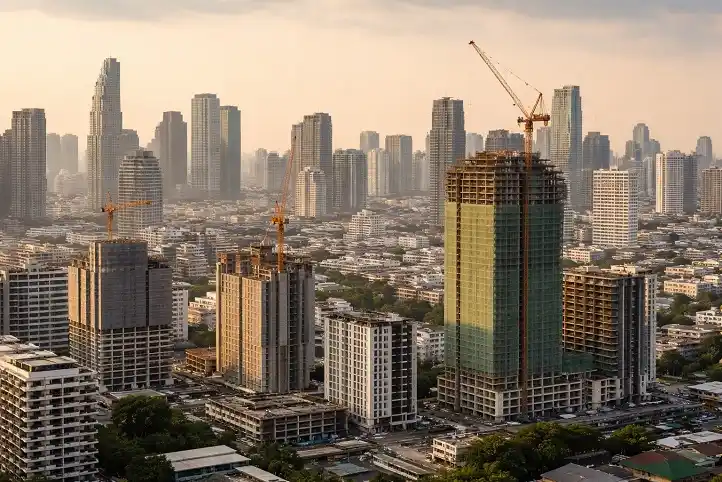
Image Credit: Bangkok Business News
Demand Weakens as Structural Pressures Mount
At the core of the slowdown is a steady erosion of domestic purchasing power. Household debt remains persistently high, while income growth continues to lag behind rising living costs. Mortgage lending has also tightened, further limiting access to financing for prospective buyers. This Bangkok Business News report highlights how these structural weaknesses are no longer cyclical but deeply embedded within Thailand’s economic fabric.
The result is a market where demand is softening across nearly all segments, with the mass-market category – homes priced between two and five million baht – bearing the brunt. This segment, which accounts for the majority of transactions in Bangkok and surrounding areas, is especially vulnerable as middle-income buyers struggle to balance rising expenses with long-term financial commitments.
Global Conflict Drives Costs Higher
Compounding domestic fragility is a powerful external shock. Ongoing conflict in the Middle East has driven global oil prices upward, triggering a chain reaction across construction-related industries. Essential materials such as steel, cement, concrete, and petrochemical-based products have all become more expensive, pushing developers into a difficult position.
Developers now face a tightening vice: raising property prices risks further dampening already weak demand, while absorbing higher costs erodes profit margins. This recalibration of the cost base is not temporary, suggesting that future project pricing could remain elevated even if market conditions stabilize.
Forecasts Signal Deepening Contraction
The data paints a sobering picture. SCB EIC forecasts that total residential transfer value nationwide will decline by around five percent year-on-year in 2026, falling to approximately 824 billion baht. In a prolonged conflict scenario, that contraction could deepen to between ten and fifteen percent.
Meanwhile, Kiatnakin Phatra Bank projects total transfer volumes will drop to about 290,000 units, down significantly from over 316,000 units in 2025. This would represent the lowest level recorded in eight years. On the supply side, new project launches in Bangkok and nearby provinces are also expected to decline for a fourth consecutive year, falling to roughly 39,000 units.
Developers Urged to Shift Strategy
In response to these pressures, both institutions recommend that developers prioritize clearing existing inventory rather than aggressively launching new projects. For buyers with sufficient financial capacity, current conditions may present a narrow window of opportunity before rising construction costs become permanently reflected in property prices.
The broader implication is clear: Thailand’s property market is undergoing more than a routine downturn. It is adjusting to a new economic reality shaped by both domestic constraints and global volatility. Without meaningful improvements in household financial health or easing external pressures, the sector may remain subdued for years to come. The coming period will test the resilience and adaptability of developers, lenders, and buyers alike in navigating a landscape that has fundamentally shifted.
For the latest on the Thai economy, keep on logging to Bangkok Business News.



