

What To Know
- FTI analysis estimates that an ICE vehicle contains around 30,000 parts, compared with roughly 1,500 to 3,000 in an EV.
- The plastics industry is particularly exposed to Middle Eastern disruption because Thailand relies on the region for an estimated 60% to 70% of its naphtha imports.
Thailand’s manufacturing sector is facing mounting pressure as factories across automotive parts, garments, rubber products and plastics temporarily suspend operations amid shrinking orders, losses and higher production costs. The trend is raising fresh concerns about employment and the resilience of manufacturers already struggling with structural change and weak demand.

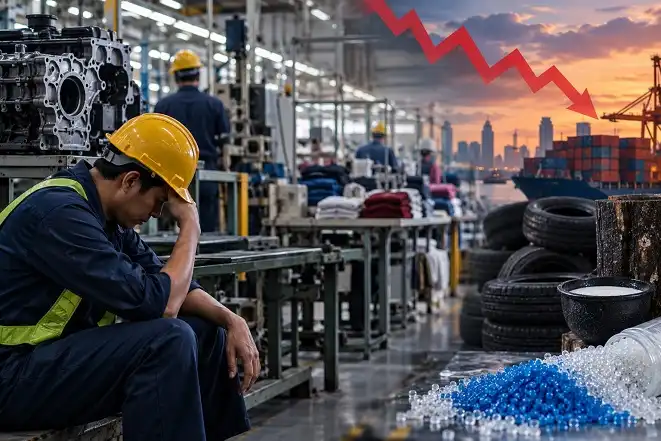
Image Credit: Bangkok Business News
Official figures for June 2026 show the strain, with temporary suspensions affecting 18,998 workers, up 58.08% from May and 18.61% from a year earlier. As this Bangkok Business News report examines the mounting pressure, partial shutdowns are becoming more common while fewer establishments are halting operations completely.
Partial Shutdowns Put More Jobs Under Pressure
In June, 44 establishments suspended part of their operations, a 22.22% increase from the previous month, while 23 establishments suspended all operations, down 14.81%.
The Bank of Thailand has highlighted businesses facing intense competition and using Section 75 of the Labour Protection Act for temporary suspensions. It identified automotive parts, garments, rubber products and plastics as industries requiring particular attention.
Pimjai Leeissaranukul, chairwoman of the Federation of Thai Industries, said employment remained broadly stable in July, but signs of structural weakness were emerging in manufacturing.
FTI vice-chairman Montri Mahaplerkpong said Section 75 was generally being invoked by businesses suffering accumulated losses, reduced order volumes or widespread cancellations. International conflict, expensive imports, transport disruption and higher shipping costs were adding pressure.
Auto Parts Industry Faces EV Disruption
Thailand’s automotive supply chain is confronting a major technological shift as production moves from internal combustion engine vehicles toward electric vehicles. The transition matters because EVs require far fewer components.
FTI analysis estimates that an ICE vehicle contains around 30,000 parts, compared with roughly 1,500 to 3,000 in an EV. As EV production expands, suppliers dependent on traditional engine, transmission and related components face declining demand, putting jobs under pressure.
Garment Makers Battle Imports and Low-Cost Rivals
Garment manufacturers are being squeezed by rising imports and overseas competitors with lower production costs. Ready-made clothing imports increased 12.30% year on year during the first half of 2026, according to FTI analysis.
Meanwhile, the garment Manufacturing Production Index declined 2.18% year on year, with capacity utilization at only 49.06%. The federation said weak purchasing power was only part of the problem. Thai producers also face challenges involving production costs, technology, product-development speed and branding, affecting their competitiveness.
Rubber Producers Confront Volatile Costs
Rubber-product manufacturers face a different combination of risks. Conflict in the Middle East has increased oil-price volatility, potentially weakening demand while making downstream factories more cautious about placing new orders.
Producers are also struggling to protect margins as fertilizer, chemical and energy prices fluctuate. These costs feed through to transportation and rubber-processing chemicals, making pricing and production planning more difficult. Some customers are delaying orders while awaiting clearer conditions.
Plastics Sector Takes a Direct Supply Hit
The plastics industry is particularly exposed to Middle Eastern disruption because Thailand relies on the region for an estimated 60% to 70% of its naphtha imports. Naphtha is a fundamental feedstock used in plastics manufacturing.
Disrupted shipping routes have tightened plastic-resin supplies domestically and globally. Domestic manufacturers responded by reducing output by an average 25% to 30% to conserve limited raw materials.
The impact on costs has been severe. Total production costs rose by 30% to 50% between March and May 2026, according to the industry assessment. Some small and medium-sized manufacturers unable to absorb the jump in raw-material expenses have already been forced to close, exposing companies with limited financial buffers.
Section 75 Becomes a Survival Tool
Section 75 gives employers a legal mechanism to suspend operations temporarily when a necessary interruption, other than force majeure, prevents normal operations. Raw-material shortages, economic difficulties and canceled customer orders can be among the circumstances leading companies to use the provision.
Under the amended law, employers must pay affected workers at least 75% of their normal wages for working days throughout the period when employees are not required to work. Employers must also provide written notification to employees and labor inspectors at least three working days before a suspension.
Federation of Thai SMEs officials said some businesses had endured prolonged liquidity shortages, volatile markets and difficulties adapting their operations. Section 75 can provide breathing room while companies restructure or await demand recovery.
Industry Calls for Urgent Recovery Support
SME representatives warn, however, that temporary suspension cannot rescue businesses indefinitely. Without effective support, companies currently relying on Section 75 could eventually conclude that permanent closure is their only viable option.
Industry proposals include business-recovery plans, access to experienced SME advisers and mentors, low-interest financing, factoring arrangements that convert receivables into working capital faster, action on payment-term problems, and debt restructuring with repayment schedules matched to companies’ ability to pay.
The growing use of temporary suspensions therefore represents more than a short-term response to weak orders. It signals deeper changes across Thailand’s industrial economy, from the EV transition to global supply disruption and intensifying international competition. Whether factories can restart at full capacity will depend on demand recovering, costs stabilizing and businesses gaining enough financial support to survive the adjustment without turning temporary shutdowns into permanent closures. The coming months will show whether these measures can preserve industrial capacity and protect employment.