

What To Know
- The Ministry’s Trade Policy and Strategy Office, led by Poonpong Naiyanapakorn, reiterated that these negative numbers were not indicative of deflation, noting that the drop is driven by supply-side issues rather than a lack of consumer demand.
- As more families begin to cut back on even basic necessities or take on more debt to survive, the social and economic implications are severe.
Bangkok Business News: Inflation Down but Wallets Still Squeezed
Thailand’s inflation rate dropped for the fourth consecutive month in July, registering at -0.7% compared to the same period last year. This marks the fifth straight month inflation has remained below the Bank of Thailand’s (BoT) target range of 1.0% to 3.0%. The decline was primarily driven by falling energy costs—particularly gasoline, diesel, and electricity—as well as fresh produce, according to the Commerce Ministry.

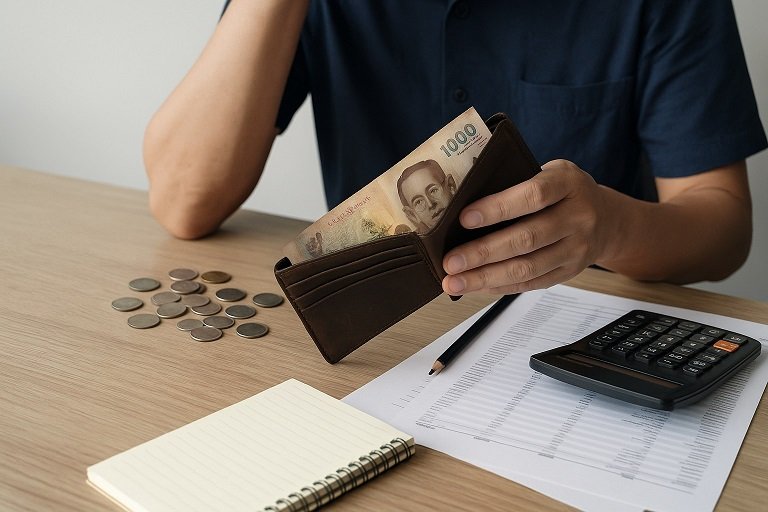
Many Thais are faced with high cost of living and are unable to make ends meet
Image Credit: Al-Generated
However, despite these figures, this Bangkok Business News report reveals a growing disconnect between official inflation data and what Thai households are actually experiencing. The Ministry’s Trade Policy and Strategy Office, led by Poonpong Naiyanapakorn, reiterated that these negative numbers were not indicative of deflation, noting that the drop is driven by supply-side issues rather than a lack of consumer demand.
Core Inflation Remains Steady Amid Mounting Concerns
Core inflation, which strips out volatile items like fresh food and energy, rose by 0.84% year-on-year in July, staying within the expected range. Yet, for millions of Thais, this modest rise in core inflation does little to reflect the true economic strain they are under.
The Ministry continues to predict a similar inflation trend through the third quarter, with a projected -0.5% CPI drop. Still, officials insist the situation does not qualify as deflation. They cite persistent core inflation and stable consumer demand as reasons to remain optimistic. The BoT is set to review its key interest rate on August 13, which currently stands at 1.75%.
Reality Bites Hard for Thai Households
While official figures suggest prices are falling, a recent nationwide survey conducted by Marketbuzzz paints a very different picture. The survey found that 42% of Thai respondents are most concerned about the rising cost of living, especially in essential categories like food, housing, utilities, and transport. In fact, household essentials have surged by 15.3% compared to the previous year.
The disparity between reported deflation and actual cost increases is most keenly felt by married couples with children and those aged 55 and above. Residents in urban areas, particularly Bangkok, report greater financial stress due to higher living expenses.
Debt and Desperation on the Rise
According to the National Statistical Office, the average Thai household now spends over 18,200 baht per month—42% of which goes to food and beverages. More troubling is the average household debt, which has ballooned to over 606,000 baht. Despite recent increases in minimum wages to between 337 and 400 baht per day, income still falls short of covering basic living expenses.
Grant Bertoli, CEO of Marketbuzzz, emphasized that inflation figures do not capture the full picture. “We need a broader measure of economic well-being,” he said. “Essential goods and services are still rising in cost, placing uneven pressure across different segments of the population.”
An Urgent Call for Policy Shifts
As more families begin to cut back on even basic necessities or take on more debt to survive, the social and economic implications are severe. If living costs keep climbing while wages remain stagnant, Thailand could see a growing wealth gap, worsening debt cycles, and deteriorating quality of life for its citizens.
To address these issues, economists and analysts alike are calling for a more holistic policy approach—one that prioritizes real household experiences over abstract economic indicators. Thailand’s future economic resilience may well depend on how seriously it responds to the voices of its people.
For the latest on the terrible state of the Thai economy, keep on logging to Bangkok Business News.