

What To Know
- Although Thailand is not directly involved in the confrontation, its extensive commercial relationship with China and dependence on imported energy could expose the country to consequences ranging from higher fuel costs to volatile investment and capital flows.
- The latest American campaign has been promoted as an economic offensive designed to isolate Iran and make companies and financial institutions around the world reconsider whether continuing business with Tehran is worth….
Thailand risks becoming an unintended casualty of an expanding American economic offensive as Washington increasingly uses tariffs, sanctions and access to its financial system as instruments of geopolitical pressure. Although Thailand is not directly involved in the confrontation, its extensive commercial relationship with China and dependence on imported energy could expose the country to consequences ranging from higher fuel costs to volatile investment and capital flows.

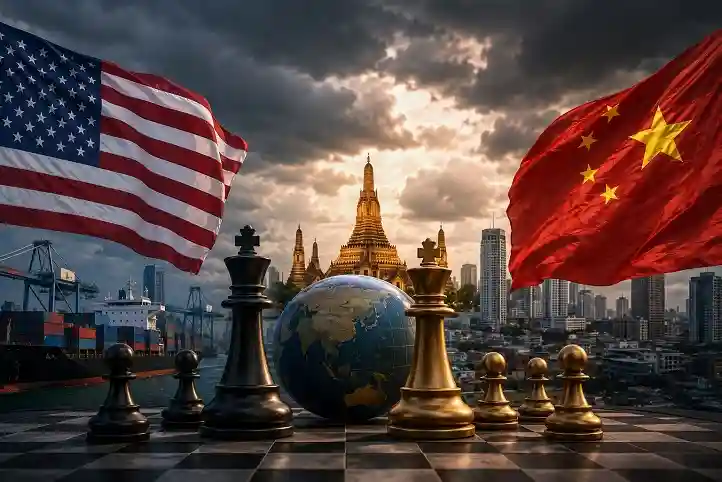
Image Credit: Bangkok Business News
The immediate concern is not Thailand’s relatively limited commercial relationship with Iran, but what could happen if Washington expands penalties against countries and companies that continue dealing with Tehran. At the centre of that equation is China, and this Bangkok Business News report examines how a widening sanctions campaign could eventually leave Thailand navigating increasingly difficult choices between two of its most important economic and strategic relationships.
Thailand Could Feel the Impact Without Being Targeted
Senior Thai banking and economic specialists have warned that the country’s relatively small volume of direct trade with Iran does not mean Thailand is insulated from the confrontation.
The greater danger could emerge through China, one of Thailand’s most important trading partners, sources of investment and participants in regional manufacturing supply chains.
If Washington broadens its measures to include businesses, financial institutions or countries maintaining substantial commercial relationships with Iran’s major trading partners, Thailand could find itself facing difficult decisions.
Bangkok would have to protect commercial ties with China while ensuring that Thai companies and financial institutions remained compliant with measures imposed through the US-dominated international financial system.
The situation could become particularly complicated if Washington begins expecting governments to demonstrate economic alignment rather than simply remain neutral.
Oil Prices Could Hit Thailand First
Before any major diplomatic dilemma emerges, Thailand could feel the consequences at petrol stations, factories and across transportation networks.
Iran’s disruption of traffic through the Strait of Hormuz has affected one of the most important energy corridors in the world. Approximately one-fifth of global oil and gas shipments are associated with the strategically important waterway.
Brent crude has subsequently risen to around US$92 per barrel.
For Thailand, which relies heavily on imported energy, persistently elevated crude prices could increase transportation, manufacturing, electricity and logistics expenses.
Those additional costs can spread throughout the economy. Businesses may absorb part of the increase, but prolonged high energy prices would eventually risk being transferred to consumers through more expensive goods and services.
Professional economic analysts have also warned about another transmission mechanism: financial markets.
A prolonged confrontation involving major economies could undermine investor confidence, increase currency volatility and cause abrupt movements in international capital. Emerging markets such as Thailand can experience significant financial consequences even when they are geographically distant from the original conflict.
Washington Expands the Economic Battlefield
The wider challenge confronting Thailand is the increasing willingness of the United States to use its enormous economic influence as an instrument of foreign policy.
Washington is simultaneously applying different forms of economic pressure against Iran, Canada and China.
While the circumstances surrounding each country are different, the underlying strategy shares a common principle: access to the American market, international financial networks and global trade can be used as leverage to extract political or economic concessions.
Senior US officials have repeatedly emphasized the importance of economic strength in achieving foreign-policy objectives, reflecting a broader shift towards financial and commercial pressure alongside traditional military power.
Iran has become the most dramatic example.
Following months of military confrontation without a negotiated settlement, Washington has widened efforts to weaken Tehran’s ability to generate revenue and participate in international commerce.
The latest American campaign has been promoted as an economic offensive designed to isolate Iran and make companies and financial institutions around the world reconsider whether continuing business with Tehran is worth the potential consequences.
Five Major Iranian Revenue Channels Targeted
The American measures focus on five strategically important areas: digital assets, technology, gold, aviation and maritime shipping.
Nearly 60 Iran-linked individuals, organizations and vessels have also been subjected to restrictions as Washington attempts to dismantle networks that help Tehran maintain access to international commerce.
Iran’s oil and gas revenue remains an even more significant target.
Washington wants countries and international businesses to reduce or terminate economic relations with Tehran, effectively forcing them to decide whether Iranian commercial opportunities justify potentially jeopardizing access to American markets or financial institutions.
US economic officials have presented Tehran with a stark choice: accept increasing isolation or change its conduct sufficiently to regain greater access to the global economy.
Iranian authorities, however, have indicated they are preparing for a prolonged confrontation rather than capitulating.
Tehran Signals It Can Withstand the Pressure
Iranian economic officials say the country has developed a two-year strategy for managing the effects of American economic pressure.
Tehran has characterized the campaign as a form of economic terrorism and maintains that it possesses countermeasures capable of imposing costs on its opponents.
The Strait of Hormuz has demonstrated the potential strength of that leverage.
Disruption to the strategically vital waterway has contributed to sharply higher international energy prices, creating a serious dilemma for Washington because measures intended to weaken Iran can simultaneously increase living costs for American consumers.
US petrol prices have risen considerably, with national averages reaching around US$4.09 per gallon compared with US$2.98 on February 28, when American and Israeli attacks against Iran began.
Higher fuel costs could become increasingly politically sensitive ahead of the November 2026 US midterm elections, particularly if American households associate foreign-policy decisions with worsening domestic living expenses.
China Is the Crucial Piece of the Puzzle
The biggest obstacle to Washington’s strategy could be China.
International economic analysts have questioned how quickly tougher sanctions can seriously undermine Iranian oil revenues when the overwhelming majority of those exports are purchased by Chinese buyers.
US government estimates indicate China accounts for approximately 90% of Iranian oil exports.
Official trade between China and Iran was valued at about US$9.96 billion in 2025. That figure excludes an estimated US$31.2 billion in unreported Iranian crude exports to China.
For Thailand, this relationship is particularly significant.
China is deeply embedded in Thailand’s economy through manufacturing, tourism, infrastructure, exports, imports and investment. Any American attempt to penalise Chinese companies or financial institutions for their dealings with Iran could therefore produce secondary consequences across Asia.
International geopolitical specialists believe Beijing may seek to avoid direct retaliation while allowing major Chinese banks and energy companies to quietly adjust transactions if they believe they risk becoming targets of American sanctions.
Such changes could reverberate through regional banking networks and supply chains in which Thai businesses participate.
Even US Allies Face Economic Pressure
Washington’s increasingly aggressive use of economic leverage is not restricted to strategic adversaries.
Canada, historically one of America’s closest allies and trading partners, is now involved in an escalating tariff dispute with the United States following the collapse of trade negotiations.
Washington imposed tariffs of 50% on more than US$20 billion worth of Canadian goods, affecting products including cement, agricultural commodities and sporting equipment.
Additional tariffs of up to 50% have also been threatened against Canadian automobiles and steel from 2027.
Canadian authorities have responded with plans for dollar-for-dollar retaliatory tariffs beginning September 8, targeting American steel, dairy goods and electrical appliances.
The dispute could create complications for Washington’s broader international strategy.
Efforts to economically isolate Iran are more likely to succeed when the United States secures cooperation from major allies and trading partners. Simultaneously conducting damaging trade disputes with those partners could weaken international willingness to participate in sanctions.
Washington Moves More Carefully with Beijing
Despite taking aggressive positions towards Iran and Canada, Washington appears considerably more cautious when dealing directly with China.
The United States is considering an additional 7.5% tariff on Chinese goods through a trade investigation concerning allegations of excessive production capacity.
If implemented, the measure would bring tariffs introduced under the current US administration to a combined 20%.
However, American trade officials have indicated that the investigation involves complex legal considerations, while Washington appears reluctant to create a major confrontation before planned high-level talks between the leaders of the two countries.
That caution demonstrates China’s unique position. Unlike Iran, China cannot easily be economically isolated without potentially causing enormous disruption to global manufacturing, financial markets, consumer prices and international supply chains.
Economic Pressure Carries Risks for Washington
America’s strategy rests partly on the calculation that the size of its economy and consumer market gives Washington enough leverage to force other governments into concessions.
Professional economists and geopolitical analysts caution that the outcome may be considerably less predictable.
Sanctions become less effective when major economies refuse to participate. Tariffs can trigger retaliation, while restrictions on energy-producing countries can push commodity prices higher and ultimately hurt consumers in the country imposing the pressure.
Economic coercion can also generate political resistance rather than submission.
Populations subjected to foreign economic pressure may rally behind their governments, particularly when sanctions or tariffs are portrayed domestically as attacks on national sovereignty.
Thai economic specialists have described the emerging confrontation as a form of economic warfare that could ultimately become more complicated than conventional military conflict.
Iran’s relationships with China, Russia and India further complicate Washington’s objectives. Alternative payment arrangements, trading networks and gaps within the international financial system could allow economic activity to continue despite American restrictions.
Thailand’s Room for Neutrality Could Shrink
Thailand consequently faces a challenge extending far beyond the immediate confrontation with Iran.
Bangkok has traditionally maintained strong security and commercial relationships with the United States while simultaneously developing increasingly important economic ties with China. That balancing strategy works most effectively when Thailand is not forced to make an explicit choice.
A world increasingly divided by sanctions, tariffs and competing economic blocs could gradually reduce that freedom.
Thailand must prepare for several interconnected risks, including persistently high energy prices, unpredictable capital movements, weakened investor confidence, disruption to regional supply chains and greater scrutiny of transactions involving Chinese companies.
The most difficult moment may never arrive as a dramatic demand for Bangkok to publicly choose between Washington and Beijing. Instead, pressure could build gradually through banking regulations, sanctions compliance, investment restrictions, tariffs and access to major export markets. Thailand will therefore need to protect its economic interests while preserving relationships with both powers, because as global trade becomes increasingly weaponized, remaining comfortably neutral may become one of Bangkok’s most difficult economic and diplomatic challenges.