


What To Know
- Thailand faces renewed economic pressure from soaring energy costs after another attack on a vessel in the Strait of Hormuz and the temporary shutdown of Saudi Arabia’s East-West oil pipeline pushed global supply fears back to the forefront.
- If crude remains above US$100 while alternative export routes stay vulnerable, the resulting increase in fuel, freight and production costs could become a significant economic headwind rather than a temporary market shock.
Thailand faces renewed economic pressure from soaring energy costs after another attack on a vessel in the Strait of Hormuz and the temporary shutdown of Saudi Arabia’s East-West oil pipeline pushed global supply fears back to the forefront. Brent crude has climbed above US$100 a barrel, intensifying concerns that prolonged Middle East disruption could drive fuel, transportation and production costs higher.
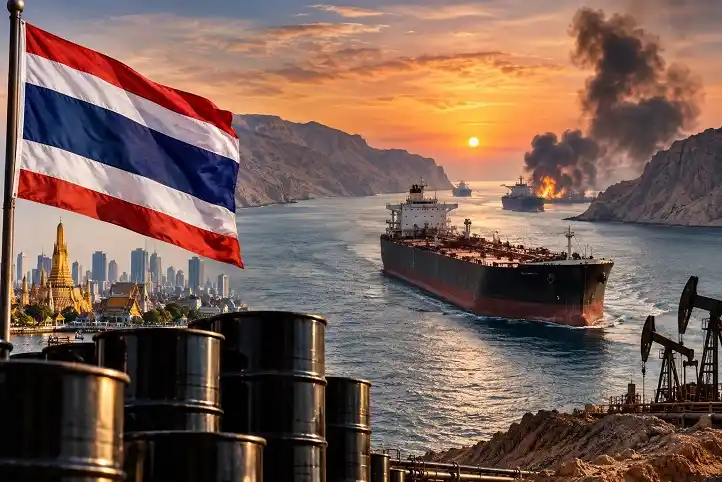
Image Credit: Bangkok Business News
The latest incident comes as security risks spread across two of the world’s most strategically important maritime corridors. For Thailand, which depends heavily on imported energy, this Bangkok Business News report highlights how sustained triple-digit crude prices could filter through the economy, increasing business costs, transportation expenses and inflationary pressure.
Hormuz Attack Shakes Energy Markets
Concern intensified after a vessel was reportedly struck by an unknown projectile while transiting the Strait of Hormuz on September 13. The United Kingdom Maritime Trade Operations received notification of the incident, although the extent of the damage and condition of the crew were not immediately clear.
The Strait of Hormuz remains crucial to international energy markets. Before the current conflict, roughly 20% of global oil supplies passed through the waterway, making any sustained disruption capable of affecting prices far beyond the Middle East.
Brent crude settled at US$104.61 a barrel on September 11, while West Texas Intermediate closed at US$100.05. Both benchmarks gained more than 8% during the week as traders priced in mounting supply risks.
Saudi Pipeline Attack Deepens Supply Fears
Market anxiety increased further after Saudi Arabia temporarily closed its East-West pipeline following a drone attack. The route is particularly important because it enables Saudi crude exports to bypass Hormuz and had recently been carrying around 4 million to 5 million barrels per day.
No group immediately claimed responsibility. US President Donald Trump indicated that Iran was probably involved, although responsibility had not been independently confirmed.
Second Chokepoint Raises the Stakes
The danger is no longer confined to Hormuz. Developments involving the Iran-aligned Houthi movement near the Bab el-Mandeb Strait have heightened concerns about another critical shipping corridor linking the Red Sea and Gulf of Aden.
Simultaneous disruption around Hormuz and Bab el-Mandeb could place additional pressure on crude supplies, shipping costs and international trade.
Thailand Watches the Oil Shock
For Thailand, the greatest danger is the duration of the crisis. Persistently high oil prices could increase transportation and manufacturing costs, put upward pressure on consumer prices and weaken economic momentum. Diplomatic efforts involving Iran, Oman and Gulf states offer some prospect of easing tensions, but there is still no immediate agreement restoring normal passage through Hormuz.
Thailand therefore faces an increasingly difficult external energy environment. If crude remains above US$100 while alternative export routes stay vulnerable, the resulting increase in fuel, freight and production costs could become a significant economic headwind rather than a temporary market shock.



