

What To Know
- Thailand’s housing market is facing mounting pressure as developers of new homes and sellers of second-hand properties slash prices in a battle to attract a shrinking pool of qualified buyers.
- Owners and property brokers selling existing homes are being forced to monitor pricing movements in the new-home market and lower asking prices to remain competitive.
Bangkok Business News: Thailand’s housing market is facing mounting pressure as developers of new homes and sellers of second-hand properties slash prices in a battle to attract a shrinking pool of qualified buyers. Stricter mortgage approvals, weak consumer confidence and slowing economic growth have combined to reshape the competitive landscape, leaving both markets under strain despite continued underlying demand. Midway through the unfolding market slowdown, this Bangkok Business News report finds that financing obstacles rather than a lack of buyer interest have become the biggest challenge confronting Thailand’s property sector.

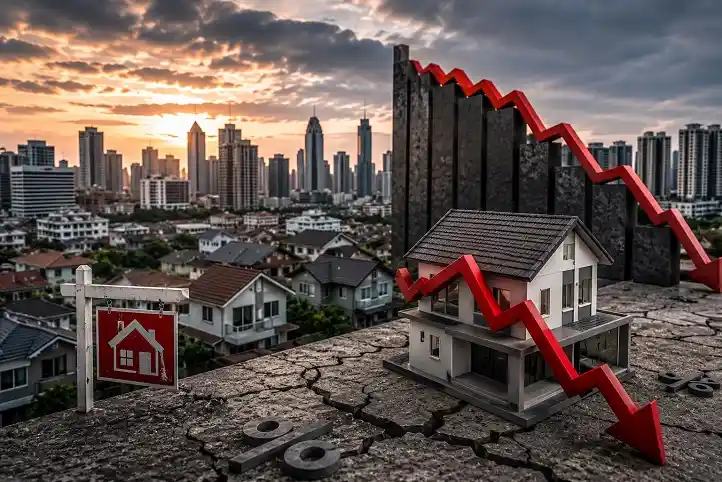
Image Credit: Bangkok Business News
Lending restrictions squeeze purchasing power
Industry leaders say the housing market is likely to remain sluggish through the second half of 2026 unless additional government support measures are introduced. Financial institutions continue to apply strict lending standards, resulting in mortgage rejection rates of around 40%, making it increasingly difficult for prospective buyers to secure financing even when they are ready to purchase homes.
Members of the Thai Real Estate Association, said both the new-home and second-hand housing markets face virtually identical challenges because they rely on the same banking system for mortgage approvals. Although demand continues to exist, many applicants fail to meet lending requirements as their income or financial position is considered insufficient for the homes they intend to buy.
Developers intensify discounts to reduce inventory
Faced with large volumes of unsold housing stock, developers have significantly expanded promotional campaigns aimed at accelerating sales. Price reductions are being combined with waived ownership-transfer costs, free furnishings, interest support and other incentives designed to encourage hesitant buyers to complete transactions more quickly.
The aggressive pricing strategies are largely intended to reduce accumulated inventories rather than stimulate entirely new demand. Developers are also delaying the launch of new residential projects while concentrating resources on selling existing stock, reflecting cautious expectations for the remainder of the year.
Second-hand sellers forced to respond
The sharp discounts offered by developers are creating direct pressure on the resale market. Buyers increasingly compare the value proposition between new and second-hand homes, especially when price differences narrow considerably after promotional offers are applied.
As a result, owners and property brokers selling existing homes are being forced to monitor pricing movements in the new-home market and lower asking prices to remain competitive. While resale properties continue to benefit from established urban locations, larger land plots and greater usable space, sellers are finding it increasingly difficult to justify higher prices when newly built homes include attractive financial incentives and quality guarantees.
Government support offers limited relief
Industry representatives acknowledge that government initiatives have provided some encouragement. Reduced ownership-transfer and mortgage registration fees, together with the Bank of Thailand’s relaxation of loan-to-value regulations, have eased purchasing costs for eligible buyers.
Data from the Real Estate Information Centre also indicate that residential ownership transfers nationwide increased during the first quarter of 2026, suggesting that housing demand has not disappeared. Instead, buyers are becoming more selective and focusing on properties that better match their financial capabilities.
However, developers argue these supportive measures are unable to fully offset broader economic weaknesses. Household debt remains elevated, purchasing power continues to weaken and uncertainty surrounding the economy is discouraging many consumers from making long-term financial commitments despite lower transaction costs.
Credit access remains the market’s biggest obstacle
Executives of the Housing Business Association, believes market conditions may improve modestly during the second half of 2026, but any recovery is expected to be gradual.
The most significant barrier remains access to mortgage financing. Surveys conducted by the association show that retail loan rejection rates averaged approximately 40% during 2025 and remained at similar levels throughout the first half of 2026.
Those figures suggest Thailand’s housing sector is constrained less by demand than by limited credit availability. Potential buyers continue to enter the market, but many cannot complete purchases because banks decline their loan applications. Unless lending conditions become more flexible, further efforts to stimulate demand may deliver only limited improvements.
Rising inventories reshape market competition
The changing balance between supply and demand has intensified competition across Thailand’s residential property market. Real Estate Information Centre figures indicate second-hand homes accounted for roughly two-thirds of all ownership transfers during the first quarter of 2026, while newly built homes represented about one-third.
Meanwhile, the volume of second-hand homes available for sale has risen sharply as economic pressures encourage more homeowners to place properties on the market. At the same time, developers have significantly reduced new project launches compared with levels recorded before the Covid-19 pandemic.
Industry estimates suggest new-home inventory now stands at approximately 210,000 units and could require four to five years to clear at current sales rates, while second-hand stock has expanded to between 220,000 and 230,000 units nationwide.
Heavy discounts spread across the market
According to members from the Real Estate Sales and Marketing Association, developers are offering discounts ranging from 10% to 30% on many projects, with some provincial detached houses reportedly reduced by as much as THB1 million from original asking prices.
Large promotional campaigns featuring extended living incentives and waived transfer fees have become increasingly common, forcing second-hand sellers to adjust their own pricing strategies. Homes requiring renovation may need substantially deeper discounts before attracting buyers, while resale prices generally remain 20% to 30% below comparable new properties even before additional negotiations.
Certain locations also warrant greater caution because of oversupply. Areas surrounding Bangkok, including Pathum Thani, Nonthaburi and Nakhon Pathom, together with eastern provinces such as Chon Buri and Chachoengsao, continue to face elevated inventory levels. Buyers are also advised to carefully evaluate physical risks, transport accessibility and the long-term resale potential of properties before making purchase decisions.
Thailand’s residential property market is increasingly being shaped by affordability rather than demand alone, with both developers and existing homeowners adapting to difficult financing conditions. While government incentives have provided some support, sustained recovery will depend largely on improved access to mortgage credit, stronger consumer confidence and broader economic momentum. Until those conditions improve, price competition is expected to remain intense across both the new-home and second-hand housing sectors, placing continued pressure on sellers while creating greater negotiating opportunities for qualified buyers.
Reference:
https://www.reic.or.th/Product/Table
For the latest on the real estate market in Thailand, keep on logging to Bangkok Business News.