


What To Know
- 16 billion baht on hosting one of the world’s most influential economic gatherings, as Bangkok gets ready for the 2026 Annual Meetings of the International Monetary Fund and World Bank Group from October 12–18.
- Hosting the IMF and World Bank meetings gives the government unusual access to global finance ministers, central bankers, investors and institutional leaders at a time when Thailand is competing for capital in technology, artificial intelligence, electric vehicles, data centers, clean energy and other higher-value industries.
Thailand is preparing to spend at least 1.16 billion baht on hosting one of the world’s most influential economic gatherings, as Bangkok gets ready for the 2026 Annual Meetings of the International Monetary Fund and World Bank Group from October 12–18. The event will put Bangkok at the center of global financial diplomacy while raising questions about the final cost to taxpayers.
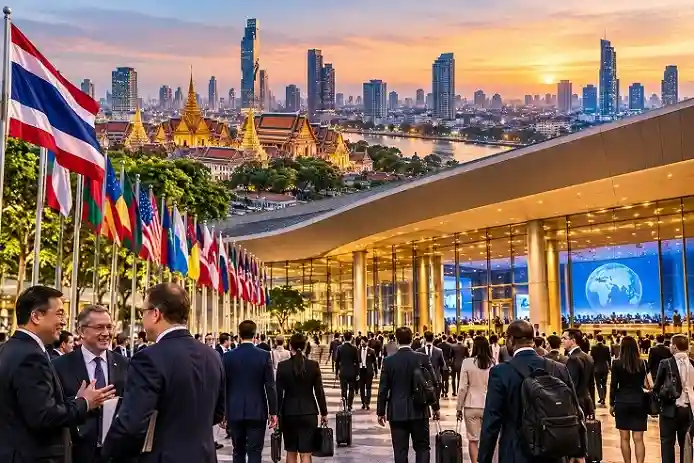
Image Credit: Bangkok Business News
The Cabinet-approved 1.16-billion-baht allocation covers preparations assigned principally to the Ministry of Finance and Fiscal Policy Office, including meeting facilities, registration areas, information technology systems, equipment and other infrastructure required to meet international standards. Yet, this Bangkok Business News report notes that the headline allocation may not represent every public-sector expense connected with the event, because numerous ministries, security bodies, transport authorities and other agencies will also be involved in delivering services across Bangkok.
A 1.16-Billion-Baht Starting Point
The government approved the allocation from Thailand’s fiscal 2026 central contingency fund as the country prepares the Queen Sirikit National Convention Center for the meetings. Preparations extend beyond conference rooms to security, transport, communications, registration and other logistics.
Government information says more than 15,000 delegates from 191 countries are expected, including finance ministers, central bank governors, executives and media. Thailand last hosted the meetings in 1991, making the 2026 gathering a return after 35 years.
The government has also designated October 16 as a special official holiday in Bangkok to reduce congestion and support security. Government agencies in the capital have additionally been instructed to implement work-from-home arrangements on October 12, 14 and 15. Around 1,000 related meetings and activities are expected alongside the main proceedings.
Could the Real Bill Be Much Higher?
The central question is whether 1.16 billion baht captures the full cost to the public sector. It clearly represents an approved hosting allocation, but additional government bodies are contributing personnel, security, traffic management, public services and operational support.
There has been speculation that the broader cost, once expenditure across agencies is considered, could approach 2.2 billion baht. However, no consolidated official accounting reviewed for this article confirms that figure. It should therefore be treated as an estimate rather than established government expenditure.
Large international summits can spread costs across agencies and budgets, making the final public-sector price difficult to establish until spending is consolidated after the event.
Government Eyes Up to 10 Billion Baht in Activity
Thai officials and business organizations see the gathering as an economic opportunity rather than simply an expense. Current estimates suggest the meetings could generate approximately 5 billion to 10 billion baht in short-term economic activity, with hotels, restaurants, transport providers, event contractors and other service businesses positioned to benefit.
If economic activity reaches 10 billion baht, it would be many times larger than the 1.16-billion-baht central allocation. But economic activity is not the same as a direct financial return to the government. Money spent by delegates circulates through private businesses, employees and suppliers, while only part returns to the state through taxes and other revenues.
The attendance figure remains a projection until registrations and arrivals produce verified numbers. Nevertheless, 15,000 international visitors would provide a significant injection into Bangkok’s hospitality and meetings industry.
Bangkok Becomes a Global Financial Stage
The benefits Thailand is seeking are not limited to hotel rooms and restaurant receipts. Hosting the IMF and World Bank meetings gives the government unusual access to global finance ministers, central bankers, investors and institutional leaders at a time when Thailand is competing for capital in technology, artificial intelligence, electric vehicles, data centers, clean energy and other higher-value industries.
The program will cover jobs, investment, growth, development and mobilizing private capital, while showcasing Bangkok’s infrastructure and financial ambitions.
That reputational value is difficult to price. A smoothly managed event could strengthen Bangkok’s standing in the international meetings market and reinforce Thailand’s argument that it can function as a regional business and financial hub.
The Final Numbers Will Matter
For now, 1.16 billion baht is the clearest confirmed central government allocation, while suggestions of a total bill approaching 2.2 billion baht remain unverified. Equally, the widely promoted 10-billion-baht economic benefit represents the optimistic end of current estimates rather than money guaranteed to flow into government coffers.
Event held as Thais Facing Hardships
The event being held at a time when parts of Bangkok and the rest of Thailand are still flooded and millions are facing hardships.
The International Monetary Fund (IMF) and the World Bank state that their ultimate goal is global economic stability and poverty reduction, but their reliance on austerity measures often inflicts immediate hardship on everyday citizens, leading to intense global criticism.
The real assessment will come after delegates leave Bangkok and the costs and benefits can be measured more precisely. Thailand is betting that immediate visitor spending, international exposure, stronger investor confidence and longer-term business opportunities will justify the substantial public commitment. Whether that wager delivers the promised economic dividend will depend on final attendance, actual spending, the full government bill and what investment follows after the global financial spotlight moves elsewhere.



