

What To Know
- A newly released nationwide survey by the Joint Standing Committee on Commerce, Industry and Banking (JSCCIB) has revealed that nearly nine out of 10 businesses now view corruption as a serious obstacle, while newly disclosed agency-level bribery-risk data has intensified scrutiny on several government departments and enforcement bodies.
- In the midst of growing concern over slowing investor sentiment and rising bureaucracy, this Bangkok Business News report highlights how corruption is increasingly being viewed as a direct threat to fair competition, business stability and Thailand’s future economic growth.
Bangkok Business News: Businesses Say Corruption Is Becoming a National Economic Threat
Thailand’s private sector is issuing one of its strongest warnings yet over what business leaders describe as a worsening corruption crisis that is damaging investor confidence, inflating operational costs and weakening the country’s long-term competitiveness. A newly released nationwide survey by the Joint Standing Committee on Commerce, Industry and Banking (JSCCIB) has revealed that nearly nine out of 10 businesses now view corruption as a serious obstacle, while newly disclosed agency-level bribery-risk data has intensified scrutiny on several government departments and enforcement bodies.


Image Credit: Bangkok Business News
The survey, conducted through the JSCCIB’s Zero Corruption working group together with Puean Mai Thon, gathered responses from 401 business executives and company representatives nationwide between March 26 and April 10, 2026. The findings have triggered renewed debate across the business community, with many executives arguing that corruption has evolved into a structural economic burden rather than merely a governance issue. In the midst of growing concern over slowing investor sentiment and rising bureaucracy, this Bangkok Business News report highlights how corruption is increasingly being viewed as a direct threat to fair competition, business stability and Thailand’s future economic growth.
Nearly 90 Percent of Firms See Corruption as a Major Obstacle
According to the survey, 89.1% of respondents said corruption represented a moderate to very serious barrier to conducting business in Thailand. More than half of all respondents, or 51.2%, said corruption had worsened during the past three years, while 51% also believed interactions with government agencies had become increasingly complicated and difficult.
Only 3% of respondents felt that dealing with state agencies had become easier.
Business operators involved in the survey warned that corruption is creating hidden costs that affect every level of commercial activity. Many executives stated that companies attempting to comply fully with legal procedures often face delays, administrative obstacles and competitive disadvantages when compared to businesses willing to engage in unofficial payments or inducements.
Several respondents also expressed fears that persistent corruption risks are discouraging foreign investment at a time when Thailand is attempting to restore economic momentum and attract international businesses seeking stable regional investment hubs.
Agency-Level Bribery Risk Data Sparks Concern
One of the most controversial aspects of the latest survey was the release of agency-level alleged bribery-risk rankings for the first time. The ranking system used two primary indicators: the frequency of alleged inducement proposals compared to business contact rates with each agency, and the alleged average bribe value linked to transactions.
The JSCCIB stressed that the survey does not represent legal findings against any agency or official. Instead, the figures reflect business-sector reports and perceptions concerning alleged requests, inducements or payments associated with official procedures.
Despite that clarification, the release of the data has already intensified calls for greater transparency and institutional reform.
Highway and Traffic Police Record Highest Alleged Inducement Rate
Among all agencies surveyed, highway and traffic police recorded the highest alleged inducement rate at 100%. Respondents reported interacting with the agency an average of 1.69 times annually, with alleged inducements reportedly proposed during each interaction.
Justice system agencies excluding courts followed closely with an alleged inducement rate of 94.4%, while subdistrict administrative organizations ranked at 91.7%.

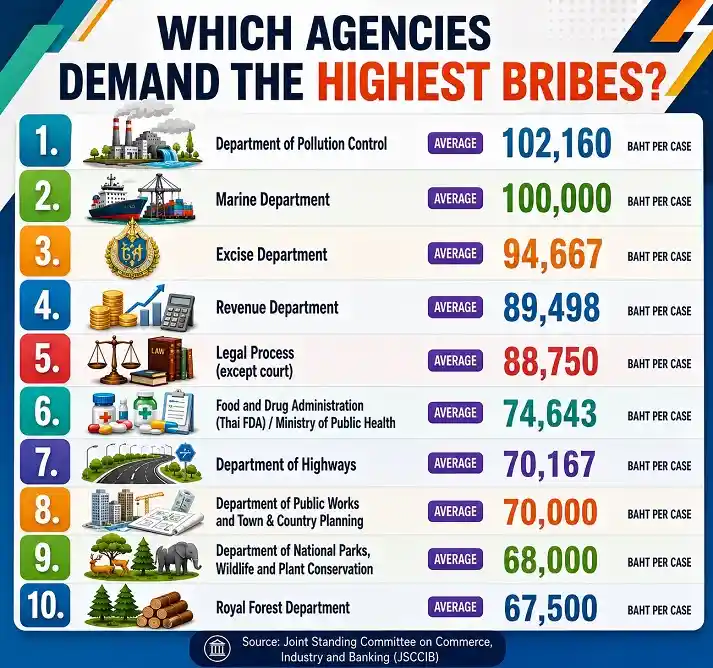
Image Credit: Bangkok Business News
Other agencies listed among the highest-risk categories included the Marine Department at 90%, the Department of Highways at 82%, the Department of Public Works and Town & Country Planning at 78.9%, local police at 77.7%, the Department of Intellectual Property at 76%, the Revenue Department at 71%, and the Department of Land Transport at 69.4%.
Business leaders said the figures reflect growing frustration within the private sector regarding inconsistent enforcement, excessive bureaucracy and alleged unofficial payment expectations tied to permits, inspections and regulatory approvals.
Pollution Control Department Tops Alleged Bribe Value List
The survey also ranked agencies based on the alleged average bribe value per transaction. The Pollution Control Department recorded the highest alleged average at 102,160 baht per case, followed closely by the Marine Department at 100,000 baht.
The Excise Department ranked next at 94,667 baht, while the Revenue Department reportedly averaged 89,498 baht per alleged transaction.
Justice system agencies excluding courts recorded an alleged average of 88,750 baht, followed by the Food and Drug Administration and public health services at 74,643 baht. The Department of Highways reportedly averaged 70,167 baht, while the Department of Public Works and Town & Country Planning stood at 70,000 baht.
Environmental and resource-related agencies also appeared on the list, including the Department of National Parks, Wildlife and Plant Conservation at 68,000 baht and the Royal Forest Department at 67,500 baht.
Businesses Push for Digital Government Reforms
Beyond the bribery figures themselves, the survey revealed deep dissatisfaction with Thailand’s administrative systems and approval processes.
Approximately 60.9% of respondents seeking permits from government agencies said they encountered implied or direct requests for inducements during their latest permit applications. Meanwhile, 45.9% admitted that their companies had provided money, gifts or other benefits to officials in order to facilitate or accelerate procedures.
Business groups are now urging the government to accelerate the adoption of digital government systems, e-procurement platforms and online approval procedures to reduce direct face-to-face interactions between officials and private companies.
Executives also demanded stronger anti-corruption enforcement, harsher penalties for officials found guilty of misconduct and greater public disclosure of procurement data, including project budgets, bidding conditions and contract awards.
Many respondents argued that reducing bureaucratic complexity and eliminating overlapping approval systems would significantly reduce opportunities for alleged corruption.
International Rankings Add to Pressure on Government
The survey comes at a sensitive moment for the government as the Anutin administration attempts to improve Thailand’s international competitiveness and rebuild investor confidence.
Transparency International’s Corruption Perceptions Index 2025 assigned Thailand a score of 33 out of 100, ranking the country 116th among 182 nations surveyed worldwide. The organisation’s Thailand findings also indicated that 88% of respondents viewed government corruption as a major national problem.
For Thailand’s business sector, the warning signs are becoming increasingly difficult to ignore. Executives now believe corruption is no longer simply a political or ethical issue but a direct economic threat capable of undermining investment, distorting competition, weakening confidence in public institutions and slowing the country’s future economic progress unless serious reforms are implemented quickly and transparently.
Reference:
For the latest on corruption in Thailand, keep on logging to Bangkok Business News.