


What To Know
- At the same time, slower economic growth could push Thailand toward stagflation, a condition where inflation remains high even as economic activity slows, creating a difficult environment for both businesses and households.
- Thailand now stands at a critical economic juncture, where decisive policy action, global developments, and business resilience will collectively determine whether the country can navigate these pressures or slip deeper into a prolonged period of economic stagnation paired with rising costs that continue to erode confidence and stability across key sectors.
Bangkok Business News: Thailand’s industrial sector is facing mounting strain as factory closures spike sharply, raising fresh concerns that the country could be edging toward a period of economic imbalance marked by rising costs and slowing growth. Industry leaders warn that a prolonged energy crisis, compounded by geopolitical tensions and domestic uncertainties, is tightening pressure across manufacturing and trade.
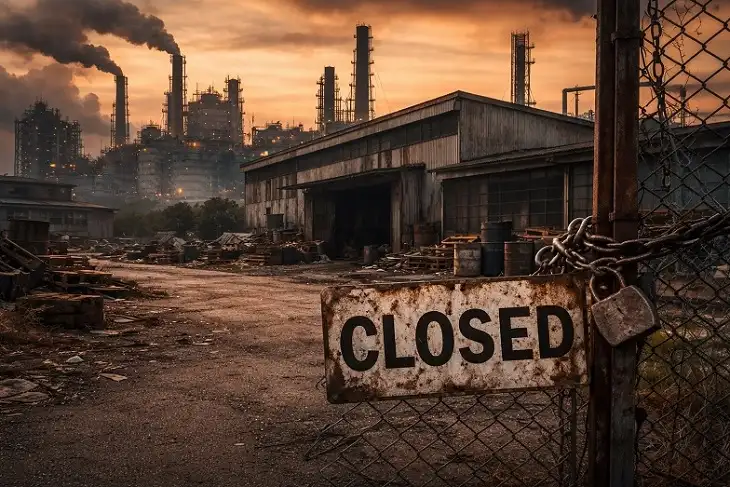
Image Credit: Bangkok Business News
According to industry data, the early months of 2026 have revealed a troubling trend. Factory closures surged by more than 58%, while new factory openings plunged significantly compared to the same period last year. This Bangkok Business News report highlights how multiple risk factors are converging at once, leaving Thailand’s industrial backbone increasingly fragile and exposed to external shocks.
Rising Costs and Weak Demand Squeeze Industry
At the heart of the crisis lies a sharp escalation in production costs. The ongoing Middle East conflict has driven global energy prices higher, pushing Thailand’s diesel costs up to approximately 48.40 baht per liter – more than 60% above pre-conflict levels. This surge has directly increased transportation and operational expenses for manufacturers already struggling with thinning margins.
Simultaneously, shortages of critical raw materials such as plastic resin, aluminium, and industrial chemicals have intensified supply chain pressures. Prices for these inputs have climbed between 10% and 30%, forcing many businesses to either absorb losses or pass costs onto consumers. However, with domestic purchasing power weakening, the ability to raise prices remains limited, creating a dangerous imbalance.
Geopolitical and Trade Pressures Add Uncertainty
External risks are further complicating the outlook. Thailand’s growing trade surplus with the United States has drawn increased scrutiny, raising fears of potential trade actions that could disrupt exports. At the same time, unresolved tensions along the Thai-Cambodian border and ongoing domestic political uncertainty are dampening investor confidence.
Industrial performance indicators reflect this strain. Capacity utilization remains below optimal levels at just over 58%, while investment activity continues to slow. The combination of declining new projects and rising closures signals a broader hesitation among businesses to expand under current conditions.
Energy Crisis Could Deepen Economic Risks
Industry leaders warn that if global oil prices remain elevated – potentially exceeding US$100 to US$120 per barrel – the impact could worsen significantly. Additional disruptions, such as restricted shipping through critical routes like the Strait of Hormuz, could drive costs even higher across supply chains.
Such developments may lead to further price increases of up to 10% in goods and services, intensifying inflationary pressures. At the same time, slower economic growth could push Thailand toward stagflation, a condition where inflation remains high even as economic activity slows, creating a difficult environment for both businesses and households.
Fragile Outlook but Pathways to Recovery Remain
Despite the challenges, there are still potential pathways to stabilization. A resolution to geopolitical conflicts, particularly involving energy supply routes, could ease cost pressures and restore some balance to global markets.
Additionally, targeted government intervention and economic stimulus measures could help support businesses and revive domestic demand.
The overall outlook, however, remains cautious. Growth projections for 2026 are modest, with expectations hovering between 1.2% and 1.6%, while inflation is forecast at 2% to 3%. Recovery, if it comes, is likely to be gradual and uneven, with meaningful improvements possibly emerging only in the latter half of the year.
Thailand now stands at a critical economic juncture, where decisive policy action, global developments, and business resilience will collectively determine whether the country can navigate these pressures or slip deeper into a prolonged period of economic stagnation paired with rising costs that continue to erode confidence and stability across key sectors.
For the latest on the Thai economy, keep on logging to Bangkok Business News.



