


What To Know
- Once hailed as a golden crop that fueled rural prosperity and powered a global coconut water boom, the sector is now teetering on the brink of collapse, with growers warning that livelihoods built over generations are evaporating almost overnight.
- Industry leaders argue that the price crash is not simply the result of oversupply, but of a sweeping transformation in who controls the business.
Bangkok Business News: Thailand’s prized aromatic coconut industry is facing one of its gravest crises in decades, as farm-gate prices have plunged to a shocking 1 to 2 baht per fruit. Once hailed as a golden crop that fueled rural prosperity and powered a global coconut water boom, the sector is now teetering on the brink of collapse, with growers warning that livelihoods built over generations are evaporating almost overnight.
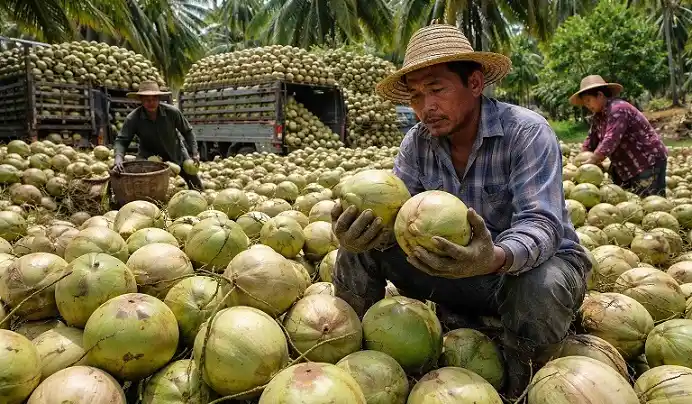
Image Credit: Bangkok Business News
Despite soaring international demand for Thai coconut water, farmers say they are seeing little benefit. Instead, prices have collapsed to levels that barely cover harvesting costs. In the middle of mounting anxiety across key growing provinces, this Bangkok Business News report reveals how structural shifts in ownership and supply chains may be driving the crisis far beyond ordinary market fluctuations.
Foreign Capital and Supply Chain Control
Industry leaders argue that the price crash is not simply the result of oversupply, but of a sweeping transformation in who controls the business. Natthasak Manusrungsri, managing director of K-Fresh and owner of the All Coco brand, has publicly warned that foreign investors, primarily from China, are using Thai nominee companies to quietly take over the entire end-to-end supply chain.
In provinces such as Ratchaburi, famed for its premium aromatic varieties, foreign-backed operators have rapidly established processing plants and logistics hubs. Armed with significant capital, they are renting large plantations, installing high-speed processing lines, and managing exports directly. By bypassing traditional Thai middlemen, these firms are able to dictate purchase prices to farmers, leaving growers with little bargaining power.
Local sources describe highly agile operations, sometimes launched within weeks through temporary container offices before scaling up into full production. Such speed and financial muscle have outpaced many domestic players, who now fear permanent displacement.
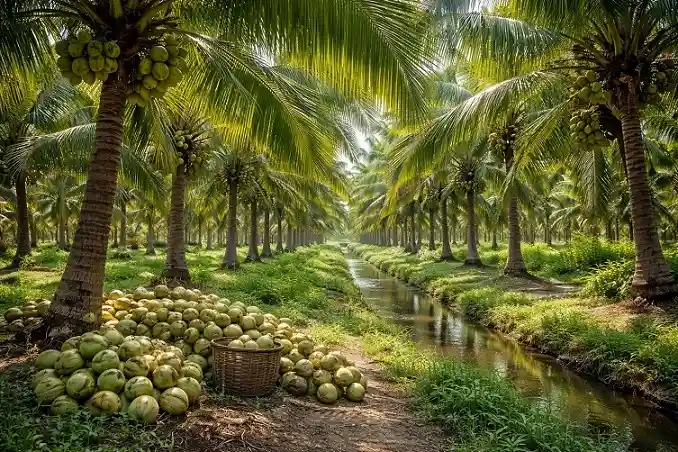
Image Credit: Bangkok Business News
Thai Farmers Squeezed to Breaking Point
The human cost of the price collapse is becoming increasingly visible. At 1 or 2 baht per fruit, farmers cannot afford fertilizers, irrigation, or labor needed to maintain the distinctive sweetness and fragrance that define Thai aromatic coconuts. Reduced investment in orchards inevitably leads to smaller fruit and diminished flavor, raising fears that Thailand’s global reputation could suffer lasting damage.
Natthasak has described the situation as heartbreaking, warning that when growers are forced to cut corners, the entire ecosystem weakens. What begins as a pricing issue quickly becomes a quality crisis, with long-term implications for export competitiveness.
Calls for a Premium Thai Strategy
Industry advocates are urging swift countermeasures. One proposal is to build stronger Thai-owned premium brands capable of commanding higher margins abroad, allowing fairer returns to farmers. There are also calls for domestic consumers and digital influencers to actively support 100 percent Thai brands, reinforcing national ownership of the value chain.
Observers caution that domestic demand alone will not rescue the sector. Without strategic positioning in high-value international markets and protective oversight of supply chain structures, Thailand risks losing control of one of its most iconic agricultural exports. The stakes extend beyond coconuts; they touch on rural stability, national branding, and the distribution of wealth within the country’s agri-economy. If decisive steps are not taken soon, the industry’s decline could accelerate in ways that are difficult to reverse.
For the latest on the Thai economy, keep on logging to Bangkok Business News.



