

What To Know
- Bangkok has emerged as the center of a renewed economic push between Thailand and Russia as senior officials, business leaders, and investors gather for the Russian-Thai Investment Forum 2026.
- The forum comes at a particularly significant moment for bilateral relations, with both countries preparing to celebrate 130 years of diplomatic ties in 2027.
Bangkok has emerged as the center of a renewed economic push between Thailand and Russia as senior officials, business leaders, and investors gather for the Russian-Thai Investment Forum 2026. The two-day event, which opened on October 30, aims to transform longstanding diplomatic friendships into substantial commercial agreements while identifying new opportunities across energy, infrastructure, agriculture, technology, and healthcare.

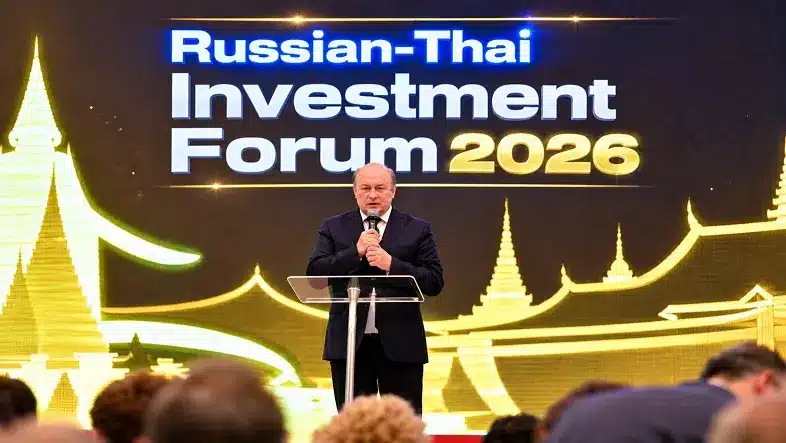
Image Credit: Organizers of the Russian-Thai Investment Forum 2026 (Image shows his excellency The Russian Ambassador to Thailand officiating the opening of the forum)
The forum comes at a particularly significant moment for bilateral relations, with both countries preparing to celebrate 130 years of diplomatic ties in 2027. Beyond ceremonial exchanges, this Bangkok Business News report examines how the latest investment discussions could reshape commercial cooperation, particularly as Russia promotes nuclear energy technology and both governments seek to expand trade far beyond existing levels.
Bangkok Welcomes Russian Investors for Major Economic Discussions
The second Russian-Thai Investment Forum, taking place from October 30 to 31, brings together government representatives, municipal authorities, and international business delegations determined to strengthen economic engagement.
Bangkok Governor Chadchart Sittipunt welcomed visiting Russian officials, including representatives from the Moscow City Government, emphasizing the historical relationship connecting the two capitals.
Thailand and Russia established diplomatic relations in 1897, making 2027 their 130th anniversary. Bangkok and Moscow will also commemorate 30 years of their sister-city agreement, originally signed in June 1997.
These milestones provide an important diplomatic backdrop, but organizers are placing particular emphasis on measurable business outcomes rather than ceremonial declarations.
Delegates are being encouraged to identify investment opportunities, address obstacles affecting cross-border commerce, and advance negotiations capable of producing actual transactions.
Investment Opportunities Extend Beyond Tourism
Although tourism remains one of the most visible connections between Thailand and Russia, the forum reflects growing interest in diversifying economic cooperation.
Agriculture, advanced technology, medical equipment, infrastructure development, and energy have emerged as important areas for potential investment.
For Thailand, stronger commercial engagement could provide opportunities to attract capital, access specialized technologies, and develop additional export markets.
Russian companies, meanwhile, could benefit from Thailand’s established manufacturing capabilities, regional connectivity, and strategic position within Southeast Asia.
However, translating these possibilities into completed investments will require businesses to address regulatory requirements, financing arrangements, logistical challenges, and market access.
The forum therefore represents an opportunity to move beyond general expressions of interest toward practical commercial partnerships.
Russia Proposes Nuclear Energy Cooperation with Thailand
One of the most consequential developments surrounding the broader economic discussions is Russia’s proposal to cooperate with Thailand on small modular reactors, commonly known as SMRs.
Russian Ambassador Evgeny Tomikhin confirmed in September that Moscow had already presented Thailand with options for bilateral cooperation involving the emerging nuclear technology.
SMRs are smaller nuclear reactors designed to provide electricity through installations that may offer greater flexibility than conventional nuclear power stations.
Tomikhin highlighted Russia’s experience developing reactor systems derived from technology used aboard nuclear-powered icebreakers.
He also pointed to Russia’s operational floating nuclear power plant as evidence of its technological capabilities.
The ambassador maintained that Russian expertise could help countries exploring alternative electricity sources, particularly those facing increasing industrial demand.
Nevertheless, any potential nuclear partnership remains dependent on decisions by Thai authorities, and no confirmed reactor procurement agreement has been announced in the supplied information.
Could Small Nuclear Reactors Power Thailand’s Data Centers?
Russia’s proposal is particularly relevant as Thailand considers how to meet rising electricity requirements from digital infrastructure and industrial expansion.
Tomikhin suggested that one or two small modular reactors could potentially supply electricity to large data centers, depending on their capacity and energy requirements.
Floating nuclear installations could also offer electricity generation options for remote locations where conventional infrastructure development presents difficulties.
Compared with large nuclear facilities, which can require lengthy construction periods, standardized smaller reactors are promoted as potentially faster to deploy.
However, actual construction schedules depend on reactor design, licensing procedures, financing, infrastructure readiness, and regulatory approval.
Thailand would also need to evaluate nuclear safety, radioactive waste management, emergency preparedness, environmental implications, and public acceptance before considering deployment.
Although nuclear generation produces low operational carbon emissions, its introduction would represent a significant long-term policy commitment requiring extensive technical and institutional preparation.
Bilateral Trade Climbs but Remains Below Expectations
Alongside energy cooperation, expanding bilateral trade remains a central priority.
According to Tomikhin, trade between Russia and Thailand reached approximately US$1.35 billion during the first seven months of 2026, representing growth exceeding 20% compared with the corresponding period in 2025.
The improvement suggests that commercial exchanges are recovering momentum, although Russian officials believe existing trade volumes remain considerably below their potential.
Senior Thai officials have previously suggested that bilateral commerce could surpass US$2 billion during 2026.
Meanwhile, business estimates cited by the Russian ambassador indicate that trade could eventually reach US$10 billion or more.
Such an expansion would require substantial increases in commercial activity, improved business connectivity, and sustained investment across multiple industries.
The US$10 billion figure should therefore be understood as a longer-term commercial ambition rather than an established forecast.
For companies attending the Bangkok forum, the immediate challenge is identifying realistic projects capable of generating sustained growth.
Diplomatic Engagement Supports Expanding Business Relations
Russian officials have also highlighted increasing high-level engagement between the two countries as an encouraging foundation for deeper economic cooperation.
A welcoming message from Russian Foreign Minister Sergei Lavrov was delivered at the forum by Lyudmila Georgievna Vorobyova, director of the Third Asian Department at Russia’s Ministry of Foreign Affairs.
The message emphasized mutual trust, constructive cooperation, and the importance of maintaining strong relationships between governments and communities.
Russian representatives expressed confidence that the forum could facilitate investment projects and strengthen practical collaboration across multiple sectors.
For Thailand, maintaining diversified international economic partnerships could create additional commercial opportunities while supporting its broader regional competitiveness.
However, diplomatic goodwill alone cannot guarantee investment success. Businesses will ultimately evaluate project feasibility, financial returns, regulatory certainty, and operational risks before committing capital.
Cultural Celebrations Reinforce Bangkok-Moscow Friendship
Economic negotiations are being accompanied by cultural activities intended to strengthen connections between Russian and Thai communities.
The Days of Moscow in Bangkok program features cultural performances and public events, including a gala ballet presentation.
The Made in Russia festival also incorporates activities such as friendly ice hockey matches and Muay Thai demonstrations at Lumpini Park.
These exchanges reflect the broader relationship between the two countries, extending beyond investment discussions into cultural diplomacy and community engagement.
Governor Chadchart highlighted the importance of these connections in sustaining friendship between Bangkok and Moscow.
Such initiatives can complement commercial cooperation by encouraging tourism, strengthening institutional relationships, and improving mutual understanding.
Turning Economic Ambitions into Lasting Partnerships
The Russian-Thai Investment Forum 2026 offers both countries an opportunity to convert diplomatic momentum into meaningful economic progress. Rising trade figures, proposed energy cooperation, and expanding investment discussions suggest considerable potential, but success will depend on concrete agreements, careful regulatory assessments, and sustained private-sector participation.
Whether the Bangkok meetings deliver lasting commercial results will become clearer as proposed partnerships advance beyond preliminary negotiations.
For more details on the Russian-Thai Investment Forum 2026, visit: