

What To Know
- Thailand’s rising cost of living is placing renewed pressure on household budgets as the price of everyday ready-to-eat meals continues climbing, leaving millions of workers paying more for basic lunches while wages remain largely unchanged.
- This Bangkok Business News report found that while the increases appear modest at between 5 and 10 baht per serving, they are having a significant cumulative effect on urban workers who regularly rely on street food and neighborhood eateries for their daily meals.
Bangkok Business News: Thailand’s rising cost of living is placing renewed pressure on household budgets as the price of everyday ready-to-eat meals continues climbing, leaving millions of workers paying more for basic lunches while wages remain largely unchanged. Fresh figures from the Trade Policy and Strategy Office (TPSO) show that higher fuel costs, transport expenses and operating overheads are forcing small food vendors nationwide to increase menu prices, adding another burden for consumers already grappling with inflation.

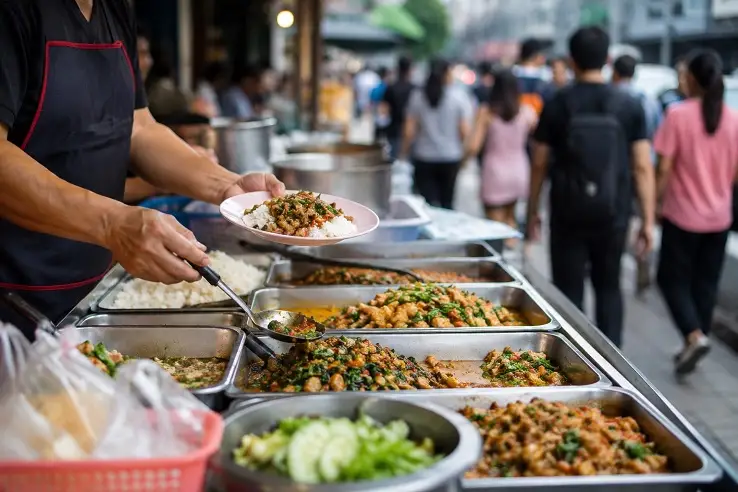
Image Credit: Bangkok Business News
The latest survey by the TPSO, under the Ministry of Commerce, found that 438 menu items across seven of Thailand’s most popular one-dish meals have recorded price increases, representing 28.53% of the 1,535 food items surveyed. This Bangkok Business News report found that while the increases appear modest at between 5 and 10 baht per serving, they are having a significant cumulative effect on urban workers who regularly rely on street food and neighborhood eateries for their daily meals.
Daily Lunch Costs Continue to Climb
The affected dishes include customer favorites such as fried rice, pad see ew, rad na, chicken rice, red pork rice, noodle soup, som tam and the ever-popular pad kra pao. These meals, traditionally priced between 35 and 60 baht, are considered affordable staples for office workers, students and low-income earners across the country.
For someone purchasing two ready-made meals each day, a five-baht increase per dish translates into approximately 300 baht in additional monthly spending. Where prices have risen by 10 baht per meal, monthly food costs can increase by around 600 baht, placing further strain on disposable income at a time when transportation expenses have also risen.
The survey found the steepest increases among meals previously priced at 40 and 50 baht, with many vendors implementing flat 10-baht increases. In percentage terms, this represents price jumps of between 20% and 25%, significantly affecting consumers who depend on inexpensive prepared food every day.
Inflation Continues to Pressure Food Businesses
The menu adjustments reflect broader inflationary trends across Thailand. Official data showed the Consumer Price Index increased by 2.42% year-on-year in June, marking the third consecutive month of positive inflation. The CPI reached 102.85 during the month as elevated fuel prices, higher transport costs and increasing food prices continued pushing up overall living expenses.
Core inflation, which excludes fresh food and energy prices, also accelerated to 1.23% in June from 0.92% in May. During the first half of 2026, headline inflation averaged 1.08%, while core inflation averaged 0.79%.
Officials attributed much of the inflationary pressure to elevated domestic fuel prices linked to continuing geopolitical tensions in the Middle East. Higher transport costs have flowed through supply chains, increasing logistics expenses for businesses and ultimately pushing up retail food prices.
Although wholesale prices for several commodities, including pork, sticky rice and selected vegetables, have softened, these reductions have not been sufficient to offset higher operating costs faced by restaurants and food stall operators.
Small Vendors Face Limited Options
According to the TPSO, most street food businesses are micro-enterprises with limited purchasing power, making them particularly vulnerable to rising costs.
Unlike larger restaurant chains that can negotiate discounts through bulk purchasing, smaller vendors have little room to absorb higher fuel, transportation and ingredient expenses. Many initially resisted increasing prices, absorbing additional costs during the early months of the Middle East conflict. However, as elevated expenses persisted, operators gradually introduced menu adjustments across different provinces until the increases became widespread.
The agency also noted that retail food prices rarely return to previous levels once increases have been implemented, even when some input costs later decline.
More Price Increases Expected
Looking ahead, the TPSO expects inflationary pressures to remain elevated during the third quarter, forecasting headline inflation of 2.79% year-on-year.
The office expects continued upward pressure from persistently high fuel prices, ongoing restructuring of domestic retail fuel pricing, widening increases in prepared food costs, higher public transport fares and rising vegetable prices.
Authorities are also monitoring the possible effects of El Niño, which could affect agricultural production and place further pressure on food supplies.
Some factors may help moderate inflation, including electricity tariffs that remain slightly below last year’s levels for the May-to-August period and stable meat supplies that could keep protein prices relatively contained.
Meanwhile, the Ministry of Commerce continues to forecast annual inflation of between 1.5% and 2.5% and maintains that the government’s planned “Thai Help Thai Plus” stimulus programme is unlikely to trigger significant inflation, citing previous co-payment schemes that showed little evidence of driving structural price increases.
For many Thai households, however, the growing cost of everyday meals remains the clearest indicator of financial pressure. As prepared food prices continue edging higher while wages struggle to keep pace, maintaining purchasing power is becoming an increasingly difficult challenge for workers, families and policymakers alike. The months ahead will be closely watched as businesses balance rising operating costs against consumer affordability, while authorities seek ways to protect household spending and support economic recovery.
For the latest on the Thai economy, keep on logging to Bangkok Business News.