


What To Know
- Thailand’s long-standing position as one of Asia’s preferred manufacturing destinations is facing a more uncomfortable test as Japanese investors become increasingly selective, while Singapore has overtaken Japan as the country’s largest source of accumulated foreign direct investment.
- More significantly, this Bangkok Business News report highlights that Japan’s share has fallen from roughly 35% in 2016 to below one-quarter today, suggesting Thailand can no longer rely on decades-old Japanese industrial commitments to guarantee future investment.
Thailand’s long-standing position as one of Asia’s preferred manufacturing destinations is facing a more uncomfortable test as Japanese investors become increasingly selective, while Singapore has overtaken Japan as the country’s largest source of accumulated foreign direct investment. The shift raises questions about whether Thailand’s economic fundamentals remain compelling enough to attract the next generation of major industrial projects.
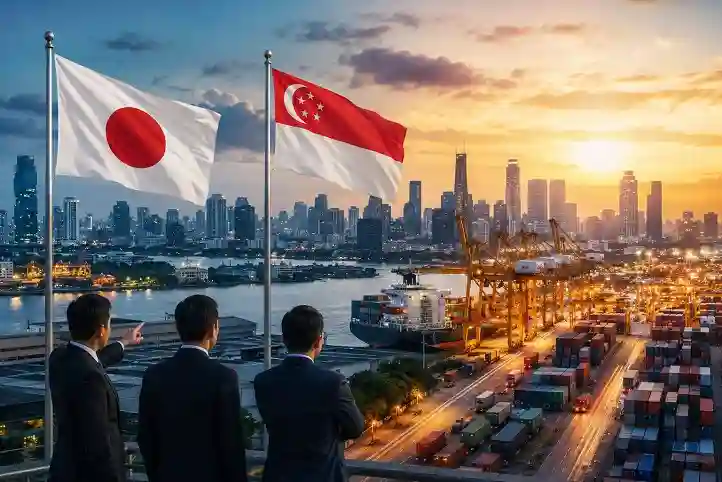
Image Credit: Bangkok Business News
Thailand’s total FDI stock reached US$405.8 billion at the end of the first quarter of 2026, with Singapore accounting for US$103.67 billion, or 25.5%, compared with Japan’s US$100.55 billion, or 24.8%. More significantly, this Bangkok Business News report highlights that Japan’s share has fallen from roughly 35% in 2016 to below one-quarter today, suggesting Thailand can no longer rely on decades-old Japanese industrial commitments to guarantee future investment.
Japanese Investors Turn More Cautious
Japan’s changing position is particularly significant because Japanese manufacturers helped build Thailand into Southeast Asia’s automotive production powerhouse. Yet investors are now confronting slower domestic growth, political and policy uncertainty, rising regional competition and a disruptive transition from internal-combustion vehicles towards electric mobility.
Japanese net FDI fell to only US$230 million in 2025, representing just 1.2% of Thailand’s total US$18.53 billion net inflow. Singapore contributed US$6.73 billion and China US$3.15 billion during the same period.
Japanese investment subsequently recovered, reaching US$864 million in the first quarter of 2026, making Japan the second-largest source behind China. Nevertheless, the rebound does not erase the broader decline in Japan’s relative importance.
Singapore Capital Masks Deeper Concerns
Singapore’s rise to the top of Thailand’s accumulated FDI rankings may look impressive, but headline numbers alone cannot resolve concerns over Thailand’s underlying competitiveness. Capital routed through Singapore can represent multinational and regional investment structures, making nationality-based comparisons more complicated than they initially appear.
Thailand is also competing against Vietnam and Indonesia, which are aggressively courting manufacturers seeking expanding consumer markets, competitive costs, export opportunities and supportive industrial policies.
The danger for Thailand is not necessarily an immediate exodus of existing factories. Decades of Japanese investment have created supply chains that would be expensive and difficult to replicate elsewhere. The greater risk is that companies retain existing Thai operations while directing their next major expansion projects to competing economies.
EV Revolution Exposes Thailand’s Vulnerability
Thailand’s automotive transformation illustrates the challenge. Chinese companies have moved rapidly into EV manufacturing, batteries, electronics and associated supply chains, while traditional Japanese manufacturers reassess strategies built around combustion-engine technology.
There are positive signs. Japanese applications for investment promotion reached 119.10 billion baht in 2025, more than double the previous year, while investment interest is expanding into digital infrastructure, semiconductors, data centers and advanced technology.
But applications do not necessarily translate immediately into actual capital inflows, jobs or completed factories.
Thailand Must Offer Investors a Stronger Future
Thailand still possesses valuable infrastructure, mature industrial clusters, experienced suppliers and a strategic ASEAN location. However, those advantages increasingly represent yesterday’s achievements rather than guarantees of tomorrow’s investment.
The message emerging from changing FDI patterns is therefore difficult to ignore: Thailand must strengthen policy stability, accelerate trade agreements, improve technological capabilities and create clearer incentives for advanced industries. Without meaningful economic reform, Japanese companies may remain in Thailand while increasingly choosing somewhere else when deciding where their next generation of investment should go.



