

What To Know
- The development highlighted in this International Business News report also suggests that Washington may treat biopharmaceuticals differently from strategically sensitive industries such as artificial intelligence and semiconductors, where restrictions on Chinese investment and technology have tightened considerably.
- During the first half of 2026 alone, Chinese companies completed a record 81 out-licensing agreements with a combined value of approximately $110 billion, according to data cited by Nomura.
Chinese biopharmaceutical stocks surged in Hong Kong on Monday after reports that Washington is considering rules that would allow U.S. drugmakers to continue striking most licensing agreements with Chinese companies, easing fears that mounting geopolitical tensions could disrupt one of the pharmaceutical industry’s fastest-growing sources of new medicines.

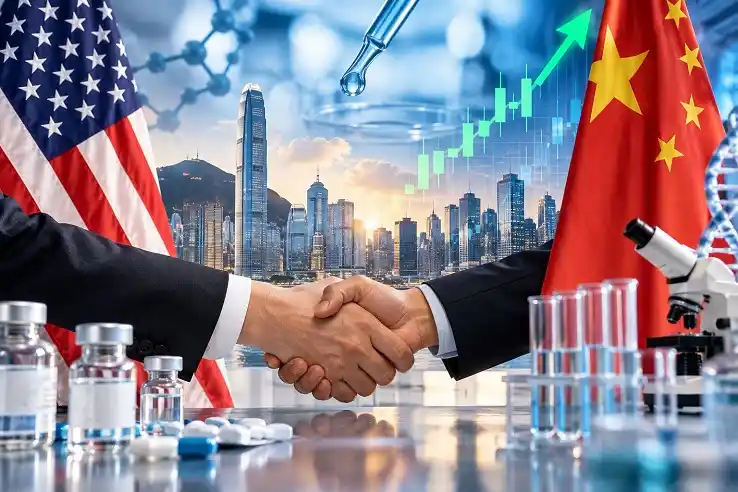
Image Credit: Bangkok Business News
The potential policy direction could provide a major boost for Chinese drug developers, which have increasingly attracted multinational pharmaceutical companies seeking innovative treatments at competitive valuations. The development highlighted in this International Business News report also suggests that Washington may treat biopharmaceuticals differently from strategically sensitive industries such as artificial intelligence and semiconductors, where restrictions on Chinese investment and technology have tightened considerably.
Chinese Biotech Shares Rally
Investors reacted quickly. Akeso climbed about 8%, while Innovent Biologics gained around 6%. Sino Biopharmaceutical rose approximately 8%, CSPC Pharmaceutical Group advanced more than 6%, and HUTCHMED gained about 3%. The Hang Seng Biotech Index climbed more than 5%.
The rally followed a media report that the U.S. Treasury Department is drafting rules likely to allow American pharmaceutical companies to continue investing in promising drugs being developed by Chinese businesses.
However, proposed restrictions could cover drugs involving pathogens and biotechnology with potential military or weaponization applications. The rules have not been finalized and could still change.
China Emerges as a Major Drug Licensing Hub
China has rapidly become an important source of pharmaceutical innovation for international drugmakers. Almost half of U.S. agreements to license drugs from overseas companies during 2025 involved Chinese businesses, according to GlobalData figures.
The scale of that relationship was demonstrated in May when Pfizer reached a global strategic agreement with Innovent covering 12 oncology programs. The transaction included a $650 million upfront payment, with potential development, regulatory and commercial milestone payments taking its overall value to approximately $10.5 billion.
$110 Billion Deal Boom Signals Growing Demand
China’s pharmaceutical licensing expansion has continued despite concerns surrounding U.S.-China relations. During the first half of 2026 alone, Chinese companies completed a record 81 out-licensing agreements with a combined value of approximately $110 billion, according to data cited by Nomura.
China has also identified pharmaceutical and biotechnology globalization as an important objective under its 15th Five-Year Plan, strengthening expectations that domestic drug developers will continue pursuing international partnerships.
Washington’s eventual decision could therefore have consequences far beyond Monday’s stock-market rally. Keeping most licensing channels open would preserve access to Chinese drug innovation for U.S. pharmaceutical companies while supporting China’s growing international biotech ambitions. Although geopolitical risks remain, the extraordinary scale of recent licensing activity shows how deeply Chinese drug development has become integrated into the global pharmaceutical industry’s search for its next generation of medicines.