


What To Know
- Thailand’s worsening economic troubles are driving thousands of businesses out of operation, with factories, small and medium-sized enterprises (SMEs), microbusinesses, and family-owned establishments struggling to survive declining consumer spending, mounting debt, and relentless competition.
- The growing number of closures is exposing serious weaknesses in the country’s economy, while raising concerns that the actual scale of business failures could be significantly greater than government statistics indicate.
Thailand’s worsening economic troubles are driving thousands of businesses out of operation, with factories, small and medium-sized enterprises (SMEs), microbusinesses, and family-owned establishments struggling to survive declining consumer spending, mounting debt, and relentless competition. The growing number of closures is exposing serious weaknesses in the country’s economy, while raising concerns that the actual scale of business failures could be significantly greater than government statistics indicate.
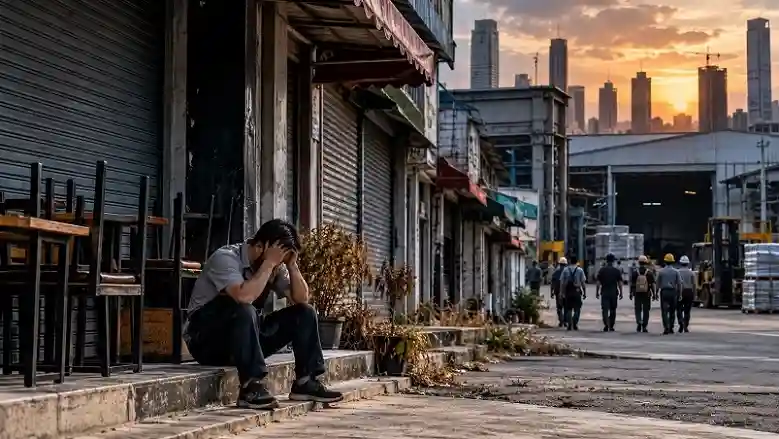
Image Credit: Bangkok Business News
Official figures from Thailand’s Department of Business Development reveal that 7,024 registered businesses closed during the first six months of 2026, representing a 12.49% increase from the corresponding period in 2025. As this Bangkok Business News report highlights, the combined registered capital of these dissolved businesses surged approximately 224% to 98.86 billion baht, suggesting that financial distress is affecting larger enterprises alongside smaller operators.
Factory Closures Expose Industrial Weakness
Thailand’s manufacturing sector is experiencing equally troubling developments. According to the National Economic and Social Development Council, 156 factories closed during the first quarter of 2026, while only 139 new factories opened.
Factory closures increased 11.4% year-on-year, while new openings plunged 63.9%, marking the first time in ten quarters that shutdowns exceeded new establishments.
These closures threaten thousands of livelihoods, including workers employed by suppliers, transportation companies, and businesses dependent on industrial activity.
SMEs and Microbusinesses Face Mounting Financial Pressure
Small businesses are particularly vulnerable as heavily indebted Thai households cut spending on nonessential goods and services.
Restaurants, neighborhood retailers, market vendors, small workshops, and independent service providers face shrinking revenues while electricity bills, rents, wages, and financing costs remain burdensome.
Many struggling entrepreneurs also encounter difficulties obtaining additional financing, leaving them unable to maintain operations during prolonged periods of weak demand.
Are Authorities Underreporting Thailand’s Business Closures?
Although official statistics acknowledge thousands of business failures, they may substantially understate the actual economic damage.
Government dissolution records primarily cover formally registered enterprises. Unregistered microbusinesses, informal traders, and companies that quietly cease operations without completing dissolution procedures may remain outside headline figures.
Consequently, the true number of businesses abandoning operations remains uncertain.
While these reporting limitations raise legitimate transparency concerns, evidence establishing deliberate concealment by government officials has not emerged.
More Businesses Could Disappear
Thailand’s business difficulties are occurring despite continued registrations of new companies, highlighting an uneven economy in which some industries expand while traditional enterprises struggle.
The disappearance of established businesses threatens employment, household incomes, consumer confidence, and entire commercial communities. Unless domestic purchasing power strengthens and struggling enterprises gain meaningful financial relief, additional closures could deepen economic hardship.
More comprehensive disclosure of business failures is essential to establish how severely Thailand’s entrepreneurial and industrial sectors have been affected.
References:
https://e-library.moc.go.th/news/detail/4449
https://secretary.prd.go.th/th/content/category/detail/id/9/iid/522894



