


What To Know
- The increase followed a decision by the Oil Fuel Fund Executive Committee on September 14 as the government sought to contain rapidly rising subsidy costs.
- With the fund shouldering an estimated 770 million baht in fuel subsidies every day, this Bangkok Business News report examines how worsening geopolitical tensions, shrinking global supplies, and refinery constraints are pushing Thailand’s energy support mechanism closer to its financial limits.
Motorists across Thailand are paying more at the pump after retail prices for gasoline, gasohol, and diesel rose by 0.85 baht per liter on September 15, as soaring international oil prices intensified pressure on the country’s Oil Fuel Fund.
The increase followed a decision by the Oil Fuel Fund Executive Committee on September 14 as the government sought to contain rapidly rising subsidy costs. With the fund shouldering an estimated 770 million baht in fuel subsidies every day, this Bangkok Business News report examines how worsening geopolitical tensions, shrinking global supplies, and refinery constraints are pushing Thailand’s energy support mechanism closer to its financial limits.
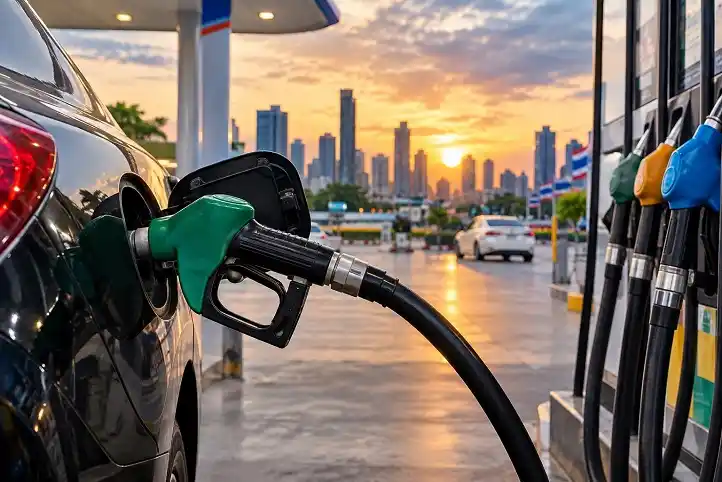
Image Credit: Bangkok Business News
Global Oil Shock Hits Thailand
The latest price increase comes amid prolonged geopolitical instability in the Middle East, including attacks on oil tankers traveling along strategically important shipping routes. Stalled international negotiations have added to uncertainty, while disruptions have removed several million barrels of crude oil per day from global and Persian Gulf supplies.
Global inventories have also declined, tightening an already strained market. At the same time, refinery bottlenecks have driven refining margins sharply higher, adding another layer of pressure to refined fuel prices across Asia.
The impact has been particularly visible in Singapore, the regional benchmark market closely watched by Thailand. On September 14, diesel traded at about US$195 per barrel, while gasoline reached approximately US$147 per barrel. Petroleum and Energy Institute of Thailand data put Singapore gasoil at US$194.97 and 95-octane gasoline at US$147.37 per barrel that day.
Oil Fund Faces Heavy Daily Burden
Those international prices have translated into enormous subsidy costs for Thailand. The Oil Fuel Fund has been absorbing approximately 770 million baht daily to limit the impact of global energy prices on domestic consumers.
Authorities said adjusting retail prices was necessary to reduce that burden, protect the fund’s liquidity, and preserve its ability to stabilize domestic prices over the longer term.
The committee simultaneously revised subsidy and levy rates across several fuel categories.
Regular high-speed diesel receives a subsidy of 9.83 baht per liter, with its retail price at 40.69 baht per liter. Diesel B20 receives a 13.50-baht subsidy, leaving its retail price at 35.69 baht per liter.
Gasoline carries an Oil Fuel Fund levy of 2.56 baht per liter and is priced at 48.93 baht per liter.
Gasohol 95 receives a subsidy of 4.10 baht per liter and is priced at 39.94 baht, while Gasohol 91 receives the same subsidy and costs 39.57 baht. E20 receives a 7.22-baht subsidy and sells for 34.94 baht, while E85 receives a 2.50-baht subsidy and costs 30.88 baht per liter.
Consumers Urged to Conserve Fuel
The government says the Oil Fuel Fund will continue to be used to moderate domestic prices and prevent international market volatility from being passed directly to households and businesses.
However, the scale of the subsidy burden highlights Thailand’s vulnerability to prolonged global energy disruption. Authorities have urged consumers and businesses to conserve fuel, reduce unnecessary energy consumption, and help lower the country’s dependence on imported petroleum.
Thailand now faces the difficult task of balancing household living costs against the financial sustainability of its fuel-support system. If international prices remain elevated, maintaining affordable domestic fuel without placing further pressure on the fund could become increasingly challenging.
References:
https://www.offo.or.th/th/announcement/fuel-fund-management-committee



