


What To Know
- Such a move could widen the already substantial interest-rate gap between the United States and Thailand, increasing pressure on the baht and potentially encouraging international investors to move capital toward higher-yielding U.
- In the middle of growing concerns over the consequences for emerging markets, this Bangkok Business News report examines why Thailand could become particularly exposed if American interest rates rise while Thai rates remain low.
Thailand is bracing for another potentially disruptive shift in global monetary policy as the U.S. Federal Reserve prepares for a crucial September 15–16 meeting, with financial markets increasingly expecting policymakers to raise interest rates by 25 basis points. Such a move could widen the already substantial interest-rate gap between the United States and Thailand, increasing pressure on the baht and potentially encouraging international investors to move capital toward higher-yielding U.S. assets.
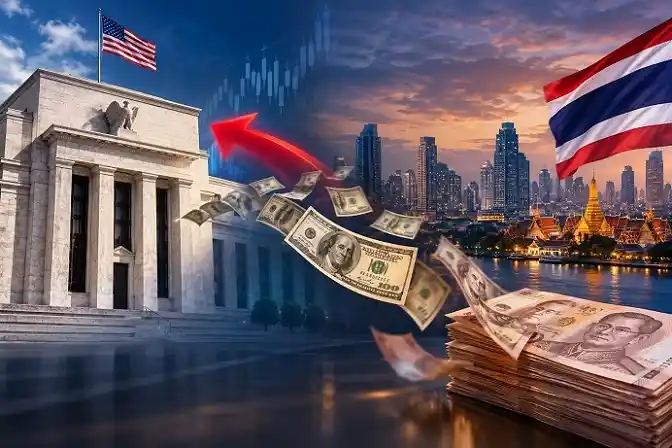
Image Credit: Bangkok Business News
The threat has intensified following fresh U.S. inflation figures showing consumer prices rising 0.4% in August, while annual inflation remained at 3.4%. Core monthly inflation also accelerated, strengthening the argument that price pressures remain too persistent for the Fed to ignore. In the middle of growing concerns over the consequences for emerging markets, this Bangkok Business News report examines why Thailand could become particularly exposed if American interest rates rise while Thai rates remain low. Fed funds futures were indicating an above-80% probability of a quarter-point increase following the inflation report.
Why a Federal Reserve Hike Now Looks Increasingly Likely
The Fed’s problem is that inflation remains stubbornly above its 2% objective while energy costs and other price pressures threaten to keep it elevated.
Gasoline prices jumped 3.9% in August and accounted for more than one-third of the monthly increase in U.S. consumer prices. Meanwhile, renewed geopolitical tensions have driven oil above $100 a barrel, increasing concerns that higher transportation and production costs could spread throughout the economy.
The labor market has also remained stronger than previously expected, reducing the urgency for the Fed to support economic activity through lower borrowing costs. Reuters reported earlier this month that strong employment data had strengthened the case for higher rates, particularly after Fed Chairman Kevin Warsh adopted a tougher stance toward inflation.
The decision is not guaranteed. A Reuters poll conducted before the latest CPI figures showed a majority of economists still expecting rates to remain unchanged. However, subsequent inflation data shifted financial-market expectations sharply toward a hike, illustrating how rapidly the monetary-policy outlook has changed.
Thailand Faces a Dangerous Interest-Rate Gap
Thailand enters this period with its policy rate at just 1.00%, after the Bank of Thailand unanimously decided on August 26 to leave borrowing costs unchanged.
By comparison, the U.S. federal funds target range currently stands at 3.50%–3.75%. A quarter-point Fed increase would widen the differential further, potentially making U.S. fixed-income investments considerably more attractive relative to Thai assets.
The Bank of Thailand has good domestic reasons for keeping rates low. It says economic growth remains low and uneven, despite support from the technology and artificial intelligence cycle. SME lending continues to contract, while financially vulnerable households remain an important concern.
Raising Thai rates simply to defend the baht could therefore create another problem: higher borrowing costs for businesses and households at a time when policymakers are trying to nurture a still-fragile recovery.
Capital Outflow Risk Could Rise Quickly
The most immediate concern is portfolio investment.
When U.S. Treasury yields rise, international investors can obtain higher returns from assets considered relatively safe. That can reduce the appeal of emerging-market equities and bonds, particularly when the difference between American and local interest rates becomes unusually wide.
Thailand is already showing signs of vulnerability. Media reported that although foreign investors returned to Asian equities collectively in August following nine consecutive months of selling, Thailand and the Philippines experienced outflows. Higher bond yields, expensive oil and geopolitical tensions remain important risks for Asian markets.
However, the picture is not one-way traffic. Thai market data showed foreign investors recording net purchases during several trading sessions in early September. That makes it important to distinguish between an increased risk of capital flight and an assumption that large-scale outflows are inevitable.
A Fed hike could become the catalyst that changes that balance.
The Baht Could Become the First Pressure Point
If foreign investors sell Thai stocks or bonds and convert baht holdings into dollars, additional demand for the U.S. currency could weaken the baht.
That would produce mixed consequences.
Exporters and tourism businesses could benefit because Thai goods and services become cheaper in foreign-currency terms. But Thailand is a major energy importer, meaning a weaker currency can simultaneously increase the local cost of oil, fuel and other imported commodities.
That threat becomes particularly significant when international oil prices are already elevated.
Thailand could consequently face imported inflation even while domestic demand remains relatively weak—a difficult combination for the Bank of Thailand.
Kasikorn Research Center recently reported that expectations of a possible U.S. rate hike and escalating Middle East tensions had already created selling pressure in Thai equities, particularly finance, electronics and transportation stocks.
AI Investment Could Also Feel the Squeeze
The consequences could extend beyond currencies and stock markets.
Thailand is positioning itself as a Southeast Asian technology, cloud and data-center hub. These projects require enormous upfront investment in land, electricity infrastructure, servers, cooling systems and advanced semiconductor equipment.
Higher global interest rates raise financing costs and increase the discount rate investors apply to future earnings. That can make capital-intensive technology projects less attractive, particularly for smaller companies without the enormous cash reserves available to major global technology groups.
Yet Thailand retains an important advantage. The Bank of Thailand says the economy continues to receive support from the technology and AI cycle, suggesting that digital investment has become an increasingly important source of growth.
Thailand Has Defenses, But Risks Are Growing
Thailand is therefore not facing an unavoidable capital exodus. Foreign investment can be influenced by economic growth, corporate earnings, political stability, export performance and expectations for the baht as much as by interest-rate differentials.
Nevertheless, another Fed hike would make Thailand’s balancing act significantly harder. Policymakers may have to tolerate currency weakness to preserve supportive domestic interest rates, while simultaneously watching imported inflation, foreign portfolio flows and financial-market volatility.
The coming Fed decision could consequently matter far beyond Washington. If U.S. rates rise while Thailand holds at 1.00%, investors will quickly test whether Thailand’s growth prospects are strong enough to compensate for its widening yield disadvantage. The country has buffers and promising technology-driven investment, but the combination of expensive oil, a potentially stronger dollar and higher U.S. yields could become a serious test for the baht, Thai financial markets and the broader economy.
References:
https://www.kasikornresearch.com/EN/analysis/k-econ/financial/Pages/MSMR07092026.aspx
https://www.cmegroup.com/market-data/market-data-api/fedwatch-api.html
https://www.federalreserve.gov/monetarypolicy/fomccalendars.htm
https://www.bot.or.th/en/news-and-media/news/mpc/news-20260826-KsecaE98.html



