


What To Know
- The stronger outlook was partly driven by a temporary boost from front-loaded global trade activity, following a 90-day pause in US reciprocal tariffs and new trade deals with partners such as the eurozone, Japan, South Korea, and several Southeast Asian countries.
- MTI’s forecast upgrade is a signal of confidence in the near-term outlook, yet the economy’s reliance on external demand means it remains highly exposed to geopolitical and trade shifts.
International Business News: Forecast Raised on Strong First Half Performance
Singapore’s Ministry of Trade and Industry (MTI) has revised its 2025 full-year growth forecast to between 1.5 and 2.5 percent, up from its earlier estimate of 0 to 2 percent. The decision follows a better-than-expected performance in the first half of the year, with gross domestic product (GDP) expanding 4.3 percent year-on-year. In the second quarter alone, GDP growth hit 4.4 percent year-on-year, up slightly from the advance estimate of 4.3 percent, and well ahead of the 4.1 percent posted in Q1. On a quarter-on-quarter basis, the economy grew 1.4 percent in Q2, reversing the 0.5 percent decline in Q1 and avoiding a technical recession. According to this International Business News report, the ministry noted that external and domestic conditions will be monitored closely, with further adjustments possible if circumstances change.
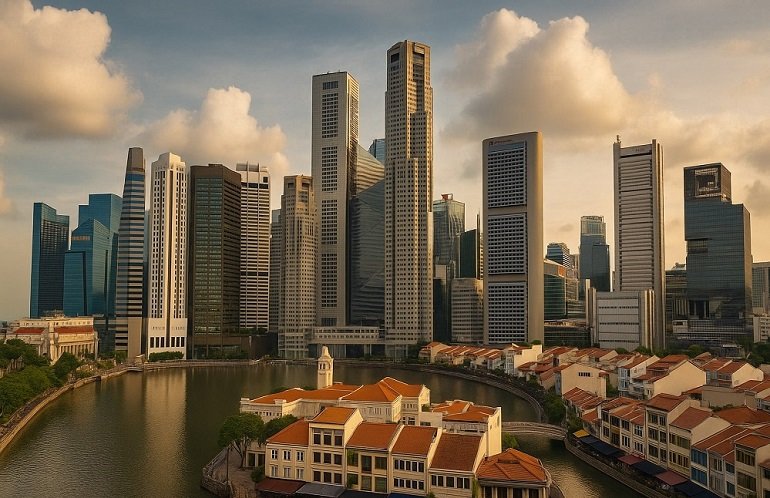
Storms still loom over Singapore economy
Image Credit: AI-Generated
Global Trade Shifts Boost Singapore in Early 2025
The stronger outlook was partly driven by a temporary boost from front-loaded global trade activity, following a 90-day pause in US reciprocal tariffs and new trade deals with partners such as the eurozone, Japan, South Korea, and several Southeast Asian countries. These developments helped cushion the impact of earlier US-China trade tensions. MTI observed that the resilience of advanced and regional economies was greater than previously expected, prompting an upgrade in Singapore’s external outlook.
Caution Over Second Half Slowdown
However, MTI warned that the second half of 2025 could bring slower growth. The temporary trade surge is expected to fade, while reciprocal tariffs take effect, potentially dampening demand from major markets. The US may face weaker growth due to a cooling labor market and softer consumer spending, while the eurozone could see export declines when US tariffs kick in. China’s growth is also likely to ease as export momentum slows, though domestic consumption and investment remain strong. In Southeast Asia, key economies may experience softer domestic demand and slower growth.
Risks Remain Tilted to the Downside
MTI stressed that risks in the global economy remain skewed toward the downside. Potential triggers include a re-escalation of tariff disputes, which could heighten uncertainty and curb business and household spending; tighter global financial conditions that may unsettle markets; and geopolitical tensions that could disrupt energy supplies and drive-up global prices. Singapore’s outward-oriented sectors such as manufacturing are particularly vulnerable, with growth expected to moderate as tariffs weigh on demand.
Sectoral Highlights Show Mixed Performance
The Q2 growth figures were supported mainly by wholesale trade, manufacturing, finance and insurance, and transportation and storage. Manufacturing expanded 5.2 percent year-on-year, though quarter-on-quarter it contracted 0.4 percent. Construction posted a robust 6 percent annual increase, reversing the previous quarter’s decline on a sequential basis. Wholesale trade grew 4.7 percent year-on-year, led by machinery, equipment, and supplies, while the fuels and chemicals segment also contributed.
Not all sectors fared equally well. Food and beverage services shrank 0.5 percent year-on-year, extending the previous quarter’s decline, while retail trade, professional services, and accommodation showed improvements. Growth in transportation and storage, information and communications, and real estate sectors slowed compared to earlier periods.
Cautious Optimism Moving Forward
While Singapore has sidestepped a technical recession and shown resilience in the face of trade uncertainty, policymakers remain alert to potential global disruptions. MTI’s forecast upgrade is a signal of confidence in the near-term outlook, yet the economy’s reliance on external demand means it remains highly exposed to geopolitical and trade shifts. Sectors like transport engineering and precision engineering may provide some support, but the broader environment calls for cautious optimism. Businesses and investors are likely to tread carefully, balancing short-term opportunities against long-term volatility. The path ahead will depend heavily on whether global trade tensions ease or flare up again, and how swiftly Singapore’s industries can adapt to shifting economic currents.
For the latest International Business News, keep on logging to Bangkok Business News.